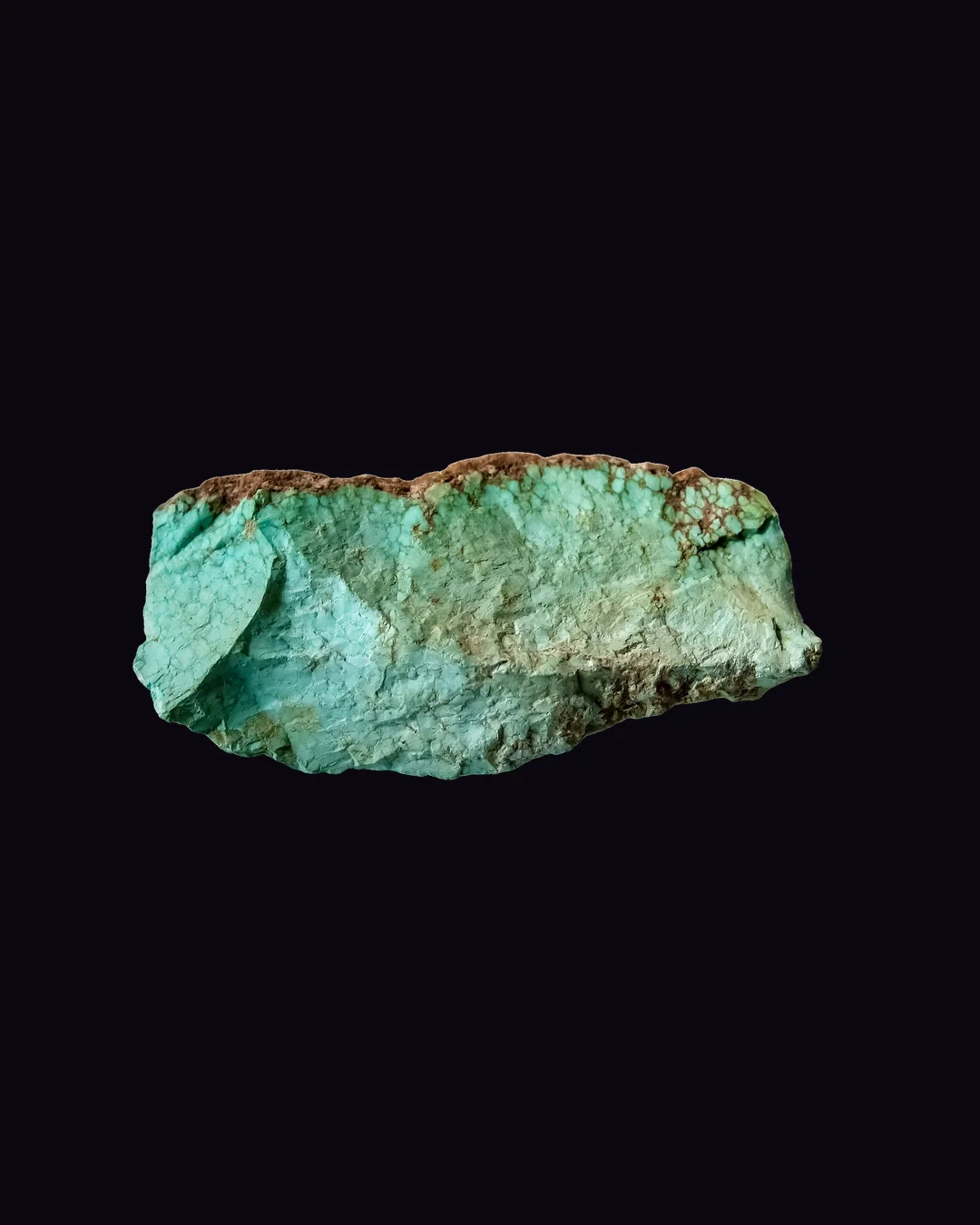
Turquoise
Turquoise
Turquoise is central to Navajo, Zuni and Puebloan life. It is worn, inherited and made into work by living artists right now. The stone itself formed near the surface. Water carrying copper soaked into dry rock and filled the cracks. Most cheap turquoise is not turquoise. It is howlite or magnesite soaked in blue dye, and some of it is plastic. Even the real thing is usually filled with resin. Natural turquoise is soft and drinks in whatever touches it. That is why old turquoise turns green. Sweat and sunscreen soak in and stay. You have been that porous. You take on the mood of whoever is in the room and carry it home in your jaw. Take it off before you wash your hands.
People carry it for protection, communication and calm. Tradition attaches it to the element air, the throat, third-eye chakra, Jupiter. It is most often given to Sagittarius, Aquarius, Pisces. It measures 5-6 on the Mohs scale.
Seen · you don't have this one yet
Common·Uncommon·Rare·Arcane
Most turquoise on sale has been stabilised with plastic or waterglass, and much of it is dyed. Block turquoise is powdered stone in resin. Dyed howlite and dyed magnesite are sold as turquoise and are neither.
This one does not go in water. It dissolves.
What it is confused with
Howlite, magnesite, dyed howlite, chrysocolla, amazonite, reconstituted turquoise, block turquoise
Opaque sky-blue to green-blue with a waxy, slightly dull shine. It never takes a glassy polish. The matrix is the key feature, brown or black or rust-coloured host-rock veining that runs in irregular angular broken-up networks, called spiderweb. Those veins vary in width and sometimes stop dead. The colour is often subtly mottled with paler and darker zones. On genuine material the matrix runs into the stone in three dimensions, and you can see that on any chipped edge.
Commonly faked · check before you buy
How to tell
Start with a drill hole or a chipped edge. Dyed stone shows a white interior under the blue skin. Then rub a cotton bud of acetone on a hidden spot. It lifts blue dye off howlite and leaves real turquoise unchanged. A steel knife will not cut the harder turquoise, which runs 5 to 6 on the hardness scale. Dyed howlite and magnesite are only 3.5, so a knife cuts them easily, and their colour sits concentrated in the veins.
The great majority of commercial turquoise is treated. Stabilisation, which means soaking the stone in plastic or waterglass, is near-universal for chalky material and it is permanent. Dyeing is common too, often with Prussian blue, and so are waxing and oiling. Block or reconstituted turquoise is powdered stone set in resin rather than a solid stone. Dyed howlite and dyed magnesite are sold outright as turquoise and are not turquoise in any sense. Untreated natural turquoise is a small fraction of the market and it costs far more. Stabilised turquoise is normal and usually disclosed.
The full mineral facts
Hardness, formula, and how the rock is put together.
Hardness
5-6 Mohs
Formula
CuAl6(PO4)4(OH)8·4H2O
Family
phosphate
How it forms
Turquoise forms near the surface in dry country, where water carrying copper soaks into aluminium-rich rock and fills the seams and cracks.
Where it comes from
Iran (Nishapur), USA (Arizona, Nevada, New Mexico), China (Hubei), Egypt (Sinai), Mexico, Chile
What it means
The moon is in Sagittarius today, so this is the Sagittarius read.
Your childhood was a list of things you were told not to try.
Right now somebody in Zuni or on the Navajo Nation is wearing turquoise that means family and place. That has never stopped being true, and it is not a style.
Turquoise forms where copper-bearing water soaks into dry rock and fills the seams. It comes out soft and porous.
So almost all of it is resin stabilised, and most cheap turquoise is dyed howlite or magnesite wearing the name.
Sagittarius, you were made in a dry place out of whatever seeped into the cracks, and you have never called that hard.
Your childhood was a list of things you were told not to try. It was delivered by people who were frightened rather than cruel, and nobody explained the difference.
So you argue with every closed door, including the ones that are simply closed.
Some doors are only doors.
That is today's sky, not your chart. Add your birth details and this stone gets read against your own.
Read it for my chart →You know what this one would do for you. You just don't have it.
Turquoise for every sign
AriesHesitation got treated as weakness in front of you when you were small.
Navajo, Zuni and Puebloan silversmiths are setting turquoise this week, as work and as inheritance. It is a living material, not a look.
It forms near the surface, where water carrying copper soaks into dry rock and fills the cracks.
Most cheap turquoise is dyed howlite or magnesite, and some of it is plastic. Even real turquoise is usually resin filled, because it is soft and porous.
Aries, you move first so that nobody gets the chance to talk you out of it.
Hesitation got treated as weakness in front of you when you were small. So you built a self that never pauses, and now you cannot tell a good idea from a fast one.
The clearing up afterwards is always yours, and it is quietly wearing you out.
Slow is not the same as scared.
TaurusSomebody gave you a cheap version of something once and expected gratitude for it.
In Navajo, Zuni and Puebloan life turquoise is worn, inherited and made into work by living artists. In a tourist shop it is a colour on a shelf.
The gap between those two things is where the fakes live. Most cheap turquoise is dyed howlite or magnesite, and some of it is plastic.
Even the real stone is usually held together with resin, because turquoise is soft and porous.
Taurus, you have paid for the difference between a thing and a picture of a thing.
Somebody gave you a cheap version of something once and expected gratitude for it. You took it, you said thank you, and you have never forgotten the weight of it in your hand.
Now you would rather own one real thing than a drawer of nearly.
That is a standard somebody made you pay for.
GeminiSomebody laughed at you for being earnest once, in a group.
A Navajo or Zuni piece can pass down through three generations and still be worn every day. That is what the material is for.
Turquoise is porous. Sweat, oils and sunscreen soak in and stay, which is why old turquoise goes green.
That softness is also why almost all of it is resin stabilised, and why so much of what is sold is dyed howlite instead.
Gemini, nearly everything on that shelf has been helped, and you have never once asked for help out loud.
Somebody laughed at you for being earnest once, in a group. You decided never again, and now you get in first with the joke about yourself.
It works. Nobody can hurt you with something you said first, and nobody can reach you either.
Say one earnest thing this week.
CancerYou come home carrying somebody else's mood in your jaw.
Somewhere right now a Navajo woman is wearing turquoise that belonged to her grandmother. It is not a symbol to her. It is family.
The stone drinks in everything it touches. Sweat, soap and perfume soak straight in and turn blue stone green over the years.
That is why nearly all of it is resin filled, and why the cheap version is dyed howlite in the first place.
Cancer, you are the one keeping your family's things, and nobody asked whether you wanted the job.
You come home carrying somebody else's mood in your jaw. You cannot always tell which parts of an evening were actually yours.
You started doing that for an adult who needed managing, and nobody ever told you the job had ended.
Take it off before you wash your hands.
LeoSomebody at home was only warm when you were entertaining.
Turquoise comes out of dry country, where water carrying copper soaked into the rock and filled the seams. That is Navajo, Zuni and Puebloan land, and the stone is still worn and worked there.
Most of what sells as turquoise is dyed howlite or magnesite. Some of it is plastic.
Even genuine turquoise is usually resin filled, because it is too soft and too porous to survive being worn otherwise.
Leo, you are the one who makes it a good night, and nobody asks what that took.
Somebody at home was only warm when you were entertaining. So you learned to earn the room every single time you walk into one.
You are still doing it at thirty, in kitchens where nobody would have minded a quiet you.
The quiet one is allowed in.
VirgoSomebody in your house had a temper that only landed when things were untidy.
Zuni inlay and needlepoint work sets tiny cut turquoise by hand, piece after piece, and it is being made right now. Navajo silversmiths have worked it for generations.
The material is soft and porous. Left alone it takes in sweat, oils and sunscreen and slowly turns green.
So most commercial turquoise is stabilised with resin, and a great deal of what is sold as turquoise is dyed howlite.
Virgo, you have been stabilised so many times that you no longer know which cracks were yours.
Somebody in your house had a temper that only landed when things were untidy. You made tidy your entire defence, and it worked often enough to keep.
Thirty years on you still clean before a difficult conversation instead of having it.
The house is fine.
LibraSomebody's disappointment used to be the loudest thing in your house.
Turquoise is handed down in Navajo, Zuni and Puebloan families and worn by whoever receives it. Living people, present tense, not a museum case.
The stone is soft, around five or six, and porous enough to take in whatever touches it.
That is why nearly all of it is resin stabilised, and why cheap turquoise is usually dyed howlite sold under a better name.
Libra, you were handed a role in your family before you could speak, and you have worn it every day since.
Somebody's disappointment used to be the loudest thing in your house. You got very good at heading it off before it ever arrived in the room.
Thirty years on you still pick the restaurant that will upset the fewest people, including the ones who are not there.
Your turn was never going to be offered.
ScorpioGetting it wrong in that house had a cost you can still describe in detail.
To Navajo, Zuni and Puebloan people turquoise is worn, inherited and worked by living artists. To a market stall it is a price point.
That gap is why the fakes exist. Dyed howlite and magnesite get sold as turquoise outright, and some of it is nothing but plastic.
Even the honest material is usually resin filled, because turquoise is soft and drinks in whatever it touches.
Scorpio, you can tell when somebody is performing sincerity, and it has never made you popular.
You learned to read people young. Getting it wrong in that house had a cost you can still describe in detail.
So you check everybody, and people feel checked, and the ones with something to hide call you intense.
You were right about that person.
SagittariusYour childhood was a list of things you were told not to try.
Right now somebody in Zuni or on the Navajo Nation is wearing turquoise that means family and place. That has never stopped being true, and it is not a style.
Turquoise forms where copper-bearing water soaks into dry rock and fills the seams. It comes out soft and porous.
So almost all of it is resin stabilised, and most cheap turquoise is dyed howlite or magnesite wearing the name.
Sagittarius, you were made in a dry place out of whatever seeped into the cracks, and you have never called that hard.
Your childhood was a list of things you were told not to try. It was delivered by people who were frightened rather than cruel, and nobody explained the difference.
So you argue with every closed door, including the ones that are simply closed.
Some doors are only doors.
CapricornYou keep a private ledger where rest is a debit and grief is a debit.
Turquoise formed in dry country, near the surface, where copper-bearing water filled the cracks in the rock. That country is Navajo, Zuni and Puebloan land, and the stone is still worn and worked there.
Almost none of the turquoise in a shop is untouched. Most is resin stabilised, and much of what is labelled turquoise is dyed howlite.
The reason is plain. Turquoise is soft and porous and will not survive being worn without help.
Capricorn, you have been stabilised so you are easier to handle, and you call that being reliable.
You keep a private ledger where rest is a debit and grief is a debit. The year you carried a family is a blank line in it.
Somebody early on paid you in approval only for output, and you kept the terms.
Nobody who stayed was auditing you.
AquariusYou worked out early that being interesting got you further than being upset.
Navajo and Zuni artists are cutting and setting turquoise this month, for their own families and for sale on their own terms. It is theirs.
The material is soft and porous, so nearly all commercial turquoise is filled with resin to survive being worn at all.
Most of the cheap blue on a market stall is dyed howlite or magnesite, or plastic with a good story attached to it.
Aquarius, you had to be filled in with something before you could survive being worn every day.
You worked out early that being interesting got you further than being upset. So you turned everything difficult into a subject and handed people the analysis.
They never get the thing underneath, and then you are surprised to feel unknown.
Say the unanalysed version to one person.
PiscesThere was somebody whose moods you learned to feel before they spoke.
In Navajo, Zuni and Puebloan families turquoise is passed on and worn by the next person, and the artists making it are alive and working now.
A stone worn for fifty years goes green. Turquoise is porous, and sweat and oils and sunscreen soak in and stay in.
That softness is why nearly all of it is resin stabilised, and why so much of what is sold is dyed howlite instead.
Pisces, you take on what is in the room and carry it home in your body.
There was somebody whose moods you learned to feel before they spoke. Being right about them kept the whole house calm, so nobody ever asked you to stop.
Now you cannot always tell whose sadness you are holding, and you apologise for it either way.
Some of that was never yours to carry.
Correspondences
What tradition attaches to this stone. Folklore, not chemistry.
Element
air
Planet
Jupiter
Chakra
throat, third-eye
Signs
sagittarius, aquarius, pisces, scorpio
What tradition says
Turquoise carries deep and specific significance for the Diné (Navajo), for the Zuni and for Puebloan peoples. Those are living cultures with a present-day relationship to this stone, not folklore for anyone else to borrow. Separately, in European crystal lore it is a protective travel stone, said to crack or change colour to warn its wearer of danger. That account is recorded in medieval Persian and European sources, and it has an obvious physical basis, because the stone really is porous and really does change colour.
Care
- Do not put this one in water. It dissolves or spalls. Dust it dry.
- Keep it out of direct sun. The colour goes and does not come back.
- Salt scratches it. Do not bury it in salt.
- Turquoise is porous, and that is the whole problem. Water and sweat and oils discolour it permanently. So do perfume and soap and sunscreen. Blue material usually turns green, which is why antique turquoise is green. Salt is out as well. Wipe it dry, take it off before you wash and keep it out of strong sun.
Turquoise contains copper, but locked up as a stable insoluble phosphate. It is not a handling hazard. Do not make elixirs from it. Treated material can also leach resin and dye into water.
Common questions
What does turquoise mean?
Turquoise is carried for protection, communication and calm. Turquoise is central to Navajo, Zuni and Puebloan life. Tradition links it to the throat, third-eye chakra.
Is turquoise real or fake?
Most turquoise on sale has been stabilised with plastic or waterglass, and much of it is dyed. Block turquoise is powdered stone in resin. Start with a drill hole or a chipped edge. Dyed stone shows a white interior under the blue skin. The great majority of commercial turquoise is treated.
Can turquoise go in water?
No. Turquoise dissolves or spalls in water. Dust it dry instead of soaking it, and keep it out of salt.
- Read: the crystals you cannot put in water →
- Read: the crystals that fade in sunlight →
- Read: fake crystals and the four tests that settle it →
Uncommon · sky blue, robin's egg, green-blue, apple green, with brown or black matrix
Where this leads
This stone belongs to
Related crystals
Is it real?
From the Grimoire
- Is Malachite Toxic? What the Copper Actually Does (and Water Rules)
- Is My Crystal Worth Anything? How to Tell Value From Hype
- Is Your Turquoise Real? Dyed Howlite Is the Number One Fake
- March Birthstone: Aquamarine, the Water Line
- What Crystal Is This? How to Identify Any Stone From One Photo
- Best Crystals for a Gemini
FOR ENTERTAINMENT AND REFLECTION. NOT MEDICAL, PSYCHOLOGICAL, FINANCIAL OR LEGAL ADVICE. How this works