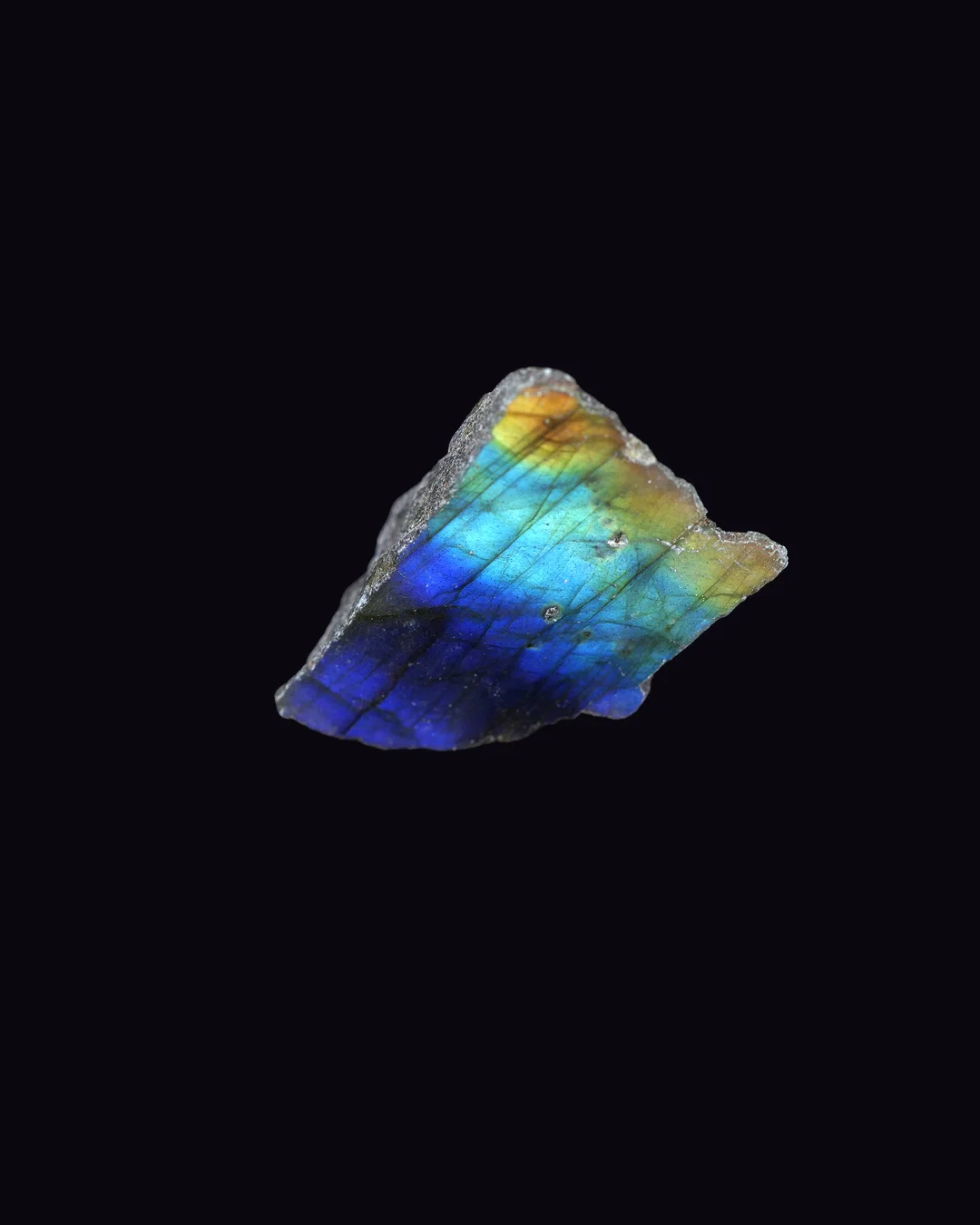
Labradorite
Labradorite (plagioclase feldspar series)
Grey and dull, like something off a driveway. Then you tilt it under a lamp and a sheet of blue switches on inside it. That flash is built in. As the magma cooled slowly, the crystal split into fine layers, and those layers break the light. Nothing was sprayed on. Coated aura stones flash from every angle, even on a broken face. This one lights from one. Inuit stories say the northern lights got caught in rocks on the Labrador coast. You keep knowing things before you can explain them, then talking yourself out of it because you cannot prove it. Somebody once made you prove a feeling and you could not. You have been apologizing for that ever since. You did not imagine it. You never did.
People carry it for intuition, protection and transformation. Tradition attaches it to the element water, the third-eye, throat, crown chakra, Uranus. It is most often given to Scorpio, Sagittarius, Leo. It measures 6-6.5 on the Mohs scale.
Seen · you don't have this one yet
Common·Uncommon·Rare·Arcane
What it is confused with
Spectrolite, rainbow moonstone, moonstone, aura quartz, larvikite, black moonstone
A dull grey to khaki body that suddenly ignites in a sheet of electric blue or green when the light hits one particular angle, then goes dead again. That flash is labradorescence. It covers broad zones and switches on and off as a whole plane, not as scattered glitter, and it comes from inside the stone rather than off the surface. Look on the cleavage faces for straight, fine, parallel twinning striations. Two cleavage directions meet at roughly 90 degrees and produce flat stepped facets. Raw material breaks into blocky cleavage fragments, never rounded grains.
How to tell
Turn the stone slowly under a single light. The flash, called labradorescence, appears and vanishes across a whole plane at one angle. An aura coating instead shows from every angle and covers even broken faces. To confirm feldspar, look for two cleavage directions meeting at about 90 degrees, and check the hardness at 6 to 6.5. It will not scratch quartz, and quartz will scratch it.
The full mineral facts
Hardness, formula, and how the rock is put together.
Hardness
6-6.5 Mohs
Formula
(Ca,Na)(Al,Si)4O8, An50 to An70
Family
feldspar
How it forms
It crystallized from slowly cooling magma deep in the crust, and as it cooled the crystal separated into fine internal layers that split light into the blue and gold flash.
Where it comes from
Madagascar, Canada (Labrador, Quebec), Finland, Russia, Mexico, Australia
What it means
The moon is in Gemini today, so this is the Gemini read.
You said nothing until it was too late to matter.
Pick it up and turn it slowly in front of a single lamp. For most of the turn it is grey. Then the whole face lights at once and it is gone again.
Nothing was sprayed on it. Those layers formed while the magma cooled, and they break the light on their own.
Gemini, you know a thing before you can explain it, so you build the argument afterwards.
Somebody once made you prove a feeling and you could not do it. You were young and you decided the feeling must have been the faulty part.
Now you will not say anything until the reasons are lined up. You have been right about people for years. You said nothing until it was too late to matter.
You did not imagine it. You never did.
That is today's sky, not your chart. Add your birth details and this stone gets read against your own.
Read it for my chart →You know what this one would do for you. You just don't have it.
Labradorite for every sign
AriesNow you drop things at the point where they stop being exciting.
Labradorite is a feldspar, the same dull family most of the world's building rock belongs to. Grey and unremarkable, like something off a driveway.
Then you tilt it once under a lamp and a sheet of blue switches on inside it. That flash lives at one angle only.
Aries, you love the moment something catches, and most of life happens at the wrong angle.
You were quick as a kid and people made a great deal of it. Fast became the thing you were, so anything needing patience started to feel like proof you were slipping.
Now you drop things at the point where they stop being exciting. Not because you are lazy. Because the flat stretch feels like being found out.
The blue was in the rock the whole time. Nobody was watching that either.
TaurusYou wait for people to be dull for a while before you believe them.
Somebody takes a plain quartz, puts it in a vacuum chamber and lays metal vapour across it. It comes out flashing every colour and it sells quickly.
That is aura coating, and you can catch it out. Coated stones flash from every angle, even on a broken face. Labradorite lights from one angle and then goes grey again.
Taurus, you distrust anything that shines from every side, and you learned that the hard way.
Somebody was lovely to you at the exact moment they needed something. You did not see it until afterwards.
You wait for people to be dull for a while before you believe them. That is not cynicism. That is one bad year you have no intention of repeating.
Turn it slowly under one lamp tonight. Watch how little it needs to prove.
GeminiYou said nothing until it was too late to matter.
Pick it up and turn it slowly in front of a single lamp. For most of the turn it is grey. Then the whole face lights at once and it is gone again.
Nothing was sprayed on it. Those layers formed while the magma cooled, and they break the light on their own.
Gemini, you know a thing before you can explain it, so you build the argument afterwards.
Somebody once made you prove a feeling and you could not do it. You were young and you decided the feeling must have been the faulty part.
Now you will not say anything until the reasons are lined up. You have been right about people for years. You said nothing until it was too late to matter.
You did not imagine it. You never did.
CancerYou still walk into a room and know within four seconds.
This crystallised deep in the crust out of magma that cooled very slowly. As it cooled the crystal separated into fine internal layers, and those layers are what split the light.
Slow is the entire reason it flashes at all. Nothing about it could have been hurried.
Cancer, you separated into layers a long way down, and only one of them ever comes to the surface.
You were the one who knew the mood in the house before anybody said a word. It kept things smooth and nobody ever knew you were doing it.
You still walk into a room and know within four seconds. You have never once said so out loud, because the first time you tried, somebody told you that you were imagining things.
You were not imagining things. You were six and you were right.
LeoYou are much easier to miss than you think.
Labradorite takes water and daily wear without complaining. What it does not take is a knock on an edge.
It has two clean splitting directions at almost a right angle. Drop it once on the corner and it opens like a book.
Leo, you have an edge you protect and nobody has ever been told where it is.
You were the bright one and people got used to it. Bright is a job with no sick pay, and you have been turning up to it since school.
The flat stretch of a week is where you go quiet, and nobody notices, because a quiet Leo just looks like a busy one. You are much easier to miss than you think.
Tell one person which day was the bad one.
VirgoYou go over a good day looking for the crack in it.
This is not a rare stone. Labradorite comes out of Madagascar by the crate, and none of that changes what it does under a lamp.
The word to watch is spectrolite, the dark Finnish material with the fuller range. Everything else is labradorite with a better price tag.
Virgo, you have decided you are the plain one, based on the wrong light.
You caught problems early at home and got thanked for it. So catching things became who you were, and now you cannot walk past a small fault.
The trouble is that you started using it on yourself. You go over a good day looking for the crack in it. You always find one, because anything looked at long enough has one.
Stop turning it over. Let one thing be fine.
LibraBy the time you get round to what you wanted, the conversation has moved on.
Somebody puts larvikite and aura quartz on the same tray as labradorite, under one hand written sign. The names blur, and that is rather the point.
Only one of them lights from a single angle. The coated ones flash from everywhere, which is how you know a person did that to them.
Libra, you let yourself get grouped in with everybody else because correcting it would make a scene.
You grew up where a raised voice meant something was about to break. You learned to give the answer that keeps a room level.
It works so well that you check the room before you check yourself, every single time. By the time you get round to what you wanted, the conversation has moved on.
Somebody should have asked you first. Say it anyway.
ScorpioYou show people the grey face and wait.
Rotate it slowly with one light on it. There is a moment when blue comes up across the whole face, and then it is grey again and you cannot get it back without moving.
It only opens at one angle. Everything else is a stone off a driveway.
Scorpio, you have been passing as grey since you were nineteen and it has worked far too well.
The first person who could not handle what you brought them told you the problem was how much of it there was. You were nineteen and you filed that as a fact about yourself.
You show people the grey face and wait. Almost nobody moves to the right angle, and you take that as more evidence, when really they did not know to turn it.
You were never the problem. Most people do not turn things over.
SagittariusYou have been going over fences since you were fifteen.
It grew deep in the crust while magma cooled over an enormous stretch. Inuit tradition holds that the northern lights were once caught in the rocks of the Labrador coast.
That story is older than the mineral name, and it belongs to the people who tell it. Nothing was sprayed on this one.
Sagittarius, you flash when the light hits right and go grey the second it moves, and only you know that.
You were told no for years by people who could not say why, so no stopped meaning careful and started meaning fence. You have been going over fences since you were fifteen.
It built nearly everything you like about yourself. It also means you have never stayed long enough to see the blue come up on anything, because that only shows for people who stand still.
Stay one week longer than you want to.
CapricornYou hold at ninety per cent for years and call it steady.
Labradorite handles water, sweat and years of being worn. One drop on a hard edge and it splits, because two clean directions run right through it.
The damage is not gradual. It is fine, and then it is in two pieces.
Capricorn, you count what got done and nothing else has ever made the list.
Somebody in your house measured people out loud by what they produced, and you were young enough to take the rule as arithmetic. You have been paying it off ever since.
You hold at ninety per cent for years and call it steady. You are not steady. You are load bearing, and nobody has checked the joins since about the year you turned twenty five.
Somebody should ask how you are and wait for the second answer.
AquariusYou can tell somebody exactly why you are like this.
The flash is not a colour sitting in the stone. It is the layers inside splitting the light, which is why the blue moves when you move.
Nothing was added and nothing was dyed. What you see depends entirely on where you are standing.
Aquarius, you show up differently to everyone and you have started to wonder which of them got the real one.
You worked out young that if you could explain a thing it could not hurt you without warning. That was true and it got you through a great deal.
It also left you with an account of yourself that is airtight and secondhand. You can tell somebody exactly why you are like this. You still cannot tell them what you want.
Which of those two would actually change anything?
PiscesThen you sit there deciding whether you are allowed to know.
Put it in your palm and turn it towards the window. Grey, then grey, and then the whole thing floods blue for about a second.
Nobody can make it do that on demand. It needs the right light, the right angle and a person willing to keep turning it.
Pisces, you feel things arriving before anybody announces them, and you have been calling that a fault.
You said something true at about nine and got laughed at for it. So you learned to check whether a feeling is allowed before you let it count.
You still do it. Somebody walks in and you know the shape of their whole week in four seconds. Then you sit there deciding whether you are allowed to know.
Say it before you check it. Just once.
Correspondences
What tradition attaches to this stone. Folklore, not chemistry.
Element
water
Planet
Uranus
Chakra
third-eye, throat, crown
Signs
scorpio, sagittarius, leo, aquarius
What tradition says
In crystal lore, labradorite is linked with the threshold between worlds, with protecting the aura and with concealing intention. Inuit tradition holds that the northern lights were once trapped in the rocks of the Labrador coast.
Care
- Water is fine. Dry it afterwards.
- Two good cleavage directions mean it splits cleanly if dropped on an edge. Water is fine. Avoid knocks and ultrasonic cleaners.
Common questions
What does labradorite mean?
Labradorite is carried for intuition, protection and transformation. Grey and dull, like something off a driveway. Tradition links it to the third-eye, throat, crown chakra.
Is labradorite real or fake?
Labradorite is not faked often, but it is still worth checking. Turn the stone slowly under a single light. The flash, called labradorescence, appears and vanishes across a whole plane at one angle.
Can labradorite go in water?
A short rinse is fine for labradorite, then dry it.
Common · grey body with blue, green, gold, orange flash, smoky grey, dark khaki
Where this leads
This stone belongs to
Related crystals
From the Grimoire
- Best Crystals for an Aquarius Woman (Feeling, Not Just Thinking)
- Best Crystals for a Pisces
- Best Crystals for a Pisces Woman (Dreamy, With Boundaries)
- Best Crystals for a Scorpio (Your Sign's Power Stones)
- Best Crystals for a Scorpio Rising (Presence and Protection)
- Best Crystals for a Scorpio Woman (Power, Not Softness)
FOR ENTERTAINMENT AND REFLECTION. NOT MEDICAL, PSYCHOLOGICAL, FINANCIAL OR LEGAL ADVICE. How this works