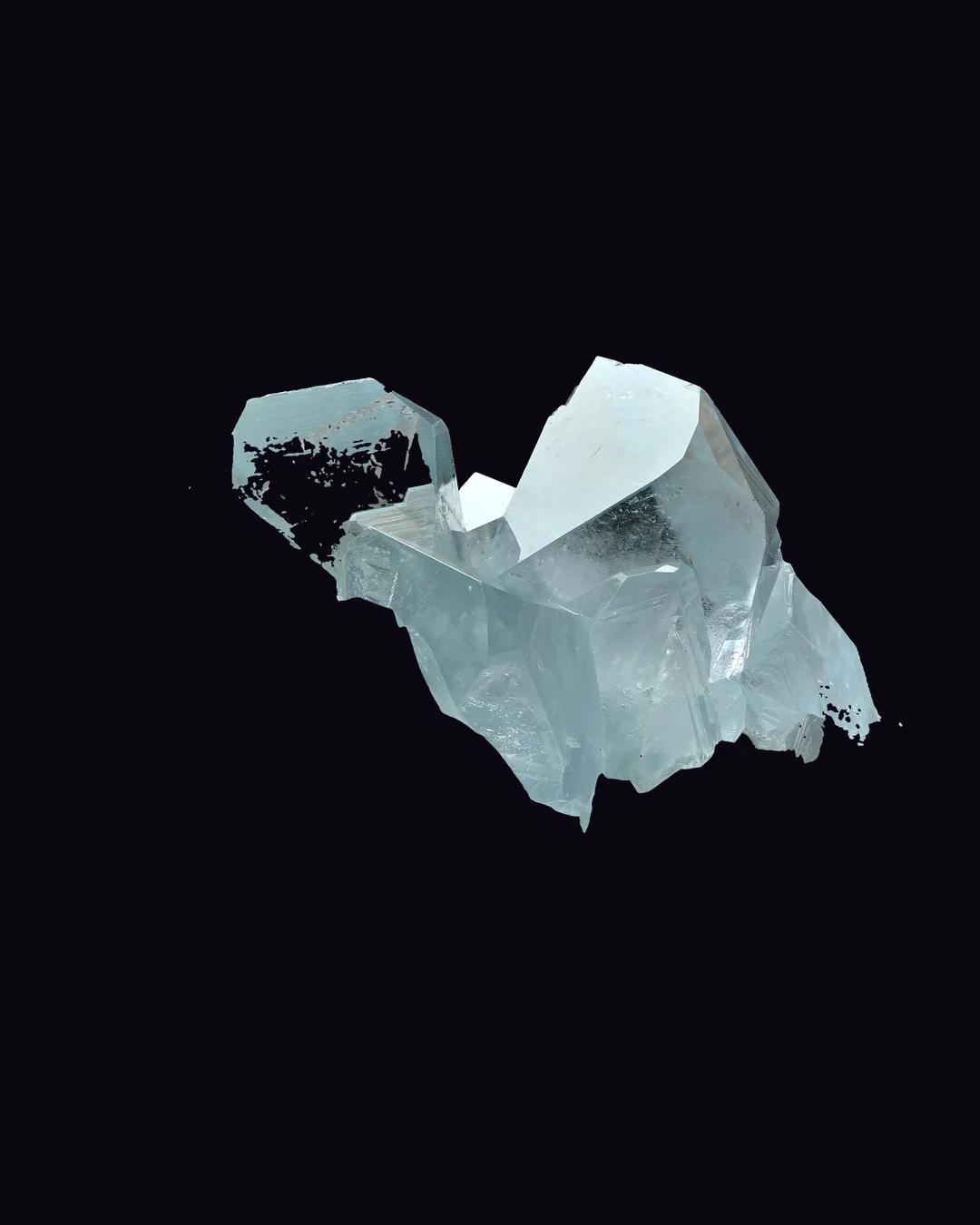
Celestite
Celestine
Celestite is losing its colour while you look at it. A sunny sill bleaches the blue out and it never comes back. It grew from strontium rich water in hollows in old limestone, lining them with pale blue points like a mouth of ice. The points shear off under almost no force, so never lift a geode by its crystals. Water dulls the tips. Dry brush only. Dyed blue quartz geodes get sold under its name. Those are hard and vivid, with dye pooled at the base. You want quiet so badly it has gone physical. Your jaw, your shoulders, the hour before sleep where the day replays like a trial. There was noise around you young, and you got good at being calm inside it. Put it somewhere dark. Take the hint.
People carry it for calm, communication and sleep. Tradition attaches it to the element air, the throat, third-eye, crown chakra, Neptune. It is most often given to Gemini, Libra, Aquarius. It measures 3-3.5 on the Mohs scale.
Seen · you don't have this one yet
Common·Uncommon·Rare·Arcane
This one does not go in water. It dissolves.
What it is confused with
Blue calcite, barite, angelite, blue quartz, dyed quartz geode
Celestite is nearly always sold as a hollow geode lined with short, blocky, tabular pale-blue crystals with bright glassy tips. The blue is very pale, cool and slightly milky, and the crystals look permanently wet. Individual crystals are stubby prisms with wedge-shaped ends. They split cleanly in one direction and well enough in a second, so broken faces are flat and pearly. The shell around them is grey-brown limestone or marl. It is noticeably heavy for its size, which is the strontium. It is also very soft, and a copper coin marks it.
How to tell
Put a drop of vinegar on a hidden spot. Celestite does not fizz. Blue calcite does, and that is what separates them. Then weigh it in your hand. Celestite is unusually dense for a pale mineral. It is soft at 3 to 3.5, so a copper coin marks it. There is also a flame test, where a fragment burns crimson from the strontium in it, but that is a lab move rather than a shop one.
Celestite is untreated. What gets passed off as it is dyed blue quartz geodes. Those are hard, 7 on the scale, so they scratch glass where celestite cannot. Their colour is vivid rather than pale, and the dye pools in the gaps between crystals.
The full mineral facts
Hardness, formula, and how the rock is put together.
Hardness
3-3.5 Mohs
Formula
SrSO4
Family
sulphate
How it forms
Celestite grew from strontium rich water inside hollows in old limestone and dolomite, lining them with pale blue crystals.
Where it comes from
Madagascar (Sakoany), USA (Ohio, Put-in-Bay), Mexico, Egypt, UK (Bristol, historic)
What it means
The moon is in Sagittarius today, so this is the Sagittarius read.
You also left before anyone could ask you to stay.
Put a fingernail to the edge of one point. It marks. This is a three on the scale, which means almost anything in your bag is harder than it.
People find that out by picking a geode up by the crystals. They come away in the hand. Once is enough to learn it.
Sagittarius, you grew something delicate inside a hollow nobody knew about, and you still keep the door shut.
Somebody said no to you about something that turned out completely fine, and you filed it. Since then a warning reads like a challenge. It has taken you places most people only read about.
You also left before anyone could ask you to stay. You called that freedom.
Some warnings are just the truth arriving early.
That is today's sky, not your chart. Add your birth details and this stone gets read against your own.
Read it for my chart →You know what this one would do for you. You just don't have it.
Celestite for every sign
AriesSomebody praised you for how quickly you picked things up.
Celestite survives being buried in limestone for an age and then loses its blue in a sunny window inside a year. That is the whole trick of it.
It is soft too. The points snap off under almost no pressure, so nobody lifts a geode by the crystals twice.
Aries, you fill the quiet with noise because the quiet is where it catches up with you.
You go in fast because slow feels like nothing is happening. Somebody praised you for how quickly you picked things up. You were young enough to build a whole self on it.
Now anything you are not immediately good at feels like proof of something, so you put it down before it can be.
Put this one somewhere dark and leave it there.
TaurusSomebody made you a promise in a very warm voice and did not keep it.
Some of what gets sold as celestite is dyed quartz. You can tell because it is vivid instead of pale, and the dye has pooled down between the points.
Real celestite is the quiet one. Pale sky blue, easy to scratch, heavier in the hand than it has any right to be.
Taurus, you learned not to trust anything too bright and too cheap, and you learned it the expensive way.
Somebody made you a promise in a very warm voice and did not keep it. You did not fall apart. You just quietly stopped taking anyone at their word.
Now you wait people out, and you hate that you do, and you have never once regretted it.
Vivid is not the same as real.
GeminiYou have started doing it alone in your own head at midnight.
Water carrying strontium got into a hollow in old limestone and stayed there long enough to line the whole cavity with pale blue points. Nobody hurried it.
Then it came up into daylight, and daylight is what takes the blue out. A bright sill will do it in a year, and it does not come back.
Gemini, there is a room in you nobody has been in and you keep giving tours of the corridor.
The plain answer is that you are tired. You have known that since about February. Instead you tell the good version, the one with a joke in it, and everybody laughs and moves on.
It works so well that it has become a habit. You have started doing it alone in your own head at midnight.
Say the tired one out loud once. See what happens.
CancerNow you are not sure who would recognise you without it.
Hold the geode by the rock, never by the crystals. They shear off under almost nothing. People find that out with a thumb.
Inside, the blue is already going if it has been near a window. Sunlight bleaches it and there is no way back.
Cancer, people handle you by the part that comes away, and then act surprised.
No single thing has been bad enough to name. That is the problem. It has been a hundred small ones, spread over years, each one too minor to bring up without sounding difficult.
So you kept being fine. Being fine became the job. Now you are not sure who would recognise you without it.
Who has seen you not be fine?
LeoThen somebody asks how you are and there is a real pause.
Pick it up and it weighs more than a pale blue stone should. That is strontium, a heavy metal sitting quietly inside something that looks like ice.
And it is soft. Softer than a copper coin. The prettiest thing on the shelf is also the one you cannot wash.
Leo, there is something heavy in you and you have made very sure it looks weightless.
You know who is having a bad day before they say a word. You adjust. You get funnier or quieter or you find them a drink, and you have been doing it since a house you grew up in needed it.
Then somebody asks how you are and there is a real pause. You genuinely have not checked.
Check tonight. Nobody else is going to.
VirgoYou have walked around the actual problem every day since spring.
Celestite comes through millions of years in the dark without a scratch and then gets ruined by a rinse. Water dulls the points. Salt eats them.
Everything sold as looking after a crystal is on the list of things that wreck this one. Dry brush, dark shelf, nothing else.
Virgo, you grew inside a gap somebody else left and you call that being easy to live with.
The drawer gets sorted. The email gets rewritten four times. You have walked around the actual problem every day since spring.
You are not lazy about it. You are doing the only useful thing you can reach. It is just not the thing.
The dark shelf is not giving up. It is the actual care.
LibraYou have said you do not mind so often that you no longer know.
Dyed quartz geodes get sold as celestite, and they look better in a photo. Hard, bright, the blue gathered down between the points where the dye ran.
The real one is paler and it is going paler still. Sunlight takes the colour out permanently.
Libra, you know exactly how to look good in the photograph of an evening, whatever the evening was.
There was a house where having a preference made things worse, so you stopped having them out loud. It was a good strategy at eleven. It is a strange one at thirty.
You have said you do not mind so often that you no longer know. The people around you think that is your personality.
It is not. It was a solution.
ScorpioYou have a version of yourself that fits in a group chat.
This grew inside a sealed hollow in limestone, out of water carrying strontium, over a stretch of time nobody was around for.
Then the light gets at it. A window bleaches the blue out for good, so the honest advice is to keep the prettiest thing you own in the dark.
Scorpio, being kept in the wrong light for years took a colour out of you that has not returned.
That is why it stuck. You could shrug off a stranger. This was somebody you loved, being gentle about it, choosing a good moment.
You have a version of yourself that fits in a group chat. It goes out. The rest stays in the flat with the light off, and it has been like that for years.
Nothing was ever too much about you.
SagittariusYou also left before anyone could ask you to stay.
Put a fingernail to the edge of one point. It marks. This is a three on the scale, which means almost anything in your bag is harder than it.
People find that out by picking a geode up by the crystals. They come away in the hand. Once is enough to learn it.
Sagittarius, you grew something delicate inside a hollow nobody knew about, and you still keep the door shut.
Somebody said no to you about something that turned out completely fine, and you filed it. Since then a warning reads like a challenge. It has taken you places most people only read about.
You also left before anyone could ask you to stay. You called that freedom.
Some warnings are just the truth arriving early.
CapricornYou file them under time you did not use well.
Take the blue off and this is a strontium mineral out of old limestone, soft enough to scratch with a coin and heavier than it looks.
The blue is the only part anybody wants and it is the part that does not last. A bright room takes it out in a year.
Capricorn, the part of you people want is the part you have the least of left.
The years you spent holding a household together do not appear on anything. No title, no payslip, no photograph. You file them under time you did not use well.
You were taught, early and without anybody saying it out loud, that you would be loved for what you produced. You have never once stopped long enough to test it.
It counted. Every quiet year of it.
AquariusIt also puts a small pane of glass between you and everyone at the table.
Celestite lasts millions of years in the dark and then loses everything people like about it in one bright summer. Sun takes the blue permanently.
Water dulls the tips. Salt eats them. The care instructions are mostly a list of what not to do.
Aquarius, you were fine while nobody was watching, and one season of being seen took something out of you.
You could describe a friend's marriage to her in three sentences and be exactly right. People come to you for that. It is genuinely useful. It also puts a small pane of glass between you and everyone at the table.
Being the one who understands has been safer than needing something, since about the age of twelve.
Who has been let close enough to be wrong about you?
PiscesYou started calling that sensitivity because somebody else called it that first.
Somebody dyed a quartz geode blue and put a celestite label on it. Those give themselves away. Hard, vivid, with colour gathered where the dye ran down between the points.
The true one is fainter and fading. It has to live in the dark to keep what it has.
Pisces, you have been fading in a bright room and calling it a busy month.
Whatever is in the room comes in. You sat down once with a person who was quietly furious and by pudding you were the one apologising, and you could not have said what for.
You started calling that sensitivity because somebody else called it that first. They said it in a tone.
Put the light off and shut the door. Both of you need it.
Correspondences
What tradition attaches to this stone. Folklore, not chemistry.
Element
air
Planet
Neptune
Chakra
throat, third-eye, crown
Signs
gemini, libra, aquarius, pisces
What tradition says
In crystal lore, celestite is kept for angelic contact, for calm and for clear communication. The name comes from the Latin caelestis, meaning heavenly. It was given for the colour rather than for any tradition.
Care
- Do not put this one in water. It dissolves or spalls. Dust it dry.
- Keep it out of direct sun. The colour goes and does not come back.
- Salt scratches it. Do not bury it in salt.
- Sunlight genuinely fades the blue, so keep it out of windows. Water dulls the crystal tips, so keep that off it too. Dry brush only. The crystals shear off with almost no force, so never pick a geode up by its crystals. Hold the shell.
Common questions
What does celestite mean?
Celestite is carried for calm, communication and sleep. Celestite is losing its colour while you look at it. Tradition links it to the throat, third-eye, crown chakra.
Is celestite real or fake?
Celestite is not faked often, but it is still worth checking. Put a drop of vinegar on a hidden spot. Celestite does not fizz. Celestite is untreated.
Can celestite go in water?
No. Celestite dissolves or spalls in water. Dust it dry instead of soaking it, and keep it out of salt.
Common · pale sky blue, ice blue, colourless, faint grey, pale yellow
Where this leads
This stone belongs to
Related crystals
FOR ENTERTAINMENT AND REFLECTION. NOT MEDICAL, PSYCHOLOGICAL, FINANCIAL OR LEGAL ADVICE. How this works