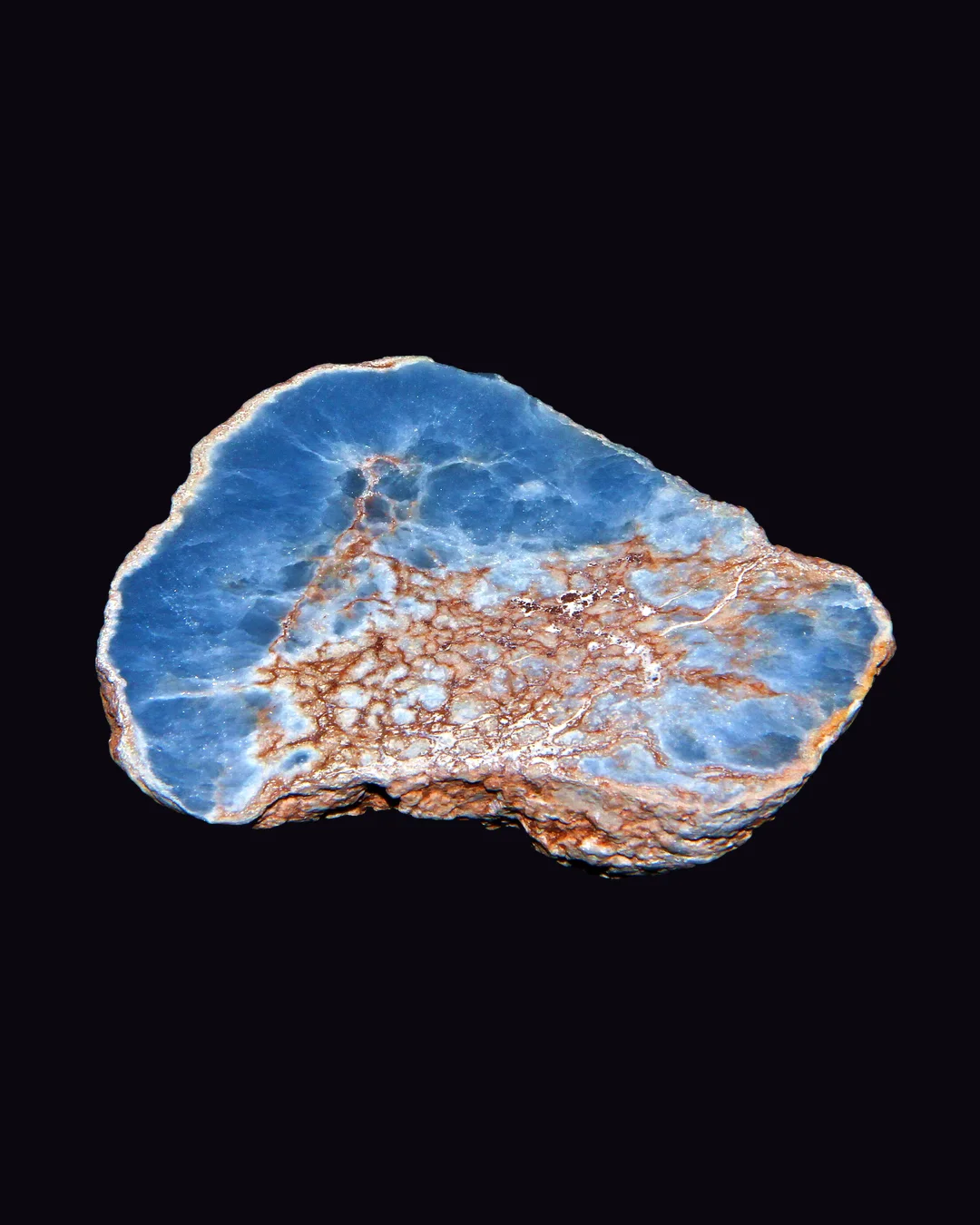
Angelite
Anhydrite
Angelite is a salt left behind where an ancient sea dried up. Burial and heat drove the water out of it. It wants that water back. Leave it wet and it swells, crumbles and starts becoming gypsum again. It survived being buried for ages. It cannot survive a bath. Dyed howlite gets sold as angelite. Look for grey web veins, real angelite has none. Some days you need everything around you to be soft for one hour. You never ask, because you are the one people come to. The angel name is younger than your grandmother. It was invented late last century, on colour alone. Keep it dry. Ask somebody for the hour.
People carry it for calm, communication and grief. Tradition attaches it to the element air, the throat, third-eye, crown chakra, Neptune. It is most often given to Aquarius, Pisces, Gemini. It measures 3.5 on the Mohs scale.
Seen · you don't have this one yet
Common·Uncommon·Rare·Arcane
This one does not go in water. It dissolves.
What it is confused with
Blue lace agate, howlite, dyed howlite, larimar, sodalite, celestite
Angelite is a chalky pale blue-lavender, opaque and matte. Even polished it stays like unglazed porcelain and never takes a glassy shine. Expect mottled white or grey patches and fine darker veining. You may see small reddish flecks, which are hematite. The colour is a muted periwinkle, never vivid. A coin will scratch it. Next to a quartz of the same size it feels lighter and slightly warmer.
How to tell
Try a copper coin on a hidden spot. Angelite is soft enough that the coin marks it. Then look at the pattern. Howlite carries a black web of veins. Angelite does not. Blue lace agate is banded and lets light through. Angelite has no bands and stays opaque. Do not use water as a test. A drop left sitting on angelite starts turning it into gypsum, and that is permanent, so never soak it either.
Peruvian angelite is sold untreated. What to watch for is dyed howlite passing as angelite. Look for the grey-black web of veins. Angelite has no such web.
The full mineral facts
Hardness, formula, and how the rock is put together.
Hardness
3.5 Mohs
Formula
CaSO4
Family
sulphate
How it forms
Angelite is anhydrite, a salt left behind where an ancient sea evaporated, then buried deep enough that heat drove the water out of it.
Where it comes from
Peru, Mexico, Germany, Poland, USA
What it means
The moon is in Sagittarius today, so this is the Sagittarius read.
You are still answering somebody who has not been in the room for years.
There is nothing angelic about it. It is anhydrite, which is a salt, and the name was made up late last century because the colour looked heavenly.
It is soft enough that a copper coin scratches it. The oldest thing on your shelf is also the easiest one to mark.
Sagittarius, you had the water driven out of you a long time ago and you have called yourself low maintenance since.
There was somebody near you growing up who was afraid of nearly everything. You watched what that fear ate, and you made yourself a promise very young.
So now every rule reads like a fence, and every fence looks like a life you refused. You are not reckless. You are still answering somebody who has not been in the room for years.
That is the honest version. Nobody said it to you before.
That is today's sky, not your chart. Add your birth details and this stone gets read against your own.
Read it for my chart →You know what this one would do for you. You just don't have it.
Angelite for every sign
AriesYou leave good things at the exact point they get boring.
The name is younger than your grandmother. Somebody late last century looked at a pale blue salt called anhydrite and decided to call it angelite.
The name was picked on colour and nothing else. The stone is real. The story attached to it was invented for a shelf.
Aries, you burned off something soft to move faster and you have not missed it until now.
This was a sea once. It dried out, got buried, and had the water baked out of it slowly, and none of that had an audience.
You were rewarded early for being first out of the gate. Now anything that takes a year without a result feels like a mistake you should cut. You leave good things at the exact point they get boring.
Boring is where it sets.
TaurusWhat went with it was your willingness to take a person at their word.
Angelite survived a whole sea drying up, then burial, then enough heat to drive every drop of water out of it. That took a stretch of time you cannot picture.
A wet cloth undoes it. Water gets back into anhydrite and it swells and crumbles and starts turning into gypsum, and nothing brings it back.
Taurus, you outlasted the years with nothing in them, and comfort is the one thing you have no defence against.
Somebody once sold you a lovely story and you paid for all of it. The money went. What went with it was your willingness to take a person at their word.
So now you test things. You wait, you watch, and you let people call you hard work. It is not hardness, it is somebody who got caught once.
Dry cloth only. Nothing wet, ever.
GeminiNow the entertaining version comes out first every time, even when you needed something.
There was a sea here once. It evaporated, left its salt behind, and the ground closed over that salt and pressed the last of the water out.
It has wanted the water back ever since. Wet it and it swells and falls apart, which is a strange end for something that survived being buried for ages.
Gemini, you sound calm because you dried out, not because you are calm.
You started that for one specific person who could not take the plain version. It made the room easier. It made you very good company.
Now the entertaining version comes out first every time, even when you needed something. Somebody asks and you make it funny, and then you drive home with the real answer still unsaid.
What is the plain one?
CancerSome days you need everything around you to be soft for one hour.
This is not really a crystal. It is anhydrite, a salt, the dried out leftovers of a sea that is not there any more.
A lot of what gets sold under the name is dyed howlite. You can tell by the grey web veins running through it, because real angelite has none.
Cancer, you have been running on the leftovers of something that dried up years ago.
You are the person everybody comes to. You have been that person since you were about nine, because somebody at home needed you to be.
Some days you need everything around you to be soft for one hour. You have never once asked for it. Asking would mean somebody had to notice, and you would rather do without.
Ask somebody for the hour.
LeoYou have a voice you use for other people's bad news.
Hold it up next to a lamp. Angelite does not let the light through, and it has no bands and no stripes, just a flat pale blue.
If yours has thin grey veins webbing across it, that is howlite with dye in it. Not a disaster. Just not the thing on the label.
Leo, there is a plainer version of you that nobody in your life has ever met.
You are soft with everybody. You have a voice you use for other people's bad news. It is genuine and it works.
Nobody has that voice for you. Somewhere back there you decided the useful version of you was the one people kept. Nobody has contradicted it, mostly because you never gave them the opening.
One person would do it. You would have to say the word.
VirgoYou were raised where a mess got commented on, so the surface stays flawless.
Angelite came through a sea drying out and a mountain of rock closing over it. It held its shape the whole way.
Then it meets a damp windowsill and starts crumbling. The water gets back in, the salt turns into a different mineral, and there is no repairing it.
Virgo, you dried out somewhere along the way and you filed it under being sensible.
You are excellent in a crisis and excellent at a list. Both are real skills. Both are also somewhere to hide.
You were raised where a mess got commented on, so the surface stays flawless. The actual problem, the one with no list, is in the back of the house getting quietly worse.
Keep it dry. Then go and look at the other thing.
LibraYou have had the honest sentence ready since about March.
A sea sat here and then it did not. What was left behind was salt, and the ground buried it, and heat took the last water out of it over an unthinkable stretch.
The blue was never a promise of anything. Somebody last century looked at that colour, attached angels to it, and the name stuck because it sold.
Libra, you went dry keeping a room warm and you still call yourself the easy one.
You have had the honest sentence ready since about March. It is short. It would settle the whole thing in one go.
You keep it in because you can see exactly who it lands on. Somebody handed you the job of keeping a household level when you were far too small for it, and nobody ever took the job back.
You can put it down. Nobody will stop you.
ScorpioSo you started giving people a diluted version and watching for the reaction.
Dyed howlite gets sold as angelite constantly. It takes blue dye beautifully and it costs the seller almost nothing.
The grey web veins give it away, because real angelite has none. Owning the dyed one is fine. Being told it is something else is the part that stings.
Scorpio, one kind sentence got into you and you have been quietly coming apart around it since.
It was said kindly, which is why it went so deep. That you were intense. That it was a lot for a Wednesday.
So you started giving people a diluted version and watching for the reaction. The ones who could have taken all of it were sitting right there the whole time. They never got asked.
The pale one was never the real thing.
SagittariusYou are still answering somebody who has not been in the room for years.
There is nothing angelic about it. It is anhydrite, which is a salt, and the name was made up late last century because the colour looked heavenly.
It is soft enough that a copper coin scratches it. The oldest thing on your shelf is also the easiest one to mark.
Sagittarius, you had the water driven out of you a long time ago and you have called yourself low maintenance since.
There was somebody near you growing up who was afraid of nearly everything. You watched what that fear ate, and you made yourself a promise very young.
So now every rule reads like a fence, and every fence looks like a life you refused. You are not reckless. You are still answering somebody who has not been in the room for years.
That is the honest version. Nobody said it to you before.
CapricornYou worked out at about thirteen that being needed was safer than being wanted.
Put it somewhere dry and leave it there. A shelf away from the bathroom, away from a wet windowsill, away from anywhere a glass gets put down.
That is the whole care instruction. Water is the one thing that ends it, because it soaks back in and turns the salt into another mineral.
Capricorn, you have decided that needing careful handling is a defect in you.
If a day made nothing you can point at, you write it off. That is where you file rest. That is where you filed most of last year.
You worked out at about thirteen that being needed was safer than being wanted. So you made yourself needed, permanently. It worked, and it is the loneliest thing you do.
Who would you be if nobody needed anything?
AquariusThen you sit at your own table and cannot say a plain sentence about your week.
This came out of a sea that evaporated, then spent an age underground with the water baked out of it. It held.
Now a damp room is enough to finish it. It takes the water back in, swells, and crumbles into something else entirely, and nobody can undo that.
Aquarius, you can go through anything dry-eyed, and one kind voice on a Tuesday takes you apart.
You can tell a friend precisely what is happening in her house. You can name the thing in a group chat before anybody else has noticed it.
Then you sit at your own table and cannot say a plain sentence about your week. You became the one who explains, because the one who needed things did badly in that house.
Say one plain sentence tonight.
PiscesBy the end of a day you cannot tell which feelings you brought.
A sea evaporated and left its salt on the floor of the world. Then the ground closed over it, and the heat drove out the last of the water.
It has been trying to get that water back ever since. Give it any at all and it swells and falls apart, which is the opposite of what a stone is meant to do.
Pisces, you soak up whatever is offered and then wonder why you come apart by Thursday.
You take on whatever is in a room before you have sat down. By the end of a day you cannot tell which feelings you brought. The rest you collected.
You were the child who kept a house calm by feeling it first. That was useful to everyone in it, and nobody ever thanked you, because nobody knew you were doing it.
Keep it dry. Keep some of yourself back.
Correspondences
What tradition attaches to this stone. Folklore, not chemistry.
Element
air
Planet
Neptune
Chakra
throat, third-eye, crown
Signs
aquarius, pisces, gemini
What tradition says
In crystal lore, angelite is kept for talking with angels and for saying hard things gently. Both the name and the meaning are recent. They date to the late twentieth century.
Care
- Do not put this one in water. It dissolves or spalls. Dust it dry.
- Salt scratches it. Do not bury it in salt.
- Never let it get wet. Angelite is anhydrite, and anhydrite takes water into its structure and turns into gypsum. It swells and crumbles as it does. This is not the stone dissolving, it is the stone chemically becoming something else, and there is no way back. Keep it dry, always. Dry cloth only.
Common questions
What does angelite mean?
Angelite is carried for calm, communication and grief. Angelite is a salt left behind where an ancient sea dried up. Tradition links it to the throat, third-eye, crown chakra.
Is angelite real or fake?
Angelite is not faked often, but it is still worth checking. Try a copper coin on a hidden spot. Angelite is soft enough that the coin marks it. Peruvian angelite is sold untreated.
Can angelite go in water?
No. Angelite dissolves or spalls in water. Dust it dry instead of soaking it, and keep it out of salt.
Common · pale periwinkle blue, grey-blue, lavender-blue with white
Where this leads
This stone belongs to
Related crystals
From the Grimoire
- Best Crystals for an Aquarius
- Best Crystals for an Aquarius Woman (Feeling, Not Just Thinking)
- Crystals for Beginners: The 8-Stone Starter Set That Actually Matters
- Crystals That Can't Get Wet: The List That Saves Your Collection
- How to Make Moon Water Tonight (and Which Crystals to Drop In)
- March Birthstone: Aquamarine, the Water Line
FOR ENTERTAINMENT AND REFLECTION. NOT MEDICAL, PSYCHOLOGICAL, FINANCIAL OR LEGAL ADVICE. How this works