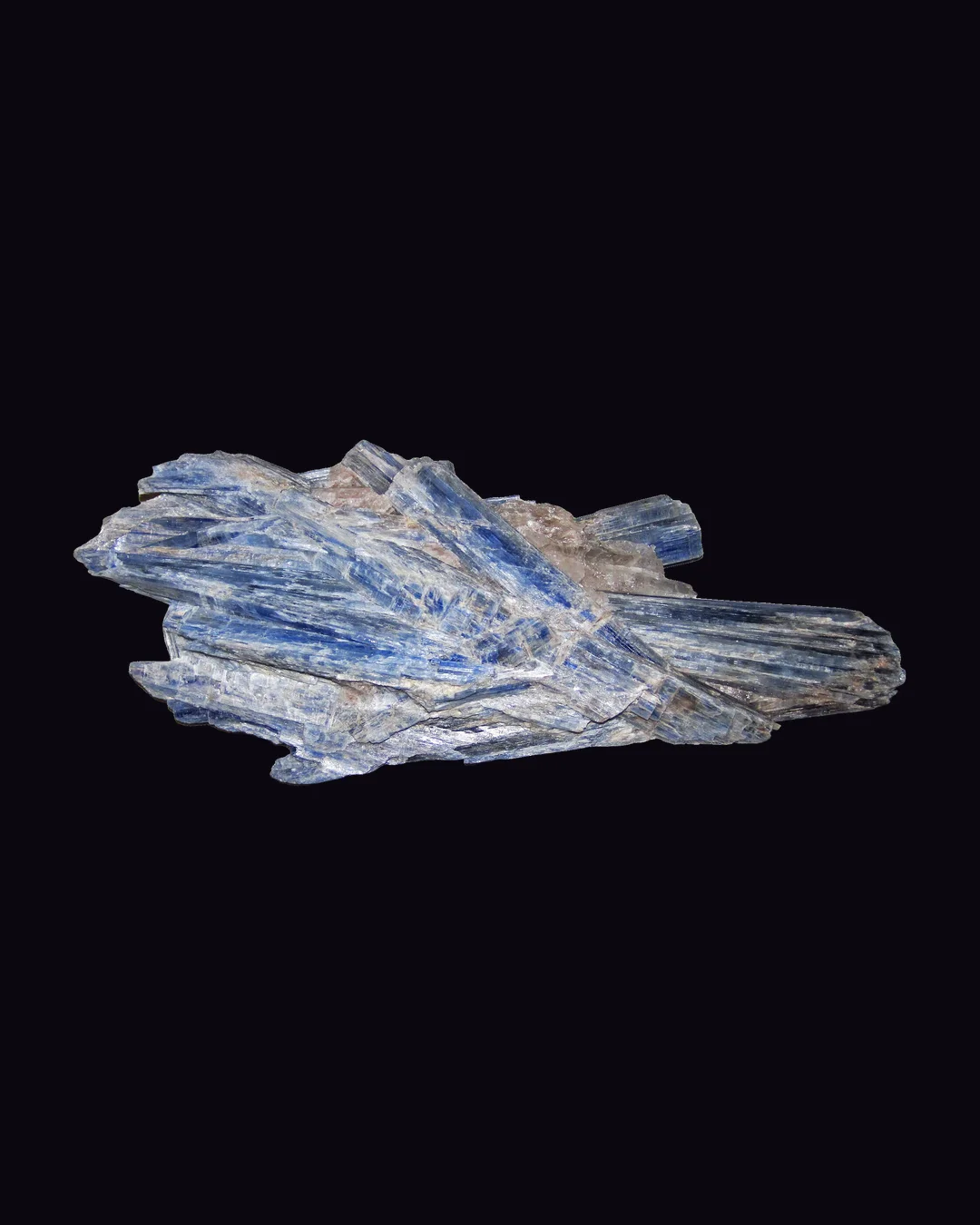
Blue Kyanite
Kyanite
Kyanite needs burial to exist. Clay rich rock gets pushed down and squeezed until the aluminium in it grows into blue blades. It came out strange. Scratch along the blade and it gives easily, scratch across and it is nearly twice as hard. The old name means two strengths. The same structure is its weakness. It splits into thin sheets, so a dropped blade shears like a splinter. Never tumble it with harder stones. The pressure you are under is not nothing. You have been calling it fine because naming it means asking someone for help. You have been the one who does not need help since you were about eleven, and nobody has checked since. It is changing you. That part is not a failure.
People carry it for communication, clarity and boundaries. Tradition attaches it to the element air, the throat, third-eye chakra, Mercury. It is most often given to Aries, Taurus, Libra. It measures 4.5-7 on the Mohs scale.
Seen · you don't have this one yet
Common·Uncommon·Rare·Arcane
What it is confused with
Blue tourmaline, sodalite, blue apatite, sapphire, dyed quartz, blue selenite
Blue kyanite comes as long flat blades that look like splinters of blue glass. The blades are thin and tabular with a pearly to glassy sheen and strong lines running along their length. They usually sit in fanned or parallel bundles, set into white quartz or mica schist. The colour is streaky and uneven, deeper down the centre line of each blade and paler at the edges. It has perfect cleavage along the blade, so it splits into thinner and thinner sheets. Blades bend and snap rather than chip.
How to tell
Kyanite has two hardnesses in one blade and that is the whole test. Run a steel needle ALONG the length of a blade and it scratches easily, because that direction is 4.5 to 5. Run the same needle ACROSS the blade and it will not mark it, because that direction is 6.5 to 7. Nothing else on a shop shelf behaves that way. The old name disthene means two strengths, for exactly this reason.
The full mineral facts
Hardness, formula, and how the rock is put together.
Hardness
4.5-7 Mohs
Formula
Al2SiO5
Family
silicate
How it forms
Kyanite forms when clay rich rock is buried deep and squeezed hard, so the aluminium in it recrystallises into blue blades.
Where it comes from
Brazil (Minas Gerais), Nepal, Zimbabwe, India, USA (North Carolina, Virginia), Switzerland
What it means
The moon is in Gemini today, so this is the Gemini read.
In your house the honest sentence made the evening worse.
Someone dug these blades out of Minas Gerais and had to pack them like glass. Kyanite cannot be tumbled with harder stones, so most of it reaches a shop rough.
Crystal lore says it never needs cleansing. That is a convenient claim about a mineral too fragile to survive a proper wash and a knock.
Gemini, you are hard in one direction and soft in the other and you only ever offer the hard side.
In your house the honest sentence made the evening worse. Funny was safer, so funny is what you got good at.
Now the true line stops at your throat and you swap it. Everyone laughs. Nobody there knows what kind of year you have had.
The clever version was never the true one.
That is today's sky, not your chart. Add your birth details and this stone gets read against your own.
Read it for my chart →You know what this one would do for you. You just don't have it.
Blue Kyanite for every sign
AriesNow the still part of anything feels like being caught.
Kyanite takes water without complaint and will sit in a bowl for years. What it cannot take is being dropped.
The blade splits into sheets along its length, like a splinter off a plank. One knock on a tiled floor and there is no repair.
Aries, you split things cleanly and then have to live in both halves.
You learned young that keeping moving was how you stayed safe. If you were already on to the next thing, nobody at home could pin the last one on you.
Now the still part of anything feels like being caught. So you start something new before the old thing gets a chance to finish.
Nothing is chasing you now.
TaurusNow a kind stranger has to pass two years of quiet checks.
Clay got buried deep and squeezed for longer than anything you can picture. Under that weight the aluminium in it rearranged itself into blue blades.
It did not choose that. Kyanite only exists because something heavy sat on it for an age and would not move.
Taurus, you stopped trusting anything that arrived cheap and gleaming, and a person taught you that.
Someone was generous fast and gone faster, and you were young enough that it changed the settings. You did not decide to become careful. It happened to you.
Now a kind stranger has to pass two years of quiet checks. Most people leave before the checks are done.
Who would still be here if you had let them in at six months?
GeminiIn your house the honest sentence made the evening worse.
Someone dug these blades out of Minas Gerais and had to pack them like glass. Kyanite cannot be tumbled with harder stones, so most of it reaches a shop rough.
Crystal lore says it never needs cleansing. That is a convenient claim about a mineral too fragile to survive a proper wash and a knock.
Gemini, you are hard in one direction and soft in the other and you only ever offer the hard side.
In your house the honest sentence made the evening worse. Funny was safer, so funny is what you got good at.
Now the true line stops at your throat and you swap it. Everyone laughs. Nobody there knows what kind of year you have had.
The clever version was never the true one.
CancerBeing fine became the thing people liked about you.
Run a needle along the blade and it marks. Turn it, run the needle across, and it will not, because it is nearly twice as hard that way.
The old name means two strengths. Same stone, same day, and how much it can take depends entirely on which way you come at it.
Cancer, you are unbreakable in one direction and a needle gets through in the other, and you know which.
Somebody at your table needed you calm, so you were calm at eight and everyone got used to it. Being fine became the thing people liked about you.
Now you hold up through the worst week and go under on a Thursday over nothing. You call that being dramatic. It is the delay.
You are allowed to say it while it is happening.
LeoYou would not be able to say when someone last spotted you.
It is aluminium silicate, which is to say buried clay that got crushed until it changed. No fire, no drama, only weight and time.
It cannot be tumbled and it cannot be dropped. The thing people here call strong is only strong in one direction.
Leo, the change that actually made you had no audience and no drama in it at all.
You were the bright one at home because somebody there was not okay, and a cheerful child kept the house from tipping. You took that job at seven and nobody offered you a way out of it.
Now you spot a friend struggling from one text. You would not be able to say when someone last spotted you.
Who is watching your face?
VirgoYou learned early that being useful kept you safe.
Water does not hurt it and salt does nothing. The blade is fine right up until the day somebody handles it badly.
Perfect cleavage means it splits clean along one plane every time. It does not chip. It shears, and there is nothing to mend.
Virgo, you were plain for a long time and you still price yourself at that.
The cupboard gets sorted at midnight. The list gets rewritten neater. Behind all of it is one thing with no fix, known to you since March.
You learned early that being useful kept you safe. The house was not always safe. That was clever then and it never clocked off.
Some things are only outlived.
LibraYou learned the forecast before you learned what you liked.
This started as clay at the bottom of something. Miles of rock pressed on it for an age, and the aluminium inside gave up its old shape and turned blue.
None of that was gentle. Kyanite is the record of a very long time spent under something that would not lift.
Libra, you gave up your old shape under the weight of somebody's needs and cannot recall what it was.
One person's mood set the temperature of your childhood house. You learned the forecast before you learned what you liked. Taking the smaller half stopped being a choice.
Now you can list what everyone else wants in a second. Somebody asks what you want and there is a blank, and the blank frightens you.
The blank is a habit. It is not who you are.
ScorpioThe people who could have taken you never got to try.
Miners pull these blades out of Nepal and Zimbabwe and cannot polish most of them. Kyanite splits if you push it, so a lot of it is sold exactly as it came up.
Nobody improved it. What you have is the thing itself, weak one way and hard the other, and no shop can change that.
Scorpio, people found the soft direction on you at fifteen and have been pressing there since.
You were maybe fifteen. It was said kindly, which is why it stuck. Too much, too intense, and a young person hears an opinion as a sentence.
Now you check every real feeling for what it will cost before you show it. The people who could have taken you never got to try.
What if they were wrong about you?
SagittariusSo many of the nos were wrong that you stopped reading them.
Pick one up and look down the blade. Fine streaks of white through the steel blue, and edges you could cut a finger on.
Do not tumble it and do not bend it. This is one of the few stones where the warning is not marketing, it is the whole handling instruction.
Sagittarius, you got squeezed young and it made you clear, and clear is not the same as fine.
You were told no about a hundred harmless things when you were small. So many of the nos were wrong that you stopped reading them. You binned the lot.
Now be careful arrives at you as be smaller. So you go anyway, and two of those trips cost you more than you have said out loud.
Not every warning was a leash.
CapricornNow you do it to yourself for free.
There is nothing mystical about the making of this. Buried clay, then pressure, then a very long time. Blue blades where there used to be mud.
The lore says kyanite never needs cleansing. That is a tidy claim about a mineral too fragile to be washed the way the others are.
Capricorn, people say you never need looking after because you have never let them find out.
A day that made nothing goes in the wasted pile. So does rest, and so does the year you spent holding people up while everybody assumed you were fine.
In your house nobody said well done for the invisible things. So you stopped counting them too. Now you do it to yourself for free.
The ones who stayed were not keeping score.
AquariusYour own want shows up as a theory with footnotes, never as a plain sentence.
It survives water and sun and years on a shelf. The one thing it cannot survive is contact with anything harder than itself.
Put it in a tumbler with quartz and it comes out as splinters. It is not delicate about everything. It is delicate about one specific thing.
Aquarius, you are fine with strangers and hard weeks, and it is one specific person who splinters you.
You explained the family to itself as a child and got called cold for being right. So you stepped back a pace, and the back of the room turned out to be quieter.
Now you know what everyone needs. Your own want shows up as a theory with footnotes, never as a plain sentence.
Say the plain sentence tonight.
PiscesYou learned to feel everything early and say none of it.
Kyanite needs burial to exist at all. Clay went down under miles of rock and stayed there, and that pressure is the only reason there is any blue.
It did not toughen evenly. Hard across, soft along, and it carries both for the rest of its life.
Pisces, you are hard in the direction nobody tests and soft in the one everybody leans on.
One adult's mood filled your whole childhood house. You had to know it before it came in. You learned to feel everything early and say none of it.
Now a stranger's bad afternoon follows you home and you cannot find the moment it got in. People call that sensitivity. It was equipment.
Rinse it gently tonight and dry it properly.
Correspondences
What tradition attaches to this stone. Folklore, not chemistry.
Element
air
Planet
Mercury
Chakra
throat, third-eye
Signs
aries, taurus, libra, pisces
What tradition says
In crystal lore, kyanite is kept for putting things back in line and for honest speech. It is also one of the very few stones the tradition says never needs cleansing. That is convenient, given how easily the blades break.
Care
- Water is fine. Dry it afterwards.
- Salt scratches it. Do not bury it in salt.
- Water is not the danger here. Pressure is. Kyanite has perfect cleavage, so a blade splits and shatters with very little force. Never tumble it with harder stones. Never drop it. Never try to bend a blade. Rinse it gently and dry it.
Common questions
What does blue kyanite mean?
Blue Kyanite is carried for communication, clarity and boundaries. Kyanite needs burial to exist. Tradition links it to the throat, third-eye chakra.
Is blue kyanite real or fake?
Blue Kyanite is not faked often, but it is still worth checking. Kyanite has two hardnesses in one blade and that is the whole test. Run a steel needle ALONG the length of a blade and it scratches easily, because that direction is 4.5 to 5.
Can blue kyanite go in water?
A short rinse is fine for blue kyanite, then dry it.
Common · steel blue, sky blue, indigo streaked with white, blue-grey
Where this leads
This stone belongs to
Related crystals
FOR ENTERTAINMENT AND REFLECTION. NOT MEDICAL, PSYCHOLOGICAL, FINANCIAL OR LEGAL ADVICE. How this works