Astrophyllite
Astrophyllite
Astrophyllite grows in a rare kind of igneous rock, in pockets where leftover elements like titanium end up. It fans out from a centre in bronze blades. The name means star leaf. It is a collector mineral that got into shops on looks alone. The blades are soft and pluck out, so pieces are often resin stabilised before cutting. You keep ending up in the same room with a different face across the table. You have started to wonder if the constant is you. That is not a verdict. A pattern is something you learned young and never got to test. In lore it is tied to seeing your own shape from the outside. Do not soak it. The blades flake off and the rock behind them is softer still. Hold it by the base. Then go back over the last three.
People carry it for transformation, intuition and clarity. Tradition attaches it to the element fire, the crown, third-eye, solar-plexus chakra, Uranus. It is most often given to Leo, Aquarius, Sagittarius. It measures 3-4 on the Mohs scale.
Seen · you don't have this one yet
Common·Uncommon·Rare·Arcane
This one does not go in water. It dissolves.
What it is confused with
Nuummite, biotite, bronzite, goldstone, pyrite in matrix, arfvedsonite
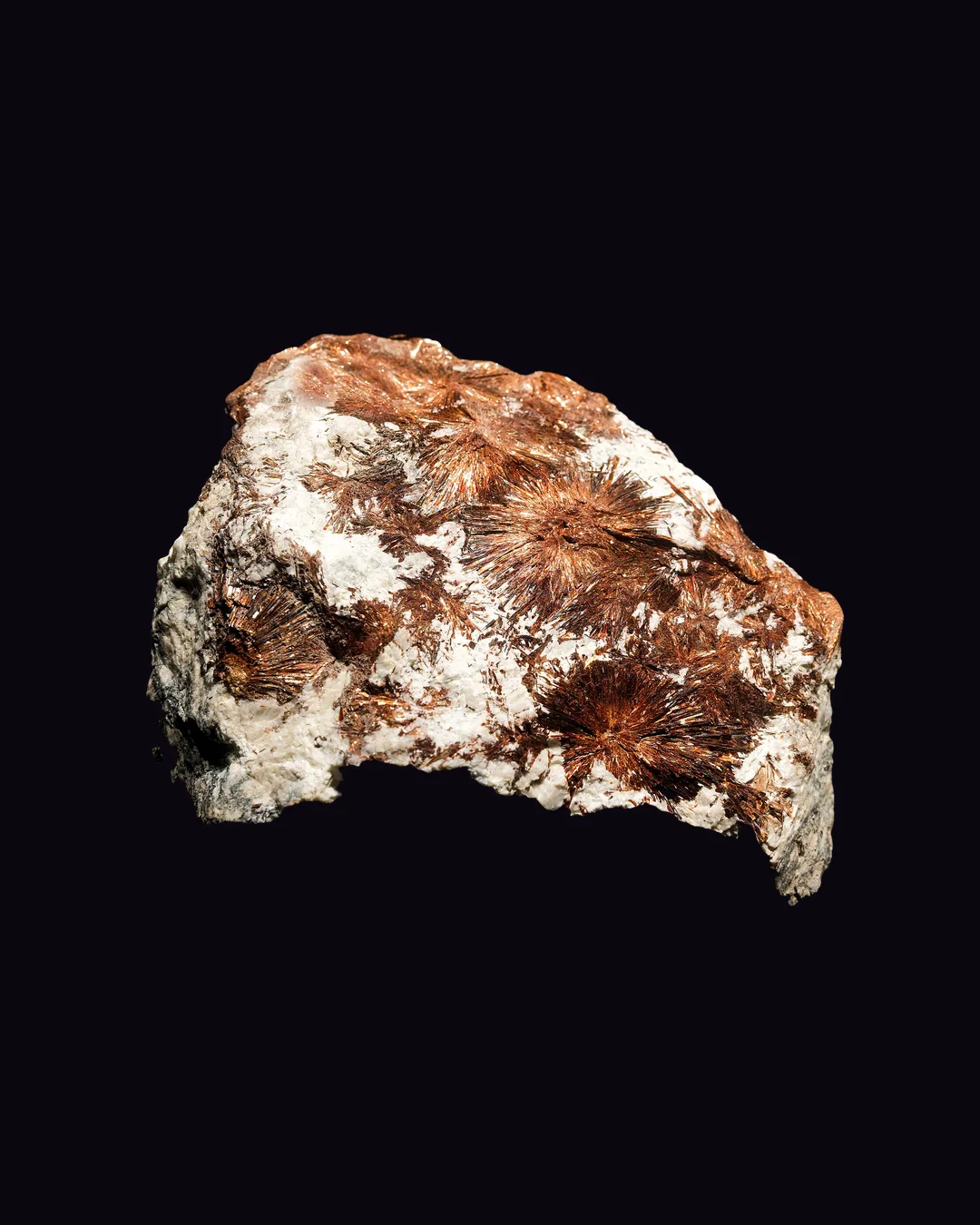
Astrophyllite is golden-bronze blades bursting out from central points into starbursts and fans. They sit on a contrasting grey, black or cream feldspar rock. That star or wheel-spoke shape is where the name comes from and it is the identification. The blades have a greasy to pearly half-metallic shine. Turn one and the colour swings from deep red-orange to lemon yellow, which is called pleochroism. The blades are flat and lath-like, they split along one flat plane, and a coin will scratch them.
How to tell
Look for star-shaped sprays of bronze blades on a pale rock. Nothing else looks like that. The blades are soft, 3 to 4, so a coin will mark them. Nuummite is hard and black bodied, and its needles run parallel rather than bursting into stars. Pyrite is far harder and grows in cubes.
Astrophyllite is often soaked with resin before it is cut. Without it the blades pull out of the surrounding rock. It is standard, it is permanent, and it is what holds a polished piece together. A seller should say so, but it does not make the specimen fake.
The full mineral facts
Hardness, formula, and how the rock is put together.
Hardness
3-4 Mohs
Formula
(K,Na)3(Fe2+,Mn)7Ti2Si8O24(O,OH)7
Family
silicate
How it forms
Astrophyllite grows in a rare kind of igneous rock, in leftover pegmatite pockets where odd elements like titanium collect, and it crystallises in fanning bronze blades.
Where it comes from
Russia (Kola Peninsula, Khibiny), Canada (Mont Saint-Hilaire, Quebec), Greenland, Norway (Brevik, type locality), USA (Colorado, Pikes Peak), China
What it means
The moon is in Sagittarius today, so this is the Sagittarius read.
Careful was the word used by the people who let you down.
Somebody decided this collector mineral should be a shop stone. The blades pluck out when it is cut, so they get soaked in resin first.
Nothing on the label says so. That does not make the stone a lie, it only means the honest part is the bit you have to ask for.
Sagittarius, you fan out in every direction at once and the middle of you is not holding.
You have gone anyway. Booked it anyway. Said it anyway, in a room where everybody else had gone quiet.
That is not recklessness. Careful was the word used by the people who let you down. You decided very young never to be one of them.
Keep it dry. That part is not a dare.
That is today's sky, not your chart. Add your birth details and this stone gets read against your own.
Read it for my chart →You know what this one would do for you. You just don't have it.
Astrophyllite for every sign
AriesYou are still trying to outrun somebody who is not chasing you.
Turn it under a lamp. The bronze blades all fan out from one point, which is why the name means star leaf.
They are soft. They pluck straight out of the rock, so most cut pieces have been soaked in resin first to hold them in.
Aries, you start again fast because standing still feels like losing.
You have quit three things this year and each time you had a good reason. Every reason was true, and that is what makes it hard to see.
Somebody taught you that slowing down was the same as giving up. Probably a person who never sat down once. You are still trying to outrun somebody who is not chasing you.
Nobody is timing you.
TaurusYou bought something once from somebody who looked you right in the eye.
Astrophyllite is made of leftovers. It grows in pockets where odd elements like titanium had nowhere else to go once the main rock had finished forming.
It was a collector mineral for years. It got into shops on looks alone, and most polished slabs were soaked in resin to stop the blades falling out.
Taurus, you do not trust a shiny thing that came cheap, and there is a reason for that.
You bought something once from somebody who looked you right in the eye. It fell apart in a month and you never told anybody what you paid.
Now you touch a thing before you believe it. That is not meanness. It is what happens after nobody comes back for the receipt.
Ask what was done to it. Any honest seller will say.
GeminiThe plain answer is still in there and it is usually the sad one.
Most astrophyllite you can buy has been soaked in resin. The blades are so soft they pluck out of the rock while it is being cut.
The shop label rarely says so. The stone did not choose that, somebody chose it so the piece would hold together on a shelf.
Gemini, you start nine things because starting is the part that feels like being alive.
You can do the voice. You can do the version of the story that gets the room. You have been doing it since school.
The plain answer is still in there and it is usually the sad one. Nobody has asked for it in years, mostly because you are so good at the other thing.
Say the boring true one to one person this week.
CancerYou have carried a family through a bad year and not once said it was hard.
Astrophyllite formed slowly in the last liquid left in a cooling rock. Everything easy had already crystallised out and gone.
What was left was the odd stuff, and it took its time turning into these bronze fans. Then a saw went through it in an afternoon.
Cancer, you were what was left after the easy people left, and you had to make something of it.
You have carried a family through a bad year and not once said it was hard. Nobody thought to check, because you never gave them a reason to.
Then a phone call comes on a Tuesday and you cannot get off the sofa. You think that means you are weak. It means you were holding more than one person should.
Put it somewhere dry. Sit down.
LeoYou learned that being needed was safer than being known.
Astrophyllite survives fine in a dry drawer. Water gets in behind the blades and lifts them off, and salt is worse.
It does not chip loudly. It just quietly sheds bronze flakes until the star is not a star any more.
Leo, you can handle almost anything except somebody being kind to you at the wrong moment.
You are the one people text when something goes wrong. You know the exact tone that means she has been crying. You have picked up at midnight for a friend who has never once asked how you are.
You learned that being needed was safer than being known. Somewhere back there, being useful was how you stayed in the room.
Who picks up for you?
VirgoIt is not a job you still have to do.
Look at the piece side on. The blades leave from one place and open out like a fan, which is where star leaf comes from.
Now look at the rock behind them. It is softer than the blades, so the part holding everything up is the weakest part of the stone.
Virgo, you hold yourself together with a system and you are frightened of what happens without it.
There is a cupboard you have reorganised twice this month. There is also a message you have not answered since March.
You worked out at about seven that a tidy house made the adults easier to be around. It worked. It is not a job you still have to do.
Answer the message. Leave the cupboard alone.
LibraYou were the child who could feel a mood change through a wall.
Astrophyllite is not rare because it is precious. It is rare because the rock it needs almost never happens.
It gets mixed up with goldstone in shop trays, and goldstone is glass with copper stirred into it. One is a rock. One is a factory.
Libra, the conditions you need to be yourself almost never happen, and you stopped asking for them.
Before you say what you want, you run a check. Who goes quiet, who brings it up in a fortnight, who takes it as a rejection.
You were the child who could feel a mood change through a wall. That skill kept a house calm. It also means you have never had an unedited want.
Want one thing badly, out loud, tonight.
ScorpioYou went quieter in that house than you had ever been.
Astrophyllite waited in a pocket of cooling rock while the ordinary minerals took everything they needed. It grew out of what was left over.
Then somebody cut it and sold it for the looks. The blades that took ages to grow were resin glued so they would not drop off in transit.
Scorpio, you pulled every blade of yourself back in to fit inside one house.
You went quieter in that house than you had ever been. You started running every real feeling through a filter to see what it would cost you first.
It did not make them stay. All it did was teach you that the true version of you needs handling.
It does not.
SagittariusCareful was the word used by the people who let you down.
Somebody decided this collector mineral should be a shop stone. The blades pluck out when it is cut, so they get soaked in resin first.
Nothing on the label says so. That does not make the stone a lie, it only means the honest part is the bit you have to ask for.
Sagittarius, you fan out in every direction at once and the middle of you is not holding.
You have gone anyway. Booked it anyway. Said it anyway, in a room where everybody else had gone quiet.
That is not recklessness. Careful was the word used by the people who let you down. You decided very young never to be one of them.
Keep it dry. That part is not a dare.
CapricornYou have been clocking in ever since and you have never asked if the shift ended.
Astrophyllite holds up for a very long time as long as nothing wet touches it. One soak lifts the blades off the rock.
There is no warning. It looks the same right up until the star starts coming apart in your hand.
Capricorn, you give no warning at all, and then one ordinary Tuesday you cannot get out of bed.
The ledger in your head only has finished things in it. The Sunday you spent on the phone with your sister is not entered anywhere. Neither is the night you did not sleep.
Somebody at home made affection feel like something you earned by the hour. You have been clocking in ever since and you have never asked if the shift ended.
It ended. Nobody told you.
AquariusYou come across as fine and people take fine at face value.
Hold it up and find the point the blades come from. Every one of them leaves the same spot and opens outward.
You can see the pattern from here, from outside it. From inside the rock there was no pattern, only whatever was left when the rest had gone.
Aquarius, you have started six different lives and every one of them began at the same kitchen table.
You told a friend exactly what her mother was doing to her and she went quiet, because you were right.
Nobody has done that for you. You come across as fine and people take fine at face value. You have never once corrected anybody.
Say one true thing to somebody this week.
PiscesYou were the one at home who always knew before anybody said.
Astrophyllite is a soft mineral that looks like metal. The bronze blades are closer to chalk than to anything you could make a tool out of.
That is why they get glued. A resin soak holds the softest part in place so it can survive being handled.
Pisces, you go out in every direction at once from one small centre nobody has asked about.
You walk into a house and pick up what is already going on in it. By the evening you cannot tell which parts were ever yours.
You were the one at home who always knew before anybody said. Everybody called it a gift, so nobody taught you where to put it down.
Where do you put it down?
Correspondences
What tradition attaches to this stone. Folklore, not chemistry.
Element
fire
Planet
Uranus
Chakra
crown, third-eye, solar-plexus
Signs
leo, aquarius, sagittarius
What tradition says
In crystal lore, astrophyllite is kept for self-knowledge, for astral work and for seeing your own pattern. Those meanings come entirely from the star shape. There is no older tradition behind them.
Care
- Do not put this one in water. It dissolves or spalls. Dust it dry.
- Salt scratches it. Do not bury it in salt.
- Do not soak it and do not tumble it. The blades flake off, and the rock they sit in is often softer than they are. A dry brush is the safe option. Store it on its own so nothing knocks the blades.
Common questions
What does astrophyllite mean?
Astrophyllite is carried for transformation, intuition and clarity. Astrophyllite grows in a rare kind of igneous rock, in pockets where leftover elements like titanium end up. Tradition links it to the crown, third-eye, solar-plexus chakra.
Is astrophyllite real or fake?
Astrophyllite is not faked often, but it is still worth checking. Look for star-shaped sprays of bronze blades on a pale rock. Nothing else looks like that. Astrophyllite is often soaked with resin before it is cut.
Can astrophyllite go in water?
No. Astrophyllite dissolves or spalls in water. Dust it dry instead of soaking it, and keep it out of salt.
Arcane · bronze-gold blades on grey, black or cream matrix, copper, brassy yellow
Where this leads
This stone belongs to
Related crystals
FOR ENTERTAINMENT AND REFLECTION. NOT MEDICAL, PSYCHOLOGICAL, FINANCIAL OR LEGAL ADVICE. How this works