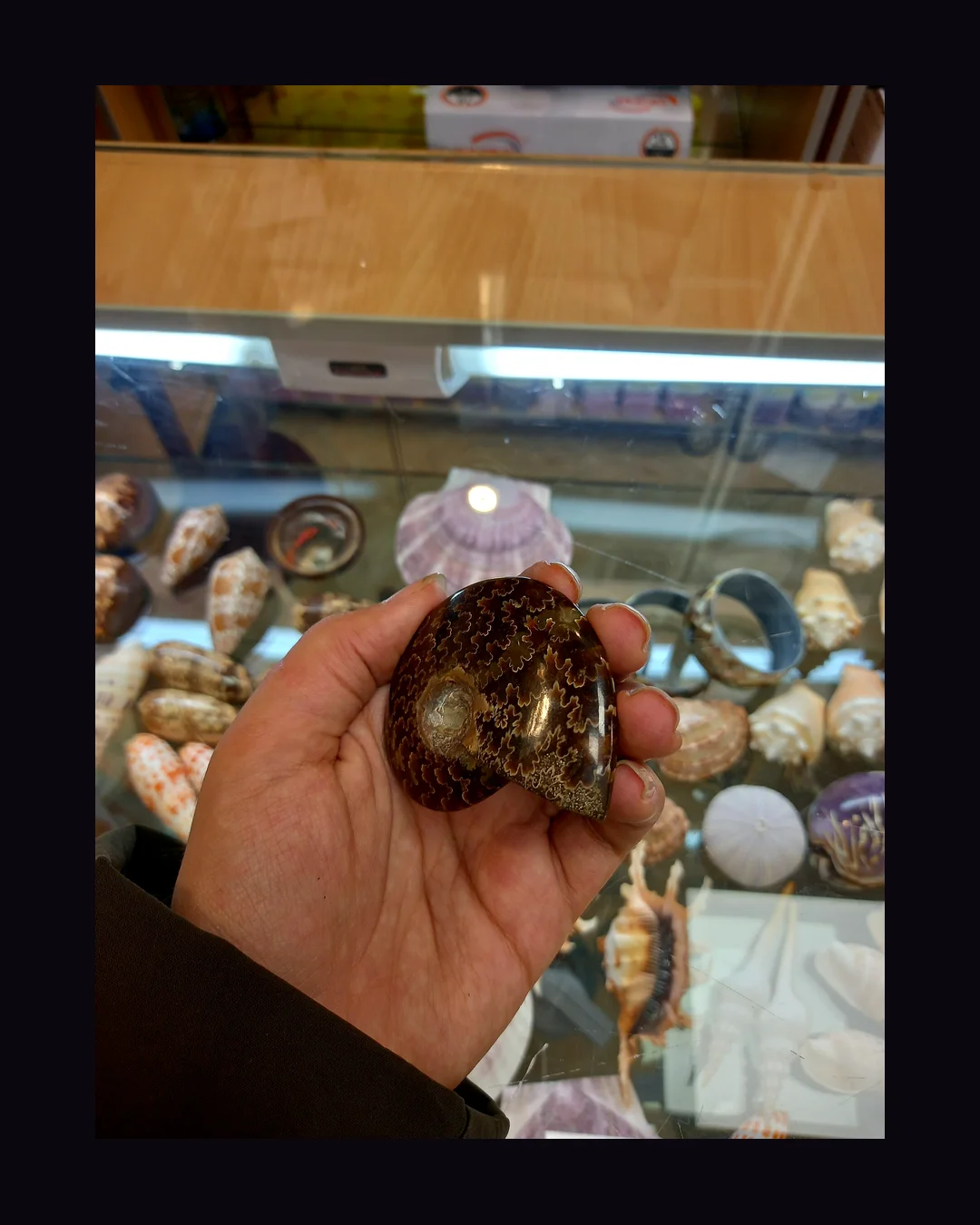
Ammonite
Fossil cephalopod shell, aragonite, calcite or pyrite replaced
This was an animal. It swam, it died out with the dinosaurs, and it sank into seabed mud. The mud turned to rock and swapped the shell out for stone, chamber by chamber. Look for the lacy frilled lines between those chambers. No factory copies them. The rainbow ammolite kind is usually a thin slice glued onto a backing. An honest seller tells you that. You can feel a chapter closing and you have not said it to anyone, because out loud it becomes real. In the Gandaki River in Nepal, black shaligram ammonites are sacred to Vishnu and are worshipped, not collected. Keep it dry. Water loosens whatever is holding a fossil together, and pyrite in damp air slowly eats itself. Keep yours dry. It already survived the end of a world.
People carry it for transformation, grounding and abundance. Tradition attaches it to the element water, the root, crown chakra, Neptune. It is most often given to Cancer, Capricorn, Pisces. It measures 3.5-4.5 on the Mohs scale.
Seen · you don't have this one yet
Common·Uncommon·Rare·Arcane
Ammolite is not a mineral of its own. It is the iridescent shell layer of an ammonite fossil, and it is nearly always sold as a doublet or triplet. That means a thin slice glued to a backing, often with a lab grown spinel or quartz cap on top. Epoxy holds it together. Fossils in general are routinely cleaned, glued, stabilised and part restored, which is normal palaeontological practice. Either way, the build should be disclosed on the label.
This one does not go in water. It dissolves.
What it is confused with
Nautilus shell, resin cast fossils, septarian, ammolite, spiral carvings
An ammonite is a flat coiled spiral split into chambers. The walls between the chambers show up as wavy, intricately frilled lines called sutures. Those lace-like lines are the defining feature and nothing manufactured copies them convincingly. Cut and polished pieces show the chambers filled with calcite or quartz crystal. Pyritised ones are metallic brassy gold. Ammolite is the nacre, the mother of pearl layer on the outside. It looks like a cracked mosaic and flashes red, green and gold.
Commonly faked · check before you buy
How to tell
Find the partition lines running across the spiral. On an ammonite they are frilled and lacy. On a nautilus they are simple smooth curves. Then pick it up. Fossil is cold and heavy in the hand. A resin cast is light and warm, and it usually shows a seam where the mould closed. If the same tiny detail repeats across two pieces, they came out of a mould.
Fossils get cleaned, glued, stabilised and part restored as a matter of course. That is normal practice in palaeontology and it does not make a specimen fake. Ammolite is nearly always soaked with epoxy to hold the flaky layer together. It is usually sold as a doublet or triplet, meaning the thin shell layer is glued to a backing and capped with lab grown spinel or quartz. A seller should tell you when a piece is built that way.
The full mineral facts
Hardness, formula, and how the rock is put together.
Hardness
3.5-4.5 Mohs
Formula
CaCO3 (aragonite/calcite), FeS2 in pyritised specimens
Family
organic
How it forms
An ammonite is the coiled shell of a sea animal that sank into seabed mud when it died, and the shell was slowly swapped out for stone as the mud around it turned to rock.
Where it comes from
Morocco, Madagascar, Canada (Alberta, ammolite), England (Whitby, Dorset), Germany (Solnhofen), Nepal (shaligram)
What it means
The moon is in Sagittarius today, so this is the Sagittarius read.
So you leave first, every time, and you call it freedom.
Run your thumb over the join between two chambers. A real ammonite has frilled lacy lines there, crenulated like a coastline.
A resin cast will not have them, and the same little detail turns up on every copy in the box. That is the whole test and it takes ten seconds.
Sagittarius, the shape of you survived and almost none of the original material did.
You keep moving because a stopped life looked terrible on somebody you loved. You watched them shrink into one room, and you swore it off before you were fifteen.
So you leave first, every time, and you call it freedom. Some of it is freedom. Some of it is a teenager still packing a bag in her head.
Nobody here is going to shut you in.
That is today's sky, not your chart. Add your birth details and this stone gets read against your own.
Read it for my chart →You know what this one would do for you. You just don't have it.
Ammonite for every sign
AriesSo you quit good things in month four.
This animal lived in the sea for ages and then went extinct with the dinosaurs. Its shell sank into mud, and the mud turned to rock around it.
Damp is what destroys it now. Water loosens the glue holding a fossil together, and the brassy pyritised ones eat themselves in a humid room.
Aries, you have been going round the same argument in a smaller and smaller circle.
The shell was built one chamber at a time. The animal moved forward and sealed the room behind it, and none of it looked like anything from outside.
You were praised early for being quick, and now a slow stretch feels like proof you picked wrong. So you quit good things in month four. Not because they failed, but because nobody was watching yet.
Keep it somewhere dry. Then go back to the thing you left.
TaurusIt was the way you stopped believing your own read on people.
Nearly every fossil in a shop has been worked on. Cleaned, glued and partly rebuilt, which is ordinary practice and not a con.
The rainbow ammolite is where it gets slippery. That is usually a wafer glued to a backing under a clear cap, and an honest seller tells you before you ask.
Taurus, you stopped trusting anything shiny that came cheap.
Somebody once sold you a version of themselves and you bought it whole. Not because you were naive. Because they were good at it, and because you wanted it to be true.
What stayed was not the loss. It was the way you stopped believing your own read on people. So now you hold everything at arm's length and let them call you cold.
You were not naive. You were being generous.
GeminiThe true short answer is still in your chest an hour later.
This is not a stone. It is an animal, replaced. The shell dissolved and rock took its place chamber by chamber, and the shape is all that stayed.
The frilled lines between the chambers are the proof. Nautilus shells have simple curves. Resin fakes carry mould seams and the same detail repeated on every copy.
Gemini, you keep adding a new chamber and sealing the last one off behind you.
You learned that in a house where the plain answer was inconvenient. It kept things calm. It made you very good company.
Now the good version arrives before you have finished thinking. The true short answer is still in your chest an hour later. You take it home like something you shoplifted.
Hold one. A real fossil is cold and heavy. The fakes are warm.
CancerYou can feel a chapter closing and you have not said it to anyone.
Pick it up with both hands. A real fossil is cold and heavy and no two are ever the same. A resin cast is light and warm and shows a seam.
Keep it out of the bathroom. Water loosens whatever is holding it together, and this one already came through the end of a world.
Cancer, you can spot a fake apology in four seconds and you accept them anyway.
You can feel a chapter closing and you have not said it to anyone. Out loud it becomes real, and the person who would take it best is the one it would hurt most.
You have been holding other people's endings since you were young. Somebody in that house needed you steady. You got so good at steady that nobody ever thought to check.
Who did you tell?
LeoSo people know your good stories and not what you did on Sunday.
It sank into the mud and lay there while the sea turned to rock above it. Chamber by chamber the shell was swapped out for stone, and the shape never changed.
The rainbow ammolite kind is a different story. That layer is a flake, it is soft, and strong sun takes the colour straight out of it.
Leo, you have not changed shape for anybody in years and it is starting to feel like a cage.
You are the one who makes a night work. Somewhere back there a room went warm when you performed and cold when you did not. You were far too young to know what to do with that.
So people know your good stories and not what you did on Sunday. Nobody is being cruel about it. It never occurred to anyone that you might need asking.
Somebody would ask. You would have to go quiet first.
VirgoThe one conversation you actually owe somebody has been waiting since spring.
This came through an extinction, a seabed turning to rock, and sixty-six million years of being buried. It is still here and still the exact shape it was.
It is also soft. Acid eats it, and a wet cloth can loosen the glue a preparer used to hold it together.
Virgo, the repairs you are ashamed of are the reason you are still here.
The drawer gets sorted at eleven at night. The list gets rewritten. The one conversation you actually owe somebody has been waiting since spring.
You grew up somewhere a mistake got noticed. So you keep the visible things perfect. The big unfixable one has sat at the back of the house for years, and you walk past it daily.
The frilled lines were never tidy. They are how you know it is real.
LibraThe reward for doing it well was that nobody noticed you were doing it.
Take the romance off and this is a dead animal. A sea creature that sank, got buried, and had its shell traded for rock one grain at a time.
The pretty rainbow version is often three layers glued into a sandwich with a lab-grown cap on top. That belongs on the ticket, and it is frequently not there.
Libra, you have been swapped out slowly, one agreement at a time, and nobody noticed when it finished.
You know the answer. You have known it since about February. Saying it would cost one specific person something, and you decided to carry that cost yourself.
That decision was not made this year. You were the one who kept the mood level at home. The reward for doing it well was that nobody noticed you were doing it.
Say it to one person this week.
ScorpioYou hold the rest back to see how the surface goes down.
Ammolite gets sold as a whole gemstone. It is usually a flake of fossil shell soaked in epoxy, glued to a backing, and capped with lab-grown spinel.
That is not a fraud if somebody says so. Owning a made thing is fine. Being told it is one thing when it is three is what people actually mind.
Scorpio, you sealed off a whole chamber of yourself after one gentle sentence.
They said it gently, which is exactly why it stuck. That you were a lot. That you took things too seriously for a Tuesday.
So you hand people the surface layer first. You hold the rest back to see how the surface goes down. The ones who could take all of it never got the chance to prove it.
Nothing about you needed a cap on top.
SagittariusSo you leave first, every time, and you call it freedom.
Run your thumb over the join between two chambers. A real ammonite has frilled lacy lines there, crenulated like a coastline.
A resin cast will not have them, and the same little detail turns up on every copy in the box. That is the whole test and it takes ten seconds.
Sagittarius, the shape of you survived and almost none of the original material did.
You keep moving because a stopped life looked terrible on somebody you loved. You watched them shrink into one room, and you swore it off before you were fifteen.
So you leave first, every time, and you call it freedom. Some of it is freedom. Some of it is a teenager still packing a bag in her head.
Nobody here is going to shut you in.
CapricornThe deal you struck at about fifteen was that you would earn your place.
It died and sank and the mud closed over it. Then the sea floor turned to rock, and the shell got swapped out mineral for mineral over millions of years.
None of that was visible while it happened. The finished thing is the only part anyone ever sees, and the finished thing is what people pay for.
Capricorn, you only ever show people the finished version, and then you wonder why nobody knows you.
If a day produced nothing you can point at, you file it as wasted. The night you talked somebody down goes in that pile. So does the year you held a house together.
The deal you struck at about fifteen was that you would earn your place. Nobody offered you that deal. You wrote it yourself, and you have never let anyone renegotiate it.
The swap happened anyway. Nobody had to watch.
AquariusYou worked that out so early that it stopped registering as a decision.
This came through an extinction that ended most of the life on the planet. Then it lay in rock for sixty-six million years without changing.
A humid shelf is what gets it now. The brassy pyritised ones crack and powder in damp air, so collectors keep them boxed with a bag of silica gel.
Aquarius, you got through the worst year of your life and it is the ordinary weeks that are wearing you down.
You will explain somebody else's family back to them and be right about all of it. You can name the thing in a group chat before anybody else has felt it.
Then you go home and cannot say the plain sentence about your own week. Watching was safer than joining. You worked that out so early that it stopped registering as a decision.
Put it in a dry box. Then say the plain sentence to somebody.
PiscesBy evening you cannot sort your own feelings from the ones you picked up at work.
In the Gandaki River in Nepal, black ammonites called shaligram are sacred to Vishnu. They are worshipped in homes and temples, not collected.
Which makes the word fossil sound a bit small. The same shape sits on a shop shelf with a price on it, and in a shrine with flowers in front of it.
Pisces, you were swapped out one chamber at a time and you kept the same shape so nobody noticed.
You walk into a room and take on whatever was already in it. By evening you cannot sort your own feelings from the ones you picked up at work.
As a child you kept the house calm by feeling it first and adjusting. That was useful to the adults in it, and nobody ever told you where you were supposed to stop.
Where do you stop?
Correspondences
What tradition attaches to this stone. Folklore, not chemistry.
Element
water
Planet
Neptune
Chakra
root, crown
Signs
cancer, capricorn, pisces
What tradition says
In Hindu tradition the black shaligram ammonites from the Gandaki River are sacred. They stand for Vishnu without depicting him, and they are worshipped today, not kept as decorative fossils. In wider crystal lore, ammonite is linked to cycles, to evolution and to the spiral of growth.
Care
- Do not put this one in water. It dissolves or spalls. Dust it dry.
- Keep it out of direct sun. The colour goes and does not come back.
- Salt scratches it. Do not bury it in salt.
- This is calcium carbonate, so acid eats it. Vinegar and lemon juice will damage the surface. Water can loosen the glues used to stabilise it. Brassy gold pyritised specimens rot in damp air, a problem called pyrite decay, so keep them in a dry box with silica gel. Ammolite is very soft, flaky and sun-sensitive. Dry cloth only, on all of it.
Common questions
What does ammonite mean?
Ammonite is carried for transformation, grounding and abundance. This was an animal. Tradition links it to the root, crown chakra.
Is ammonite real or fake?
Ammolite is not a mineral of its own. It is the iridescent shell layer of an ammonite fossil, and it is nearly always sold as a doublet or triplet. Find the partition lines running across the spiral. On an ammonite they are frilled and lacy. Fossils get cleaned, glued, stabilised and part restored as a matter of course.
Can ammonite go in water?
No. Ammonite dissolves or spalls in water. Dust it dry instead of soaking it, and keep it out of salt.
- Read: the crystals you cannot put in water →
- Read: the crystals that fade in sunlight →
- Read: fake crystals and the four tests that settle it →
Uncommon · brown, grey, cream, black, brassy gold (pyritised), iridescent red-green (ammolite)
Where this leads
This stone belongs to
Related crystals
FOR ENTERTAINMENT AND REFLECTION. NOT MEDICAL, PSYCHOLOGICAL, FINANCIAL OR LEGAL ADVICE. How this works