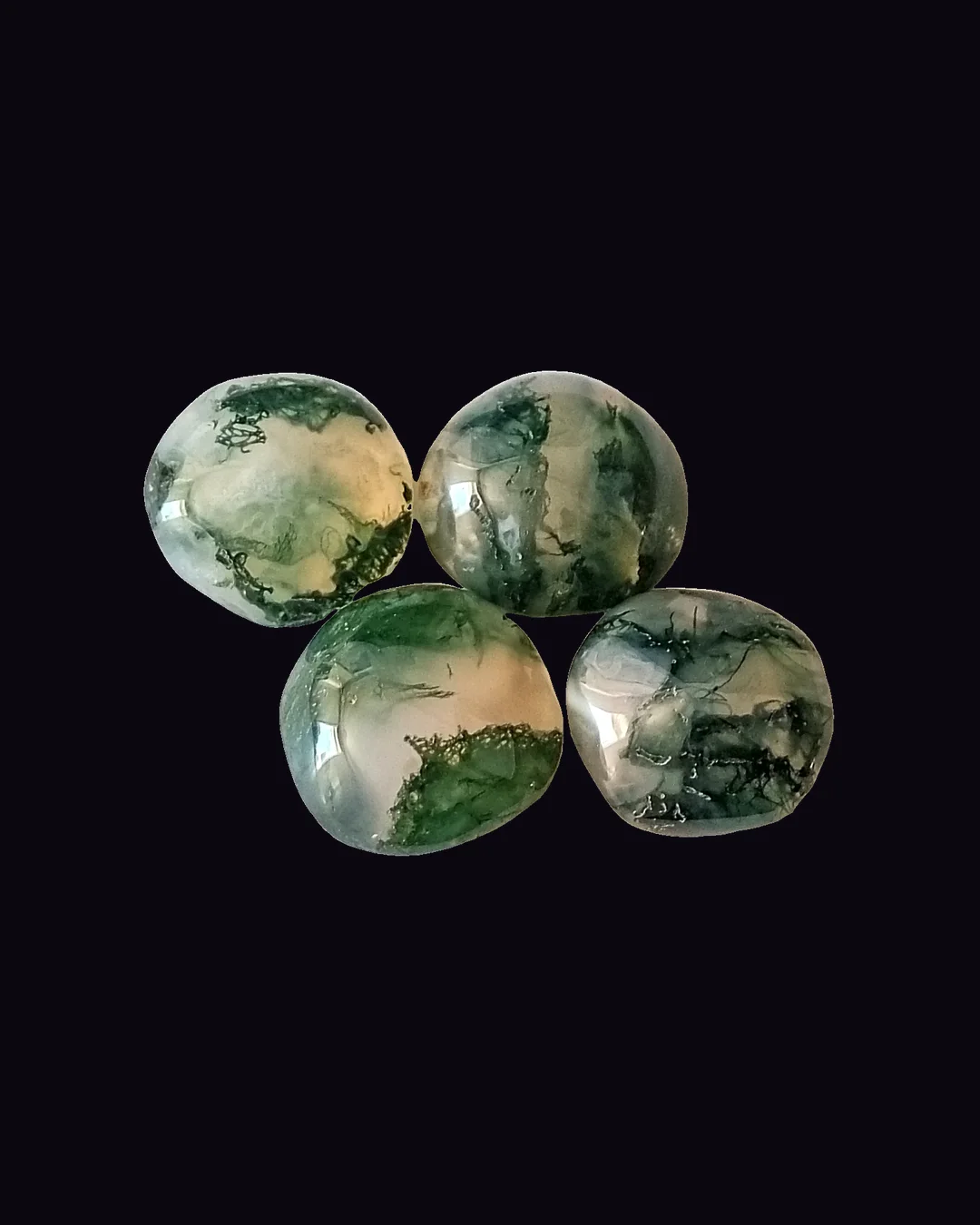
Moss Agate
Chalcedony with chlorite/hornblende or manganese oxide inclusions
The moss in this is not moss. It is mineral threads that grew inside the silica before it hardened, sharp and three dimensional when backlit. It is not really an agate either. Agates have bands. This one never got any. Paint and dye sit on the surface. Real fronds have clear stone in front of them and behind them. Farmers carried it for their crops. That is the whole tradition, growth you have to wait through. You planted something. A plan, a habit, a different life. Now you are in the long stretch where nothing shows above ground, and you feel stupid for starting. What were you expecting to see by now?
People carry it for abundance, grounding and calm. Tradition attaches it to the element earth, the heart, root chakra, Earth. It is most often given to Virgo, Taurus, Cancer. It measures 6.5-7 on the Mohs scale.
Seen · you don't have this one yet
Common·Uncommon·Rare·Arcane
What it is confused with
Dendritic agate, tree agate, chlorite included quartz, green jasper, seraphinite
It gets mixed up with dyed chalcedony and with resin fakes. Moss agate is a clear or milky chalcedony holding branching, feathery green or black inclusions that look like moss suspended in ice. Despite the name it is not a true agate, because it has no banding at all. The inclusions are three-dimensional and change as you turn the stone. Under magnification their edges are sharp and fibrous, not fuzzy the way a dye bloom is. Tree agate is the same material with an opaque white body.
How to tell
Put a light behind it. In real moss agate the fronds sit inside the stone in three dimensions, with clear chalcedony visible between them. Painted and resin-filled imitations carry the pattern on the surface only. Real moss agate also scratches glass.
The full mineral facts
Hardness, formula, and how the rock is put together.
Hardness
6.5-7 Mohs
Formula
SiO2 + Fe/Mn/Mg silicate inclusions
Family
chalcedony
How it forms
Silica-rich water filled cavities in old lava and hardened into chalcedony around fronds of green iron and magnesium minerals that were already growing inside it.
Where it comes from
India (Deccan), USA (Montana, Oregon), Brazil, Uruguay, Indonesia
What it means
The moon is in Sagittarius today, so this is the Sagittarius read.
It has also meant you leave right before the part where somebody actually knows you.
The moss in this stone is not moss and never was. It is mineral thread, green iron and magnesium, frozen mid-growth inside the silica.
It is not truly an agate either. Agates carry bands, and this one never got a single one.
Sagittarius, something has been quietly growing in you all year while you looked the other way.
The people who told you what would go wrong were the least happy people in the room, and you clocked that before you were ten. So you decided caution was catching and kept moving.
It has shown you things most people never see. It has also meant you leave right before the part where somebody actually knows you.
The middle is not a trap. It is just quiet.
That is today's sky, not your chart. Add your birth details and this stone gets read against your own.
Read it for my chart →You know what this one would do for you. You just don't have it.
Moss Agate for every sign
AriesSomebody taught you early that fast was the same as good.
Hold it up to a lamp and look through it. The green fronds sit inside the stone, with clear chalcedony in front of them and behind.
That is the whole test and it takes one second. A painted one keeps its pattern on the outside, where a fingernail can find the edge.
Aries, you have never once been beaten by the start of anything.
You are three weeks into something and there is nothing above ground yet. That silence feels like proof you were wrong.
Somebody taught you early that fast was the same as good. It was not. It was just easier to praise.
Nothing is showing above ground. That is exactly what week three looks like.
TaurusSomebody sold you something once and you decided you would never be that person twice.
Whatever the label says, this is not really an agate. Agates come in bands and this stone never got a single one.
The moss is not moss either. It is threads of green iron and magnesium minerals that were already growing when the silica closed over them.
Taurus, you distrust anything that turns up with a good name and a low price.
Somebody sold you something once and you decided you would never be that person twice. Now you check the label twice and the price three times and still walk out without it.
It has saved you money. It has also cost you a few things you actually wanted, because you would rather want nothing than be caught out.
What did you talk yourself out of last month?
GeminiThe plain version of your week feels too small to say out loud.
Somebody with a spray gun can make one of these. Green dye over grey chalcedony reads as moss from a metre away.
You can catch it in a second. Real fronds have clear stone in front of them and behind, and paint only ever sits on top.
Gemini, the true answer bores you before it has finished arriving.
Being interesting was a job you took on early, in a house where the quiet child got skipped. It worked, so you kept it, and then you could not put it down.
The plain version of your week feels too small to say out loud. You have never checked whether anyone would have preferred it.
Say the flat one once. Watch who stays.
CancerSo you learned to hold the room and keep your own bad weeks in a drawer.
Silica-rich water crept into holes in old lava and hardened into chalcedony. It closed around green fronds that were already growing in there and kept them exactly as they were.
None of that was quick. The stone has no bands because it never had a dramatic moment worth recording.
Cancer, everybody's news arrives at you and nobody has ever asked why.
It started in a house where somebody needed you steady, at an age when you thought that was simply your job. So you learned to hold the room and keep your own bad weeks in a drawer.
People call you the calm one. They mean you have never made them uncomfortable, and you let them think those are the same thing.
You are allowed to be the one who needs something.
LeoThe last person to ask you a real question was a long time ago.
Moss agate takes almost everything. It scratches glass, water does not touch it, and the green will not fade in a window.
What ruins one is a workshop with a dye bath. Nothing about the weather threatens this stone. A shortcut does.
Leo, you never fade in front of people, and that is not the same as being fine.
You worked out young that your mood took up more room than other people's, so you started editing before you walked in. It made you very good company.
The last person to ask you a real question was a long time ago. You did not notice when they stopped.
Who gets the unedited one?
VirgoYou were finding the one thing you could move.
Somebody dyes these on purpose. Green over plain grey chalcedony passes easily at arm's length in a market stall.
Backlight it and the lie ends. Real fronds are three dimensional, with clear stone visible in front of them and behind.
Virgo, the thing you keep trying to tidy up is the only reason anybody loves the piece.
The cupboard gets reorganised on the night the real thing is hurting. You alphabetise a shelf while a conversation you have been avoiding sits unanswered in your phone.
It started small, in a house where something was going wrong that no child could touch. You were not being fussy. You were finding the one thing you could move.
Some things only get better by being left alone.
LibraBy the time you reach your own preference you cannot find it.
Hot water full of dissolved silica filled cavities in old lava. It set around green fronds over a stretch of time nobody was there to sit through.
Nobody chose the pattern. The fronds were already growing, and the stone simply hardened around whatever was in the way.
Libra, you grew around somebody else's life so completely that leaving would take pieces of you with it.
Every option in your head has a face attached to it. You run the whole table before you answer.
By the time you reach your own preference you cannot find it. It began in a house where one person's mood set the weather, and you learned to forecast instead of ask.
Say one want out loud tonight. Do not soften it first.
ScorpioNow every real feeling gets checked for size before it is allowed out.
Take it to the window and turn it slowly in the light. The green threads have real depth, with clear chalcedony sitting in front of them and behind.
A dyed one is flat. The pattern stops at the surface, and the seller is not going to volunteer which kind you bought.
Scorpio, what grew inside you got there before you were old enough to have any say in it.
You were a lot, apparently, at an age when you had no way to argue back. Now every real feeling gets checked for size before it is allowed out.
So people get the flat version, and then they tell you that you are hard to know. That is the exact thing you were trying to prevent.
You were not too much. You were badly matched.
SagittariusIt has also meant you leave right before the part where somebody actually knows you.
The moss in this stone is not moss and never was. It is mineral thread, green iron and magnesium, frozen mid-growth inside the silica.
It is not truly an agate either. Agates carry bands, and this one never got a single one.
Sagittarius, something has been quietly growing in you all year while you looked the other way.
The people who told you what would go wrong were the least happy people in the room, and you clocked that before you were ten. So you decided caution was catching and kept moving.
It has shown you things most people never see. It has also meant you leave right before the part where somebody actually knows you.
The middle is not a trap. It is just quiet.
CapricornYou learned that being useful was the price of being kept.
Moss agate is hard, around 6.5 to 7, and it will scratch glass. Water and sunlight do nothing to it at all.
It is the plainest stone in the case. It was also the one farmers kept in a pocket through a whole growing season, which is the entire tradition attached to it.
Capricorn, you are the one people keep in a pocket all season and never mention.
A day with nothing to show for it gets filed as a wasted one. So do the hours you spent beside somebody frightened, and the year you kept a household upright.
You learned that being useful was the price of being kept. You have never once tested the bill.
The season was not empty. It was underground.
AquariusYou started watching from outside because inside was not somewhere you were allowed to be.
Somebody in a workshop worked out that green dye on plain chalcedony sells. It is cheap, it is quick, and it photographs beautifully.
Hold it to a lamp instead. Real fronds go the whole way through, with clear stone in front of them and behind.
Aquarius, you need to know whether a feeling goes the whole way through, and that has cost you a few good nights.
You can lay out a friend's whole pattern in three sentences and be exactly right about it. Then you go home to something you have been doing for six years and cannot see the edges of.
You started watching from outside because inside was not somewhere you were allowed to be. You never worked out how to come back.
Who is allowed to tell you what you are doing?
PiscesA friend's bad afternoon is in your chest before you have taken your coat off.
This stone set slowly, in a hole in old lava, around threads that were already there. Nothing was added and nothing was arranged.
There are no bands in it. It holds no record of a single dramatic day, only one very long ordinary one.
Pisces, what looks alive in you grew there before anything hardened, and nobody planted it.
A friend's bad afternoon is in your chest before you have taken your coat off. People who have never had to sort their own feelings out from the room's have told you to toughen up, and you believed them.
You cannot fit a door now. You can learn to notice the moment a mood arrived with somebody else.
Tonight, say out loud whose mood you are carrying.
Correspondences
What tradition attaches to this stone. Folklore, not chemistry.
Element
earth
Planet
Earth
Chakra
heart, root
Signs
virgo, taurus, cancer
What tradition says
In crystal lore, moss agate is called the gardener's stone. Old accounts keep it for growth, for harvest and for slow improvement rather than sudden change.
Care
- Water is fine. Dry it afterwards.
- It is hard and stable. Warm water. Nothing else to watch for.
Common questions
What does moss agate mean?
Moss Agate is carried for abundance, grounding and calm. The moss in this is not moss. Tradition links it to the heart, root chakra.
Is moss agate real or fake?
Moss Agate is not faked often, but it is still worth checking. Put a light behind it. In real moss agate the fronds sit inside the stone in three dimensions, with clear chalcedony visible between them.
Can moss agate go in water?
A short rinse is fine for moss agate, then dry it.
Common · colourless to milky white with green, black or red-brown inclusions
Where this leads
This stone belongs to
Related crystals
From the Grimoire
FOR ENTERTAINMENT AND REFLECTION. NOT MEDICAL, PSYCHOLOGICAL, FINANCIAL OR LEGAL ADVICE. How this works