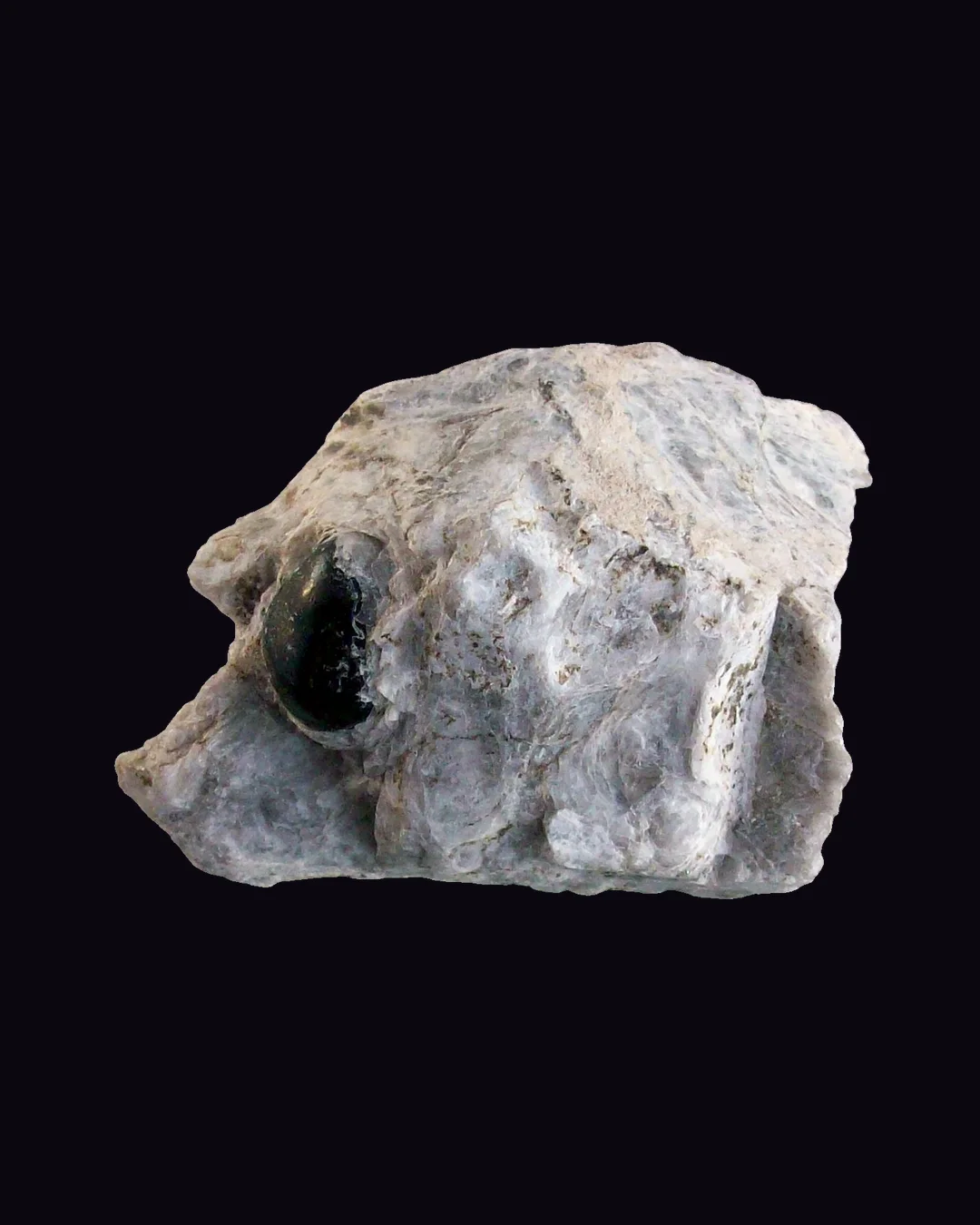
Apache Tears
Obsidian (marekanite nodules in perlite)
It is not a stone. It is glass, lava that cooled too fast to become anything else. Hold one up to a lamp. The whole pebble glows smoky brown, which black onyx will never do. The name comes from a nineteenth century settler legend in Arizona, not from documented Apache history. We are not going to sell it to you as that. You are grieving, and you are tired of being told to move on. The people saying it are not cruel. They are just finished waiting. You are not finished. Nobody asked what the timeline actually was. People have carried these small ones for grief that keeps its own schedule. You are not behind.
People carry it for grief, protection and shadow work. Tradition attaches it to the element water, the root, heart chakra, Pluto. It is most often given to Scorpio, Pisces, Capricorn. It measures 5-6 on the Mohs scale.
Seen · you don't have this one yet
Common·Uncommon·Rare·Arcane
What it is confused with
Black obsidian, smoky quartz, black tourmaline, hematite, smoky glass
Apache tears are small nodules, roughly 1 to 4 cm, rounded or lumpy. The outer skin is dimpled and pockmarked like a chewed pebble. That texture is the giveaway. It comes from the grey perlite the nodules weathered out of, which took on water around them. Held to a light they nearly always glow translucent smoky brown-grey, even when they look flat black in your hand. Chipped areas show a glassy curved break. Tumbled ones lose the dimpling and end up smooth translucent brown-black lozenges.
How to tell
Hold it up to a bright lamp. An Apache tear lets smoky brown light through the whole nodule. A solid piece of black obsidian the same size stays dark. Then feel the outside. The natural skin is dimpled and pockmarked, and the pieces are small and lumpy. It is softer than quartz, so quartz will scratch it.
The full mineral facts
Hardness, formula, and how the rock is put together.
Hardness
5-6 Mohs
Formula
SiO2 glass
Family
volcanic glass
How it forms
Apache tears are lumps of volcanic glass that formed when lava cooled too fast to crystallise, and they weather loose out of the softer grey rock that held them.
Where it comes from
USA (Superior, Arizona, Nevada, New Mexico), Mexico, Russia (Marekanka River, type locality)
What it means
The moon is in Sagittarius today, so this is the Sagittarius read.
You have been running from about twenty minutes of it.
Volcanic glass does not care about water, salt or sun. It is inert, it will outlast the shelf it sits on, and nothing in your house will hurt it.
It is only small and dark and easy to lose. Most people lose theirs down the side of a sofa inside a year.
Sagittarius, you weathered loose from the people who held you, and you have told it as a funny story ever since.
Movement has always been how you handled things. Somewhere back there you learned that staying in a room with a feeling did not end well, and that leaving did.
So this year you have kept busy at a level that would exhaust anybody. You have not been running from your life. You have been running from about twenty minutes of it.
Twenty minutes. That is all it wants.
That is today's sky, not your chart. Add your birth details and this stone gets read against your own.
Read it for my chart →You know what this one would do for you. You just don't have it.
Apache Tears for every sign
AriesYou keep treating them like projects that are behind schedule.
This is not a stone. It is glass. Lava that cooled so fast it never got the chance to become a crystal.
It did not fail at anything. There was simply no time, and glass is what you get when there is no time.
Aries, you left before you had finished feeling it and it has been rolling around loose ever since.
You are quick, and you were praised for it before you were old enough to question it. So now slow feels like failing at something.
There are things in your life this year that will not go faster because you want them to. Grief is one of them. You keep treating them like projects that are behind schedule.
They are not behind. There was no schedule.
TaurusYou check and you wait and you let people call you slow.
These formed in a hurry and then waited. The lava chilled to glass in minutes, and the softer grey rock around it took an age to weather away.
The pebble you have was released, not mined. It fell out of the hillside when the rock holding it finally gave up.
Taurus, you did not leave that house, you stayed until the thing holding you finally gave out.
Somebody sold you something once with a story attached. This one has a story too. The name comes from a settler legend in Arizona in the eighteen hundreds, not from documented Apache history.
You have got very careful since then. You check and you wait and you let people call you slow. That is not stubbornness, it is somebody who found out what a nice story costs.
The glass is real. Only the legend was borrowed.
GeminiThe plain version is much shorter and you have not said it out loud once.
Hold one up to a lamp and look through it. The whole pebble goes smoky brown, right through the middle.
Solid black obsidian the same size will not do that, and onyx never will. Two seconds at a window tells you what you are holding.
Gemini, you came loose from something and you have been telling it as a good anecdote ever since.
You have been fine for months. You say it lightly and people believe you, because you say it well.
The plain version is much shorter and you have not said it out loud once. You learned that in a house where the short version made things worse, and you were young, and it worked.
Say the short one to one person.
CancerEveryone else has gone back to normal and you are still finding their handwriting on things.
This came through a volcano and then a hillside falling apart around it. It is glass, and glass does not rot or fade or mind water.
It is only very easy to lose. Small, dark, and exactly the shape of a thing that rolls into a gap in the floorboards.
Cancer, you cried where nobody could see for years and decided that meant you had dealt with it.
You handled the worst week. You handled the phone calls and the food and the person who could not stop crying.
It is the eighth month that gets you. Everyone else has gone back to normal and you are still finding their handwriting on things. Nobody is being unkind, they are just finished waiting.
Who is still asking you about it?
LeoSo when something in you actually broke this year, you kept it out of every room.
Somebody in Arizona in the eighteen hundreds attached a legend to these pebbles, and the name stuck for good. It is a settler story, not documented Apache history.
Sellers still tell it as though it were ancient. The stone did not ask for the story. It is volcanic glass that fell out of a hill.
Leo, a story got attached to you by people who were not there, and you never corrected it.
There is a version of you that arrives already bright. It is not fake. It is just the one that gets asked back.
So when something in you actually broke this year, you kept it out of every room. Somewhere back there you learned that the heavy version of you made people leave, and nobody has ever told you otherwise.
Somebody would stay. You have not tested it.
VirgoYou were raised where competence got you approved of, and grief is not competent.
Lava hit cold and stopped. No crystals had time to grow, so it froze as glass, and then it sat inside softer grey rock for a very long time.
The dimples on the outside came from that weathering. Polish them off and it shines beautifully, and the record of what happened to it is gone.
Virgo, you came out of that fast and you never got to finish reacting to it.
You have organised your way through this year. The paperwork, the accounts, the appointments, every bit of it handled.
None of it was avoidance exactly. A list is the only thing in front of you that will actually answer back. You were raised where competence got you approved of, and grief is not competent.
Leave the dimples on. They are the record.
LibraYou give a slightly smoothed version to each person, calibrated to what they can take.
Roll one between your fingers. The surface is dimpled and slightly rough, which is exactly how it came out of the hillside.
The glossy polished ones have had that skin ground off to sell better. Nothing dishonest in it. You just cannot get it back.
Libra, you smooth yourself before anybody asks, then wonder why nobody knows what you want.
You have been managing how everybody else feels about your bad year. You give a slightly smoothed version to each person, calibrated to what they can take.
That job was handed to you when you were small, in a house where one person's mood set the weather. You got good at it, and nobody once noticed you were working.
You are allowed to be the one who gets looked after.
ScorpioYou decided it yourself, the first time somebody's face changed while you were talking.
It is glass, not crystal. Lava that cooled too fast to arrange itself into anything, and it has been exactly that ever since.
It is also softer than quartz, which surprises people who bought it as a protective stone. It scratches on a keyring.
Scorpio, somebody put a time limit on your grief while you were still inside it.
They probably said it while you were in the worst of it. That you were dwelling. That it had been a while now.
So you took the whole thing underground and got very good at appearing fine. Nobody made you promise that. You decided it yourself, the first time somebody's face changed while you were talking.
People have carried these for grief that keeps its own schedule. You are not behind.
SagittariusYou have been running from about twenty minutes of it.
Volcanic glass does not care about water, salt or sun. It is inert, it will outlast the shelf it sits on, and nothing in your house will hurt it.
It is only small and dark and easy to lose. Most people lose theirs down the side of a sofa inside a year.
Sagittarius, you weathered loose from the people who held you, and you have told it as a funny story ever since.
Movement has always been how you handled things. Somewhere back there you learned that staying in a room with a feeling did not end well, and that leaving did.
So this year you have kept busy at a level that would exhaust anybody. You have not been running from your life. You have been running from about twenty minutes of it.
Twenty minutes. That is all it wants.
CapricornNot one person had to cover for you, and you made sure of that.
The name was put on these by settlers in Arizona in the eighteen hundreds. It is a legend of uncertain origin, and it is not documented Apache tradition.
The pebble itself is honest. Volcanic glass, weathered out of soft grey rock, worth roughly the price of a coffee.
Capricorn, you have priced yourself by what you produce and the number always comes out low.
You went back to work. You got everything done. Not one person had to cover for you, and you made sure of that.
Nobody knows what it cost. The cost was paid at four in the morning, with no witnesses, on the nights you told everyone you had slept fine.
That was never the deal. It was only the first thing you were told.
AquariusYou learned very early that understanding a thing was safer than feeling it.
Take one to a window and look through it. Smoky brown light comes right through the middle, even on the ones that look solid black in your palm.
That is the test and it costs nothing. The dimpled skin and the small size are the other two tells.
Aquarius, people read you as closed because nobody has ever held you up to a light.
You could explain what you are going through in detail if it were happening to somebody else. You have the whole framework ready.
Applied to yourself it goes strangely flat. You learned very early that understanding a thing was safer than feeling it. It has worked for about twenty years.
What if you just felt it?
PiscesYou have been apologising for taking longer than the room expected.
The lava cooled in minutes. Then the grey rock holding these pebbles took thousands of years to crumble away and let them go.
That is the honest shape of it. A fast break, then a very long release, and nobody standing over it with a stopwatch.
Pisces, something happened too fast for you to form any answer to it.
You are grieving and you are tired of being told to move on. The people saying it are not cruel. They are just finished waiting.
You are not finished. Nobody ever asked what the timeline actually was. You have been apologising for taking longer than the room expected.
There was no room. There was no timeline.
Correspondences
What tradition attaches to this stone. Folklore, not chemistry.
Element
water
Planet
Pluto
Chakra
root, heart
Signs
scorpio, pisces, capricorn
What tradition says
In crystal lore, Apache tears are kept for grief, and for grieving without being swallowed by it. The story behind the name is a nineteenth century American legend of uncertain origin. It is not documented Apache tradition and should not be presented as such.
Care
- Water is fine. Dry it afterwards.
- Water is fine. The stone is inert and very little bothers it. The real risk is losing it, because it is small. Keep it somewhere with a lid. If you like the dimpled skin, do not let anyone polish it off. That texture is part of the specimen.
Common questions
What does apache tears mean?
Apache Tears is carried for grief, protection and shadow work. It is not a stone. Tradition links it to the root, heart chakra.
Is apache tears real or fake?
Apache Tears is not faked often, but it is still worth checking. Hold it up to a bright lamp. An Apache tear lets smoky brown light through the whole nodule.
Can apache tears go in water?
A short rinse is fine for apache tears, then dry it.
Common · smoky black-brown, translucent grey-brown, near-black
Where this leads
This stone belongs to
Related crystals
FOR ENTERTAINMENT AND REFLECTION. NOT MEDICAL, PSYCHOLOGICAL, FINANCIAL OR LEGAL ADVICE. How this works