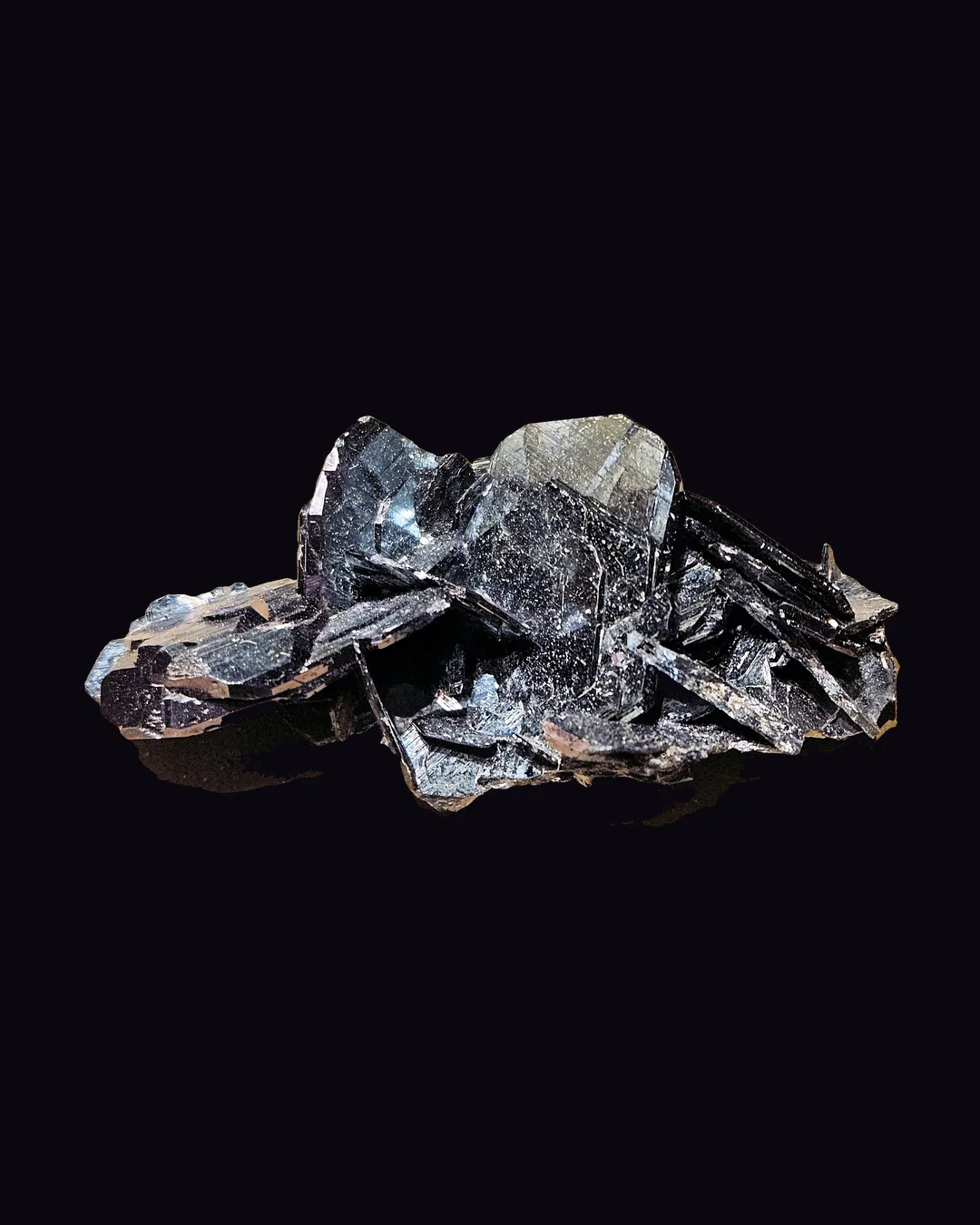
Hematite
Hematite
It looks like machined steel. It is rust. Iron and oxygen joined in an old sea and settled in layers on the floor. Burial pressed those layers into rock. Drag it on rough concrete and it writes red-brown, however silver the face looks. That streak is the whole test. One warning. Anything called magnetic hematite that leaps to your fridge is a made ceramic, not this. You have been living slightly above your own life lately. Agreeable in rooms. Saying yes in a voice that is not quite yours. Somebody taught you early that keeping the peace was the same as being good. Hold it until it stops feeling cold. Keep it dry, water stains it.
People carry it for grounding, protection and boundaries. Tradition attaches it to the element earth, the root chakra, Mars. It is most often given to Aries, Capricorn, Aquarius. It measures 5.5-6.5 on the Mohs scale.
Seen · you don't have this one yet
Common·Uncommon·Rare·Arcane
This one does not go in water. It dissolves.
What it is confused with
Magnetite, hematine magnetic hematite, galena, black obsidian, pyrite, steel
Heavy, mirror-bright silver-grey, with a hard metallic shine that looks almost chrome-plated once tumbled. The decisive feature is the streak. Rubbed on unglazed porcelain or rough concrete it leaves a rust-red to blood-red mark, however silver the surface looks. Natural masses grow as kidney-shaped botryoidal bubbles, or as micaceous specularite, a mass of glittering platelets. It feels noticeably dense in the hand. Rounded specimens may show a faint red-brown dust in the crevices.
How to tell
The streak is the whole test. Rub it on something rough and unglazed. Hematite writes red. Magnetite and galena write black-grey. Second test, try a magnet. Real hematite is only very weakly attracted. Anything sold as magnetic hematite that snaps onto a fridge magnet is hematine, a manufactured barium-ferrite ceramic and not a mineral.
Natural hematite is untreated. The very common magnetic hematite rings, beads and singing stones are hematine, a synthetic ferrite. If it is strongly magnetic and perfectly uniform, it was manufactured.
The full mineral facts
Hardness, formula, and how the rock is put together.
Hardness
5.5-6.5 Mohs
Formula
Fe2O3
Family
oxide
How it forms
Iron and oxygen locked together in ancient seawater and settled in layers on the seafloor, and burial hardened those layers into the banded iron rock most hematite is cut from.
Where it comes from
Brazil, England (Cumbria, kidney ore), USA (Michigan, Minnesota), Italy (Elba), Switzerland (iron roses), Australia
What it means
The moon is in Sagittarius today, so this is the Sagittarius read.
It also left you completely alone the one time a warning was true.
Hold it in your hand and wait. It starts cold and takes a surprisingly long time to warm, because it is dense iron oxide.
While you are waiting, remember the magnet rule. Anything that snaps to a fridge and calls itself hematite is factory ceramic.
Sagittarius, you laid it all down in layers and then let the weight of it turn you hard.
Adults spent your childhood telling you what you could not do, and being wrong about nearly all of it. So you stopped taking warnings seriously at all.
It made you braver than most people you know. It also left you completely alone the one time a warning was true.
Keep it dry. Water stains it orange.
That is today's sky, not your chart. Add your birth details and this stone gets read against your own.
Read it for my chart →You know what this one would do for you. You just don't have it.
Hematite for every sign
AriesYou learned that speed was the thing about you worth having.
Hematite looks like machined steel and it is rust. Iron oxide, and it behaves like one. Water stains it orange and salt pits the polished face.
Here is the part the stall skips. Anything sold as magnetic hematite that snaps to your fridge is a manufactured ceramic, not hematite at all.
Aries, you have been the heavy one in every group and it has never once been your turn.
Somebody praised you for how fast you moved long before anybody praised you for staying. You learned that speed was the thing about you worth having.
Now the quiet stretch of anything reads as failure, and you go hunting a new beginning to fix the feeling.
This one settled out of a sea in layers. No hurry in it anywhere.
TaurusYou just moved your standards up and never moved them back.
Iron and oxygen locked together in an ancient sea and drifted down in layers on the floor. Burial pressed those layers into banded rock, and this was cut out of it.
Real hematite is only very weakly pulled by a magnet. The magnetic hematite in bead shops is a made ferrite ceramic wearing the name.
Taurus, you stopped trusting anything that shines cheaply, and somebody gave you that lesson.
You paid for something once that turned out to be mostly a label. You did not complain to anybody. You just moved your standards up and never moved them back.
Now every good thing has to serve time outside before you let it in, and a couple of them got tired of waiting.
Drag it on concrete. If it writes red-brown, it is real.
GeminiSomebody asked how you were on the phone last week and got the bright version.
Take the shine away and hematite is rust in a solid piece. Iron oxide, polished until it passes for machined steel.
The name gets lent out as well. Magnetic hematite rings and singing stones are manufactured ferrite, not a mineral at all.
Gemini, you laid every hard year down flat and let the weight of the next one press it shut.
You worked out young that quick and interesting kept people around, and that plain and true emptied a room. So the flat sentence started to feel dangerous.
Somebody asked how you were on the phone last week and got the bright version. The dull true one would have taken four words.
Polish is not the same thing as steel.
CancerYou still read a room from the doorway and adjust yourself before you sit down.
Somebody worked out you can press barium ferrite into shiny grey beads and call them magnetic hematite. They are not hematite. They are moulded in a factory and they snap to a fridge.
Real hematite came from iron and oxygen settling in layers on an old seafloor. It barely notices a magnet.
Cancer, you have accepted a factory version of closeness because it snapped into place fast.
Somebody at home needed managing before you were old enough to have a say in it, and you got very good at it, and nobody ever named it.
You still read a room from the doorway and adjust yourself before you sit down. You have never once asked anybody to do that for you.
It stains in water. Wipe it dry and put it where you can reach it.
LeoBy the end of a night you know how everybody in that room is doing.
Take it outside and drag it once across rough concrete. Whatever the face looks like, the line it leaves is red-brown, and that streak is the whole test.
Do the magnet test as well. If it leaps at your fridge it is a manufactured ceramic wearing the hematite name.
Leo, you would rather be scraped raw than have somebody guess wrong about you.
Being the warm one earned you a place somewhere early, so you kept being the warm one, and it stopped being a choice around your twenties.
By the end of a night you know how everybody in that room is doing. Nobody knows how you are, and you would struggle to tell them.
Red streak. Grey face. Both of them true.
VirgoYou were the reliable one before you had any say in it.
Iron and oxygen joined in old seawater and settled to the bottom, layer on layer, for longer than any record covers. Pressure turned that into the banded rock this was cut from.
Nothing was done to it afterwards. The magnetic version in the same shop was made from scratch in a factory.
Virgo, you have been laying down the same careful layer every day and nobody has thanked you for one of them.
You were the reliable one before you had any say in it. Reliable children get handed more jobs, not more help.
So you handle everything that can be handled, at speed, and the one thing that cannot be handled sits there quietly getting older.
It chips. Under the metal face it is dull red-grey.
LibraNow you say yes in a voice that is not quite yours.
Underneath the gunmetal polish this is rust, plainly. Iron oxide, hard enough to take a shine, brittle enough to chip.
It is barely magnetic at all. Anything that grabs a fridge and calls itself hematite came out of a mould, not out of the ground.
Libra, the polish is real and so is the chipping, and you only ever let people see the first one.
Somebody taught you early that keeping the peace was the same as being good, and you were young enough to file that as fact.
Now you say yes in a voice that is not quite yours. You notice it afterwards, in the car, and you decide it was not worth mentioning.
It was worth mentioning.
ScorpioYou have spent years being the only person who knows she is a surface.
Hematite chips more easily than it looks like it should, and salt pits the polish. Leave it wet and orange rust blooms across the surface.
It is also the name that gets stolen most often. The shiny magnetic beads sold as hematite are a manufactured ceramic.
Scorpio, you look like steel and you leave a red mark on everything you get dragged across.
You were telling the truth in a room that did not want it, and you were young, and you watched the temperature drop. So you built a smaller one and sent her out.
Everybody likes her. You have spent years being the only person who knows she is a surface.
The metal face is a surface too. The inside is red.
SagittariusIt also left you completely alone the one time a warning was true.
Hold it in your hand and wait. It starts cold and takes a surprisingly long time to warm, because it is dense iron oxide.
While you are waiting, remember the magnet rule. Anything that snaps to a fridge and calls itself hematite is factory ceramic.
Sagittarius, you laid it all down in layers and then let the weight of it turn you hard.
Adults spent your childhood telling you what you could not do, and being wrong about nearly all of it. So you stopped taking warnings seriously at all.
It made you braver than most people you know. It also left you completely alone the one time a warning was true.
Keep it dry. Water stains it orange.
CapricornYou were rewarded for being capable before you were old enough to want anything else.
Barium ferrite gets pressed into perfect grey beads and sold as magnetic hematite in every market in the country. It was never hematite. Real hematite barely notices a magnet.
The real thing settled out of an old sea in layers and got squeezed into rock. Nobody manufactured any of it.
Capricorn, you do not pull people towards you, and you have decided that means you are not wanted.
You were rewarded for being capable before you were old enough to want anything else. Capable is what you have been ever since.
Rest goes down as waste. So does the stretch of years you spent holding people up, because none of it can be shown to anybody.
Nobody watched this settle either.
AquariusYou will diagnose a stranger's marriage over one coffee.
The iron in this came out of seawater an enormous time ago and settled on a seafloor in flat bands. Everything about it happened slowly and in layers.
It is untreated. The magnetic version on the next table is a ferrite ceramic somebody moulded and named after it.
Aquarius, you built yourself in flat quiet layers and you are surrounded by people doing a louder version of it.
You were the strange one somewhere early, and you got through it by stepping half outside and studying the room instead of joining it.
It worked so well that you never came back in. You will diagnose a stranger's marriage over one coffee. You go home without telling anybody how your week actually went.
There is a seat. It has your name on it.
PiscesA good busy Saturday still costs you the whole of Sunday.
The mirror finish is the surprise. What it actually is is rust, iron and oxygen bonded together and pressed into rock on an ancient seafloor.
Rub it on concrete and it writes red-brown. The magnetic version sold under the same name never came out of any seafloor.
Pisces, you look far harder than you are and you have never corrected anybody about it.
Whatever the room is carrying comes straight into you, and it always has, and as a child you had no way of knowing other people were not like that.
So you never learned where you end. A good busy Saturday still costs you the whole of Sunday.
Would a door have helped, or only made you lonely?
Correspondences
What tradition attaches to this stone. Folklore, not chemistry.
Element
earth
Planet
Mars
Chakra
root
Signs
aries, capricorn, aquarius
What tradition says
In crystal lore, hematite is linked with grounding, with the blood and with boundaries. Roman soldiers reportedly rubbed it on themselves before battle. That claim is repeated widely and sourced thinly.
Care
- Do not put this one in water. It dissolves or spalls. Dust it dry.
- Salt scratches it. Do not bury it in salt.
- This is iron oxide, and iron oxide rusts. Long water contact and salt both cause orange staining and pit the polished surface. Wipe it dry. It is also brittle despite the metallic look. It chips, and the chip shows dull red-grey inside.
Common questions
What does hematite mean?
Hematite is carried for grounding, protection and boundaries. It looks like machined steel. Tradition links it to the root chakra.
Is hematite real or fake?
Hematite is not faked often, but it is still worth checking. The streak is the whole test. Rub it on something rough and unglazed. Natural hematite is untreated.
Can hematite go in water?
No. Hematite dissolves or spalls in water. Dust it dry instead of soaking it, and keep it out of salt.
Common · silver-grey metallic, gunmetal, steel black, earthy red-brown
Where this leads
This stone belongs to
Related crystals
From the Grimoire
- Can You Shower With Crystals? The Ones That Can't
- The 7 Crystals People Actually Reach For During a Panic Spiral
- Mercury Retrograde Is Back: 5 Crystals to Grab First
- Carry These and Nothing Gets In: A Real Protection Crystal Guide
- Crystals That Can't Get Wet: The List That Saves Your Collection
- Crystals You Shouldn't Keep Together: 7 Pairings That Clash
FOR ENTERTAINMENT AND REFLECTION. NOT MEDICAL, PSYCHOLOGICAL, FINANCIAL OR LEGAL ADVICE. How this works