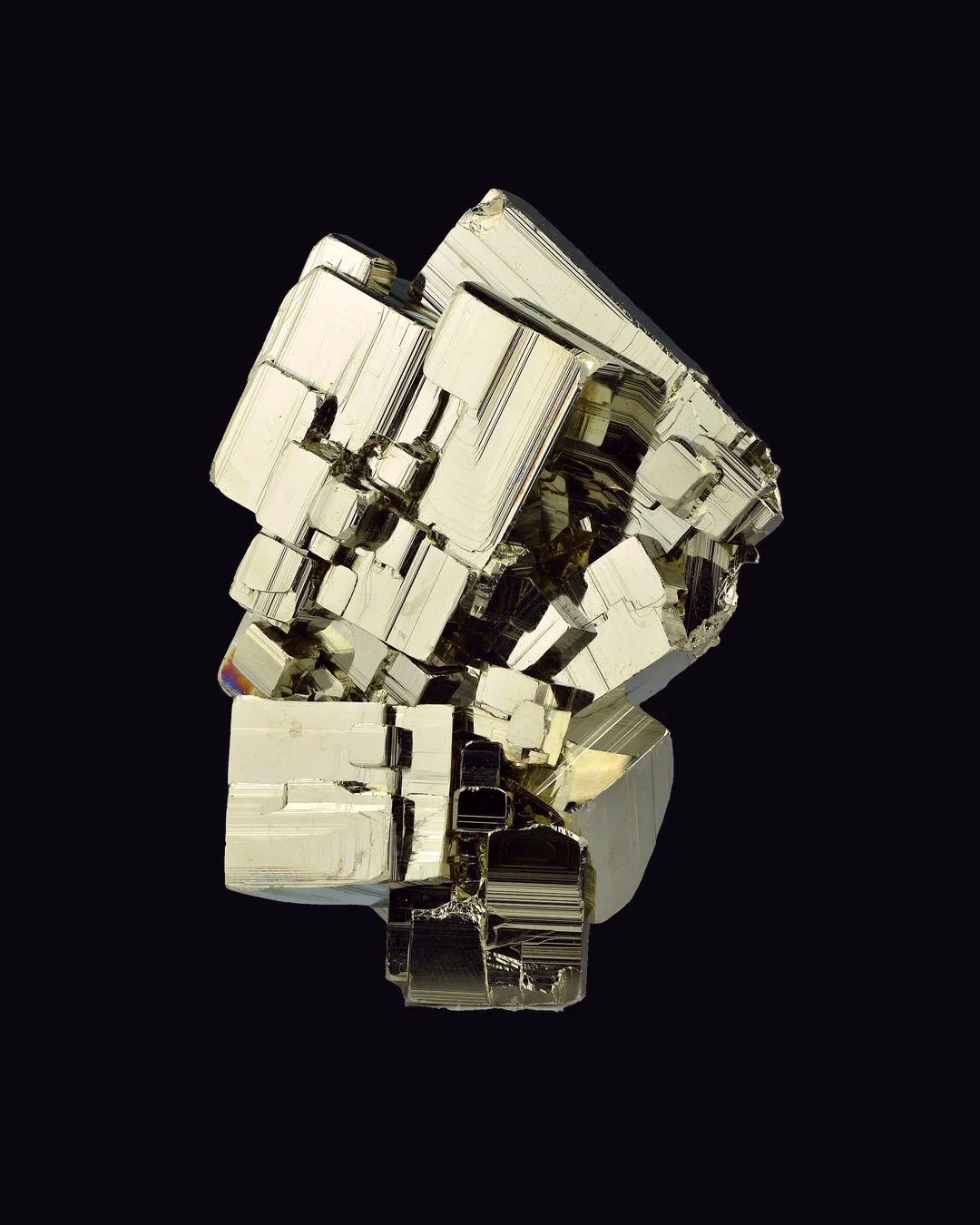
Pyrite
Pyrite
Pyrite is iron and sulphur. The name comes from the Greek word for fire, because struck against steel it throws a spark. It is not gold and never was. Gold is soft and dents. Pyrite shatters, and it leaves a greenish black mark where gold leaves gold. Here is the part the shop leaves out. In damp air it slowly turns, making acid and white crust, and a good cube can crumble in a few years. So keep it dry and out of the bathroom. Never soak it, never salt it, and never put it in water you plan to drink. A silica gel packet in the drawer is enough. You have been called the cheap version of somebody. Fool's gold, a joke made once that stuck. It still throws sparks. Gold never has.
People carry it for abundance, protection and courage. Tradition attaches it to the element fire, the solar-plexus, root chakra, Mars. It is most often given to Leo, Aries, Taurus. It measures 6-6.5 on the Mohs scale.
Seen · you don't have this one yet
Common·Uncommon·Rare·Arcane
This one does not go in water. It dissolves.
What it is confused with
Gold, chalcopyrite, marcasite, goldstone, brass
It gets confused with gold and with chalcopyrite. Pyrite is bright metallic brass-yellow with a slightly greenish or pale cast. It forms razor-sharp cubes with fine parallel striations on each face, and the striations on neighbouring faces run at right angles to each other, which is diagnostic. It also turns up as twelve-sided pyritohedrons and as flat radiating sun discs. It is brittle, so a struck piece shatters into angular fragments instead of bending. Its streak on unglazed tile is greenish-black to brownish-black. Old specimens may carry a white powdery bloom or rust from oxidation.
How to tell
Press a pin into it. Gold is soft and malleable, so it dents and smears. Pyrite is hard, 6 to 6.5 on the Mohs scale, and it shatters instead. Now rub it on unglazed tile. Pyrite leaves a greenish-black streak, gold leaves a gold one. Chalcopyrite is the other lookalike, softer at 3.5 to 4, a deeper brass-gold, and often iridescent purple-blue. Pyrite will also strike a spark on steel.
The full mineral facts
Hardness, formula, and how the rock is put together.
Hardness
6-6.5 Mohs
Formula
FeS2
Family
sulphide
How it forms
Iron and sulphur locked together where there was no oxygen, either in hot fluids moving through rock or in dark seabed mud, and grew into cubes.
Where it comes from
Spain (Navajún, the famous cubes), Peru, Italy (Elba), USA (Illinois, pyrite suns), China, Bolivia
What it means
The moon is in Gemini today, so this is the Gemini read.
Nobody in your life has ever had the unpolished one.
Pick it up. It is heavier than it looks, the faces are flat and square, and the yellow is more brass than gold.
Drag it across something rough and the mark it leaves is greenish black. Gold leaves gold. That is the whole test.
Gemini, somebody called you a fake once and they were wrong, and it has been eating at you since.
There was a lot of noise in that house and only so many turns, so you learned early to be quick and interesting. It got you your place at the table.
Now you have a good version of everything, including the parts that hurt. Nobody in your life has ever had the unpolished one. You are not being dishonest, you are just very well practised.
Leave the next true thing plain.
That is today's sky, not your chart. Add your birth details and this stone gets read against your own.
Read it for my chart →You know what this one would do for you. You just don't have it.
Pyrite for every sign
AriesNow you measure yourself by how brightly a thing begins.
Iron and sulphur locked together in the dark where there was no oxygen, in hot fluids or in seabed mud, and grew into cubes with square corners.
Nothing shaped those cubes. That is simply what iron and sulphur do when they are left alone long enough.
Aries, the thing you have not said is sitting somewhere damp and going bad.
Somebody called you a spark early on. It was meant as praise, so you took it and built the rest of yourself on it.
Now you measure yourself by how brightly a thing begins. The long unglamorous middle feels like proof you were only ever the flash, and you have walked away from good work at exactly that point.
Its name comes from the Greek for fire. Struck on steel it still throws one.
TaurusYou believed somebody once in front of an audience.
Somebody named it fool's gold, and the name stuck harder than the mineral ever did. Prospectors threw it away by the bucket.
It was never pretending to be anything. The people looking at it were wrong, and the joke got attached to the rock instead of to them.
Taurus, you stopped trusting anything shiny and cheap, and there is a reason under that.
You believed somebody once in front of an audience. When it fell over, the story that got told was about how you had been taken in, not about what they did.
That is the part you still carry. Not the loss, the version other people repeated. You have been careful ever since, and it has cost you some good things too.
The rock did not lie. Somebody else made that mistake.
GeminiNobody in your life has ever had the unpolished one.
Pick it up. It is heavier than it looks, the faces are flat and square, and the yellow is more brass than gold.
Drag it across something rough and the mark it leaves is greenish black. Gold leaves gold. That is the whole test.
Gemini, somebody called you a fake once and they were wrong, and it has been eating at you since.
There was a lot of noise in that house and only so many turns, so you learned early to be quick and interesting. It got you your place at the table.
Now you have a good version of everything, including the parts that hurt. Nobody in your life has ever had the unpolished one. You are not being dishonest, you are just very well practised.
Leave the next true thing plain.
CancerIt is the ordinary damp of a hard year doing the work on you.
It is not gold and it never was. Gold is soft and dents under a fingernail. Pyrite is hard and it shatters.
It is not permanent either. In damp air it slowly turns, making acid and white crust, and a good cube can crumble in a few years.
Cancer, you look sturdy and you do not dent, and that is exactly why nobody sees the crack coming.
It is not the disasters that get you. It is the same low worry at four in the morning, the one nobody thinks to ask about because from outside nothing is happening.
You handled the funeral. You handled the move. It is the ordinary damp of a hard year doing the work on you.
What has been quietly damp around you for two years?
LeoNobody has asked how the room is for you in a long time.
Damp air is what kills it. The sulphide oxidises, sulphuric acid forms, white crust appears, and a solid cube can fall apart in a few years.
So keep it dry, out of the bathroom, never soaked and never salted, and never in water anybody is going to drink. A silica gel packet in the drawer is enough.
Leo, it is not one bad night, it is the damp low-grade version of your life going on too long.
You learned that arriving bright kept things easy for everybody, so you kept arriving bright, and then it became the thing people expect on sight.
Nobody has asked how the room is for you in a long time. There is somebody you keep being fine around who would be genuinely shocked by the answer.
Dry air. That is the whole ask.
VirgoThat is why nobody ever came and told you it was not your job.
It grew where there was no oxygen at all, in hot fluids in rock or deep in dark seabed mud. Cube after cube, square corners, no help from anybody.
Then it got dug up and put in a room with air and water in it. That is where its problems started.
Virgo, the worry you have been keeping in a damp drawer is eating the drawer.
Something in your childhood could not be repaired, and you were a child, so you found the parts that could be done correctly and did those instead.
It worked well enough that nobody worried about you. That is why nobody ever came and told you it was not your job. You are still doing it at midnight.
The drawer was not the problem.
LibraNow somebody asks a small question and you find their preference before your own.
Its whole reputation was assigned by disappointed people. They wanted gold, they found this instead, and they named it after their own mistake.
Fool's gold is not a description of the mineral. It is a description of the person holding it.
Libra, somebody else's disappointment got attached to you young and you have been apologising since.
Somewhere back there one person's mood set the temperature for the whole house, and you got very good at giving the answer that kept it level.
That skill followed you into every room since. Now somebody asks a small question and you find their preference before your own. It takes less than a second.
Answer the next one before you look up.
ScorpioYou are still waiting for the day they do.
Strike it on steel in a dark room. It throws a spark, which is where the name came from, out of the Greek word for fire.
That is not decoration. It is what iron and sulphur do under a hard enough hit.
Scorpio, somebody decided early that you were the imitation, and you have been proving otherwise since.
You were young, and it came from someone whose opinion set the weather, so you filed it as a fact about you rather than a limit in them.
Since then you have sent in a smaller version first and kept the rest back. The handful of people who ever got the full thing did not go anywhere. You are still waiting for the day they do.
It throws sparks. That was never the problem.
SagittariusCare came to you shaped like a fence, and you learned to climb.
This is iron and sulphur. Not a precious metal, not a rare find, just two very common things locked together in a cube.
It is also unstable. Left in damp air it makes its own acid and eats itself, which is not superstition, it is a chemical process with a name.
Sagittarius, you have been mistaken for the cheap version so often that you stopped correcting anybody.
Somebody spent your childhood listing what could go wrong before you had asked. Care came to you shaped like a fence, and you learned to climb.
You have gone anyway nearly every time, and two or three of those cost you people. This particular warning is not a fence. It is a fact about a rock in a steamy bathroom.
Some things really do just need a dry drawer.
CapricornYou have never given yourself credit for a Tuesday where you got up and were decent.
It survives being buried without oxygen for an age. What it cannot survive is a humid shelf, because the sulphide turns, acid forms and the cube crumbles.
The enormous conditions were never the danger. It is ordinary damp air, over years, that takes it apart.
Capricorn, it is not the crisis that gets you, it is the damp ordinary Wednesdays stacking up.
If a day produced nothing you can point at, you file it under wasted. The rest days go there. So do the months you were only just managing.
You have never given yourself credit for a Tuesday where you got up and were decent. That is the work that has actually been holding the whole thing up.
The damp is what does it. Not the big years.
AquariusNow you say the odd thing first so nobody else gets to.
Iron and sulphur found each other where there was no oxygen and grew into cubes with square corners. Navajun in Spain produces them so sharp that people assume somebody cut them.
Nobody cut them. That is simply the shape those two elements make when nothing interrupts.
Aquarius, people assume somebody made you this sharp on purpose, and you have never told them how alone that was.
You were the strange one in that house, and somebody made a running joke of it that everybody joined in with. You laughed too, because laughing was cheaper.
Now you say the odd thing first so nobody else gets to. It looks like nerve from outside. It started as a flinch.
You did not write that joke. You just kept telling it.
PiscesYou have a whole practice of shrinking after a real reaction.
Somebody looked at this and decided it was a cheap version of something better. That name has been on it for a very long time and it is still on the label today.
The mineral did nothing to earn it. Its name in every shop is a record of what other people wanted it to be.
Pisces, you have been called the cheap version of something you were never trying to be.
You were the child who felt things at full volume, and somebody in that house said it was too much, and you believed them because they were the adult.
So now you register everything and apologise for it in about four seconds. You have a whole practice of shrinking after a real reaction. It is so quick now that you do not notice.
Who was in the room the first time you went quiet?
Correspondences
What tradition attaches to this stone. Folklore, not chemistry.
Element
fire
Planet
Mars
Chakra
solar-plexus, root
Signs
leo, aries, taurus
What tradition says
In crystal lore, pyrite is kept for money, for willpower and for defending your own interests. The modern money attribution comes straightforwardly from how much it looks like gold.
Care
- Do not put this one in water. It dissolves or spalls. Dust it dry.
- Salt scratches it. Do not bury it in salt.
- Pyrite disease is real. Damp air oxidises the sulphide, which makes acid, then white crusts, and eventually the piece crumbles. Keep it dry. Keep it out of the bathroom. Never soak it and never salt it. Store it with a silica gel packet if you live somewhere humid.
Pyrite is an iron sulphide. It is not acutely toxic to handle. As it oxidises, though, it produces sulphuric acid and iron sulphates. Never put it in drinking water. Never make an elixir with it. The acid and sulphate production is a real chemical process, not a superstition. Wash your hands after handling decaying specimens.
Common questions
What does pyrite mean?
Pyrite is carried for abundance, protection and courage. Pyrite is iron and sulphur. Tradition links it to the solar-plexus, root chakra.
Is pyrite real or fake?
Pyrite is not faked often, but it is still worth checking. Press a pin into it. Gold is soft and malleable, so it dents and smears.
Can pyrite go in water?
No. Pyrite dissolves or spalls in water. Dust it dry instead of soaking it, and keep it out of salt.
Common · pale brass yellow, greenish brass, iridescent tarnish
Where this leads
This stone belongs to
Related crystals
FOR ENTERTAINMENT AND REFLECTION. NOT MEDICAL, PSYCHOLOGICAL, FINANCIAL OR LEGAL ADVICE. How this works