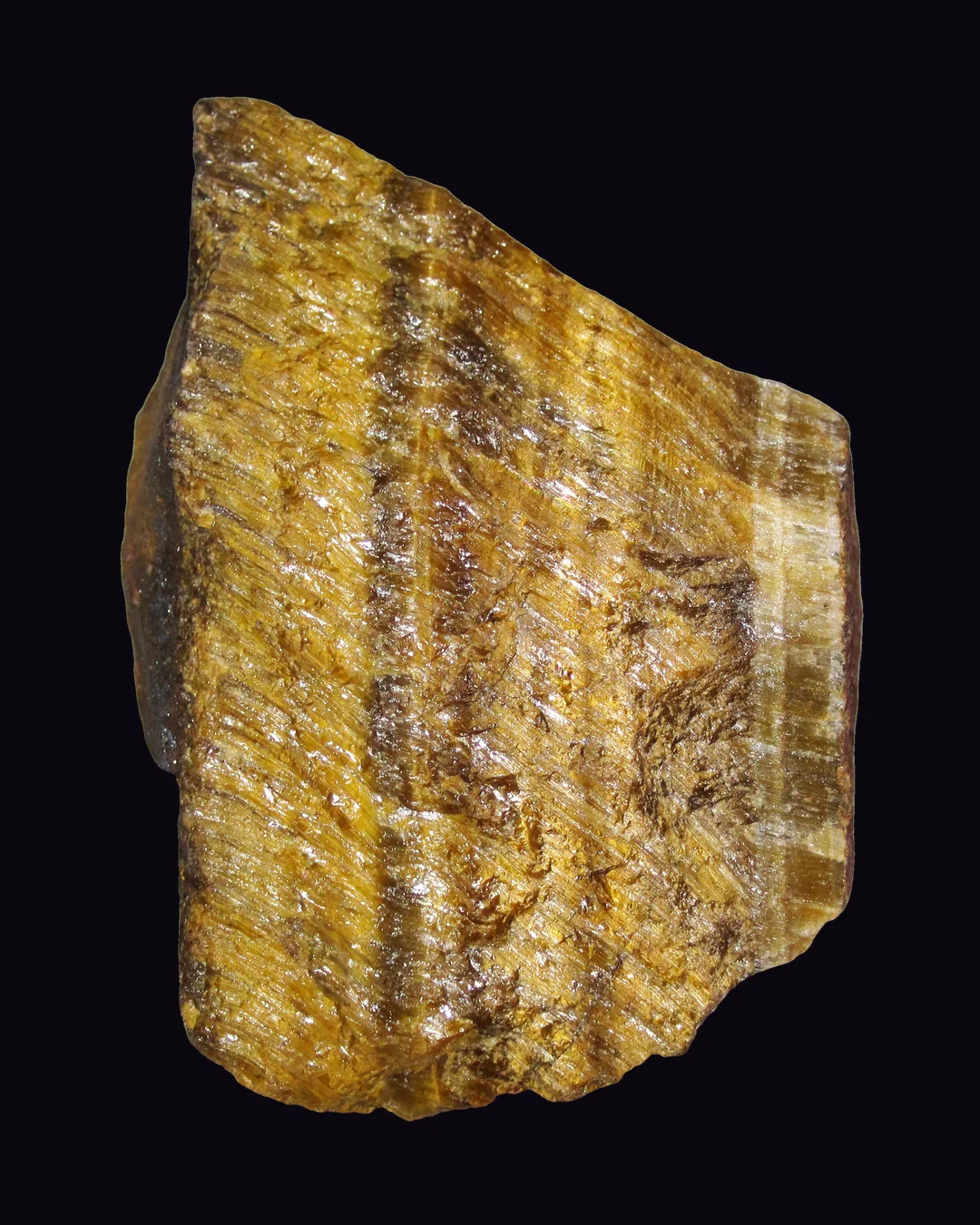
Tiger's Eye
Quartz pseudomorph after crocidolite
This used to be asbestos. Blue crocidolite fibres grew in the rock first, and quartz replaced them one by one. The silk you can see is the shape of those fibres, held in place. Polished, it is safe to hold. Do not sand it, grind it or drill it dry. That is the only real hazard. Red tiger's eye is the golden kind after an oven. Bleached pale ones went through acid. You are the one who watches the room. You clocked the mood at the door before anyone spoke, and you were right. That is not a gift. It is a skill a child builds in a house where the mood could turn. You are allowed to stop scanning in your own kitchen.
People carry it for courage, protection and clarity. Tradition attaches it to the element fire, the solar-plexus, root chakra, Sun. It is most often given to Leo, Capricorn, Gemini. It measures 6.5-7 on the Mohs scale.
Seen · you don't have this one yet
Common·Uncommon·Rare·Arcane
Red tiger's eye is heated. Pale honey tiger's eye is acid-bleached. Blue and green and purple tiger's eye is dyed. All of it is still tiger's eye, just coloured by a person rather than by the ground.
What it is confused with
Pietersite, hawks eye, cats eye quartz, fibre optic glass, bronzite
One band of silky light sweeps across the stone in a single direction as you tilt it. That effect is chatoyancy, and it comes from parallel fibres of altered asbestos that have been replaced by silica. Because the fibres all run the same way, the sheen is one rolling stripe rather than a scattered shimmer. The colour is golden brown to honey with darker brown fibre bands. Thin edges look fibrous and silky rather than glassy. Red material has been heated. Blue-grey material, called hawk's eye, is less oxidised.
Commonly faked · check before you buy
How to tell
Use the single-direction rule. Tilt the stone and watch the silky sheen. If it runs in more than one direction across one stone, with fibre bundles pointing different ways in patches next to each other, you are holding pietersite and not tiger's eye. Fibre-optic glass gives itself away with a perfectly regular grid of fibres and often a mirror-flat cut end. Real tiger's eye scratches glass.
Red tiger's eye is golden material that has been heat-treated. Honey or pale tiger's eye has been bleached with acid. Dyed blue and green and purple tiger's eye is common, and it reads as unnaturally saturated. These are permanent and they are ordinary trade practice rather than fraud, as long as the seller says so.
The full mineral facts
Hardness, formula, and how the rock is put together.
Hardness
6.5-7 Mohs
Formula
SiO2 replacing Na2Fe5Si8O22(OH)2
Family
quartz
How it forms
Tiger's eye began as crocidolite, a fibrous blue asbestos mineral, and quartz replaced it fibre by fibre while keeping the silky lines exactly where they were.
Where it comes from
South Africa (Northern Cape, Griqualand West), Australia (Western Australia), Namibia, India, Brazil
What it means
The moon is in Sagittarius today, so this is the Sagittarius read.
Somebody said careful to you in a tone that meant do not bother.
This was asbestos. Blue crocidolite fibres grew here first, and quartz replaced them one at a time without moving a single line.
That sounds alarming and mostly is not. Polished, it is inert and safe to hold. The only real rule is that you never sand, grind or drill it dry.
Sagittarius, you swapped out the dangerous material and kept the exact same shape, and you wonder why it still aches.
Somebody said careful to you in a tone that meant do not bother. You went the other way at fifteen and you have not been back to check since.
The cost is that you can no longer tell whether you want a thing or just want to be the one who did it.
Some rules are only dust and lungs.
That is today's sky, not your chart. Add your birth details and this stone gets read against your own.
Read it for my chart →You know what this one would do for you. You just don't have it.
Tiger's Eye for every sign
AriesSomewhere back there you got clapped for being fast and never once for being still.
Tilt it slowly and one band of light slides across the surface in a single direction. That silk is the shape of old fibres, held exactly where they grew.
They were crocidolite, which is blue asbestos. Quartz replaced them one by one, so polished it is safe in your hand. Just never sand it, grind it or drill it dry.
Aries, you kept the exact shape of the fight and swapped out what it was actually about.
Somewhere back there you got clapped for being fast and never once for being still. So the middle of anything now feels like being ignored.
You keep leaving good things at week three, because nobody is watching at week three.
Stay for one dull week. See what the light does.
TaurusYou handed over money and belief at the same time.
What this actually is, is asbestos that got replaced. Crocidolite fibres grew in the rock first and quartz took their place, one fibre at a time, keeping every line where it was.
Polished, it is safe to hold. Do not sand it, grind it or drill it dry, and that really is the only hazard on it.
Taurus, you can smell a thing that is too shiny for its price, and you paid to learn that.
Somebody sold you a story once. You handed over money and belief at the same time. Only one of those came back.
You still feel the heat of it in a shop doorway years later, reading a label you have already read twice.
Careful is not the same as small.
GeminiBy the end of the night you cannot find the actual thought under any of it.
Red tiger's eye is the golden kind after an oven. The pale honey ones went through acid, and the loud blue and green ones were dyed.
Underneath the treatments it is quartz standing where crocidolite, a blue asbestos, used to be. Safe once polished. Never sand, grind or drill it dry.
Gemini, you replaced the dangerous thing with a safer one and kept the exact same pattern.
Plain sounds like admitting you are ordinary, and somebody made you feel ordinary once, in front of people who laughed.
So you talk in decorations. By the end of the night you cannot find the actual thought under any of it.
Say the plain one first tomorrow.
CancerYou held a mood level for an adult who could not hold their own.
First there were crocidolite fibres, growing through the rock in fine blue threads. Then silica came in and swapped itself for them, one thread at a time, over an unhurried stretch of geological time.
Crocidolite is blue asbestos. Finished and polished the stone is inert and safe to handle, and the only rule is that you never sand, grind or drill it dry.
Cancer, somebody replaced you thread by thread with the person they needed, and you helped them do it.
You held a mood level for an adult who could not hold their own. You were far too young to have been given that job.
Being needed and being loved arrived together in that house, and you have never managed to tell them apart since.
Somebody would stay through a bad night with you.
You have not tested that in years.
LeoSomebody's approval used to come and go without warning when you were small.
It is hard and it is stable. Water will not hurt it and the sun will not fade it, which makes it one of the tougher things in a collection.
The only real hazard is dust. Its parent mineral was crocidolite, blue asbestos, so never sand, grind or drill the raw material dry.
Leo, you are the reliable one in every group and not one of them has checked on you.
Somebody's approval used to come and go without warning when you were small. So you learned to earn it fresh every single time you walked into a room.
There is the one who walks in and the one who sits on the kitchen floor afterwards, and only one of them gets asked how they are.
When did you last ask the other one?
VirgoYou have been tidying ahead of the next one ever since.
Hold it under a lamp and turn it. The band of silk moves in one direction only, because every fibre inside points the same way.
Those fibres were crocidolite, a blue asbestos, until quartz replaced them. The polished stone is safe to carry. The only rule is never to sand, grind or drill it dry.
Virgo, you took the dangerous thing out of yourself one fibre at a time and nobody watching noticed a single one.
The cupboard gets emptied at half eleven at night because the real problem has no handle on it anywhere.
Somebody in that house fell apart on a schedule and you were the one who tidied up afterwards. You have been tidying ahead of the next one ever since.
Put the cloth down.
Whatever you are avoiding will keep.
LibraYou learned to read their face before you learned to read your own.
The blue fibres came first. Quartz worked through them slowly, taking each one's place and leaving the silk lines exactly where they had grown.
Those fibres were crocidolite, blue asbestos, which is why you never sand, grind or drill this stone dry. Polished and finished, it is safe to carry every day.
Libra, somebody replaced your opinions with theirs one at a time and left the lines exactly where they were.
One person at home used to set the weather for everybody. You learned to read their face before you learned to read your own.
Now somebody asks you a simple question and you feel the whole room's reaction before you feel your own opinion.
Your opinion is in there. It is standing behind everybody else's.
ScorpioYou went quiet in a way people mistook for calm.
Somebody heats the golden ones to get red. Somebody else runs the pale ones through acid, and the loud blue and purple stones are dyed.
Underneath all of that it is quartz standing exactly where crocidolite, a blue asbestos, used to be. Safe once polished. Never sand, grind or drill it dry.
Scorpio, the thing in you people were frightened of got replaced years ago and nobody noticed.
Nobody shouted it. It came wrapped in concern, which is why there was nothing there to argue with.
You went quiet in a way people mistook for calm. Now every real reaction goes past a checkpoint before it is allowed out of your mouth.
The checkpoint was somebody else's idea.
SagittariusSomebody said careful to you in a tone that meant do not bother.
This was asbestos. Blue crocidolite fibres grew here first, and quartz replaced them one at a time without moving a single line.
That sounds alarming and mostly is not. Polished, it is inert and safe to hold. The only real rule is that you never sand, grind or drill it dry.
Sagittarius, you swapped out the dangerous material and kept the exact same shape, and you wonder why it still aches.
Somebody said careful to you in a tone that meant do not bother. You went the other way at fifteen and you have not been back to check since.
The cost is that you can no longer tell whether you want a thing or just want to be the one who did it.
Some rules are only dust and lungs.
CapricornThe winter you kept somebody else alive is in that pile.
Water will not touch it. The sun will not fade it. It sits in a pocket for twenty years and comes out looking the same as it went in.
The only thing that makes it dangerous is a power tool. Its parent mineral was crocidolite, blue asbestos, so never sand, grind or drill it dry.
Capricorn, the only thing that can harm you is being taken apart, and you keep doing it to yourself.
There is a whole decade in there filed as nothing, because nothing came out of it that could be shown to anybody.
The winter you kept somebody else alive is in that pile. So is the year you were ill.
Put those two back on the ledger before you sleep tonight.
AquariusYou learned to study people instead of trusting them.
Fine blue threads grew through the rock first. Silica came along after and took their place, thread for thread, keeping the pattern intact while changing everything it was made of.
Those threads were crocidolite, blue asbestos. The finished stone is safe in your hand, and the only rule is never to sand, grind or drill it dry.
Aquarius, you have changed absolutely everything about your life and kept the exact shape of it.
Somebody at home was unpredictable. You learned to study people instead of trusting them. Studying works, and it has never once got you held.
People call it detachment. It is a chair you chose at twelve and never got up from.
Who in that room has been waiting for you?
PiscesYou could feel somebody's mood coming up the stairs before you heard the words.
Turn it in your palm at the window and the light rolls across in one clean band. Every thread inside points the same way, which is why the silk only moves in one direction.
Those threads were crocidolite, a blue asbestos, before quartz took their place. Polished it is safe. Never sand, grind or drill it dry.
Pisces, the dangerous thing you were made of got replaced one fibre at a time, quietly.
You could feel somebody's mood coming up the stairs before you heard the words. In that house it was a useful skill, so nobody ever suggested you switch it off.
Now a stranger on the bus can set the tone of your whole evening, and you call that being sensitive.
It was a job. Nobody has told you it is finished.
Correspondences
What tradition attaches to this stone. Folklore, not chemistry.
Element
fire
Planet
Sun
Chakra
solar-plexus, root
Signs
leo, capricorn, gemini
What tradition says
In crystal lore, tiger's eye is kept for watchfulness, for nerve and for telling one thing from another. Roman soldiers are traditionally said to have carried it engraved into battle.
Care
- Water is fine. Dry it afterwards.
- Do not sand or grind or drill it dry. That is the only real hazard with this stone. Otherwise it is hard and stable in water. Warm water and a cloth for cleaning.
The parent mineral is crocidolite, which is blue asbestos. In finished tiger's eye it has been fully replaced by silica and the fibres are silicified. Polished stones present no asbestos hazard. Do not dry-grind raw material and do not cut it without dust control.
Common questions
What does tiger's eye mean?
Tiger's Eye is carried for courage, protection and clarity. This used to be asbestos. Tradition links it to the solar-plexus, root chakra.
Is tiger's eye real or fake?
Red tiger's eye is heated. Pale honey tiger's eye is acid-bleached. Use the single-direction rule. Tilt the stone and watch the silky sheen. Red tiger's eye is golden material that has been heat-treated.
Can tiger's eye go in water?
A short rinse is fine for tiger's eye, then dry it.
Common · golden brown, honey, red-brown (heated), blue-grey (hawk's eye)
Where this leads
This stone belongs to
Related crystals
FOR ENTERTAINMENT AND REFLECTION. NOT MEDICAL, PSYCHOLOGICAL, FINANCIAL OR LEGAL ADVICE. How this works