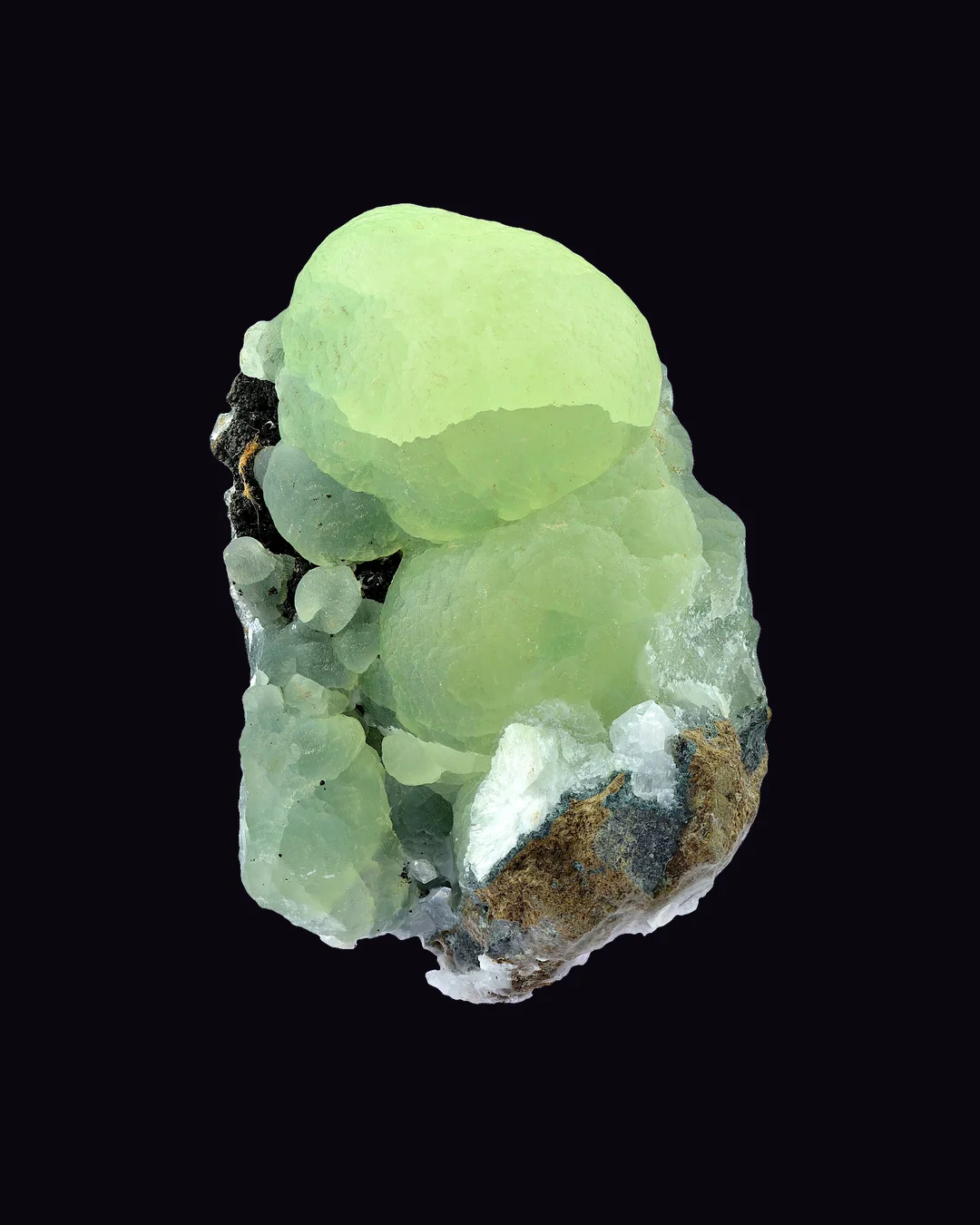
Prehnite
Prehnite
Hold it up to a lamp. The green is cloudy rather than clear, and inside it fine fibres run outward from a centre. It grew in gas bubbles inside cooled lava. Hot water carried the minerals into the empty pockets and left rounded green crusts behind. The black needles crossing it are epidote, a mineral that grew in the same space at the same time. They are not flaws and not damage. It chips along those rounded domes, so keep it out of a pocket with your keys. You call yourself hard to read. You are not. You are somebody who fills whatever room she is put in and takes the shape of it, and then gets blamed for having no edges. The fibres all point the same way. So do you.
People carry it for calm, intuition and self-love. Tradition attaches it to the element earth, the heart, solar-plexus chakra, Venus. It is most often given to Libra, Virgo, Pisces. It measures 6-6.5 on the Mohs scale.
Seen · you don't have this one yet
Common·Uncommon·Rare·Arcane
What it is confused with
Jadeite jade, serpentine, chrysoprase, green opal, grossular garnet, green fluorite
It gets confused with serpentine and with pale jade. Prehnite is translucent pale yellow-green with a soft, slightly cloudy look, like set olive oil or a green grape. It grows as bubbled crusts and rounded globular masses covered in low domes, a habit called botryoidal. Broken across, those show a fibrous structure fanning out from the base. Dark green to black needles of epidote very often pierce through it, which is close to diagnostic. The shine runs glassy to waxy, and it is hard enough to resist a knife.
How to tell
Look for the bubbled surface, low domes over rounded masses, a habit called botryoidal. Look into a broken one and the fibres fan out from the base. Dark green to black epidote needles running through it seal the identification. Now try a knife. Prehnite is 6 to 6.5 on the Mohs scale, so the knife leaves no mark, where serpentine at 3 to 5 cuts easily. Its cloudiness sits inside the stone rather than on a glassy surface.
The full mineral facts
Hardness, formula, and how the rock is put together.
Hardness
6-6.5 Mohs
Formula
Ca2Al(AlSi3O10)(OH)2
Family
silicate
How it forms
It grew inside gas bubbles and cracks in cooled lava, where hot mineral-rich water filled the empty pockets and left rounded green crusts on the walls.
Where it comes from
Australia (Wave Hill, Northern Territory), Mali, South Africa (Cape, type locality), China (Fujian), USA (New Jersey, Michigan), Scotland
What it means
The moon is in Gemini today, so this is the Gemini read.
Nobody comes out of it knowing one true thing about your month.
It is hard enough for daily wear but brittle. Those rounded domes chip if you knock them, so it should never live in a pocket with your keys.
The damage does not come from wear. It comes from one careless second.
Gemini, you line the empty space with something pleasant so nobody notices it is empty.
There was a lot of talking in that house and not much listening, so you learned to be quick and funny to get a turn. It worked, and it kept working, and nobody noticed the cost.
Now you can hold a room for an hour. Nobody comes out of it knowing one true thing about your month. You did that, and you are the only one who can stop it.
Say one plain sentence and do not follow it with a joke.
That is today's sky, not your chart. Add your birth details and this stone gets read against your own.
Read it for my chart →You know what this one would do for you. You just don't have it.
Prehnite for every sign
AriesYou quit at the exact point where the thing stops being exciting and starts being yours.
Hold it up to a lamp. The green is cloudy rather than clear, and inside it fine fibres run outward from one centre like a spray.
It grew in a gas bubble inside cooled lava. Hot water found the empty pocket and left a rounded green crust on the walls of it.
Aries, you rush into every empty space and call the rushing being helpful.
Somebody in your family treated your enthusiasm like weather. They loved it when it was on and went quiet when it dropped.
So now the second week of anything feels like you have let somebody down. You quit at the exact point where the thing stops being exciting and starts being yours.
It filled the space it was given. That took no audience at all.
TaurusIt was standing there working out how long they had known.
It is not jade. It is prehnite, softer and cloudier than jade, and a knife will not mark it, which is how you tell it from serpentine.
Shops still put it in the jade tray. Jade is a nicer word and it moves faster.
Taurus, you stopped trusting anything shiny and cheap, and there is a specific reason.
Somebody once told you a price that was not the price. You found out afterwards, in front of other people, and the worst part was not the money.
It was standing there working out how long they had known. You have been checking everything since and calling it being careful.
Ask what it actually is. The right answer is prehnite.
GeminiNobody comes out of it knowing one true thing about your month.
It is hard enough for daily wear but brittle. Those rounded domes chip if you knock them, so it should never live in a pocket with your keys.
The damage does not come from wear. It comes from one careless second.
Gemini, you line the empty space with something pleasant so nobody notices it is empty.
There was a lot of talking in that house and not much listening, so you learned to be quick and funny to get a turn. It worked, and it kept working, and nobody noticed the cost.
Now you can hold a room for an hour. Nobody comes out of it knowing one true thing about your month. You did that, and you are the only one who can stop it.
Say one plain sentence and do not follow it with a joke.
CancerIt looked like a house that ran itself and you were the reason it did.
There was a bubble of gas trapped in cooling lava, and then nothing for a very long time. Eventually hot water carrying minerals found the empty pocket and began leaving green on the inside walls.
It did not build outward into the world. It grew inward, filling something that was already hollow.
Cancer, you waited a very long time in an empty stretch and you learned to call the waiting normal.
You were the one who kept a household running while nobody said the word out loud. Meals, birthdays, who needed a phone call, all of it carried in your head with no list.
Nobody thanked you because nobody knew it was work. It looked like a house that ran itself and you were the reason it did.
It was not a house that ran itself.
LeoYou have been quietly fine about it for years.
It is named after a colonial officer who shipped the first specimens back to Europe. The stone had been sitting in that ground the whole time.
Nothing was done to it and nothing needed to be. It only needed somebody to arrive and put a name on it.
Leo, somebody else got named for a thing you had already been doing quietly for years.
Somebody took the credit for something of yours once, early on, and you said nothing because saying something would have made a scene.
You have been quietly fine about it for years. You are not fine about it. It comes back at odd hours and you tell yourself it was a long time ago.
It was still yours.
VirgoNobody ever told you the rest was never yours to fix.
Look for the black needles crossing the green. That is epidote, a different mineral that grew in the same pocket at the same time.
They are not flaws and they are not damage. A dealer who calls them a defect is either wrong or hoping that you are.
Virgo, you fill other people's empty spaces and call it being useful.
You grew up next to something you could not repair. A person, an illness, a mood in a house, and you were a child with no way to change any of it.
So you got very good at the parts that could be done right. The homework. The kitchen.
Nobody ever told you the rest was never yours to fix.
The needles stay in. They were always part of it.
LibraIt just never got asked for often enough to develop a voice.
It has no edges of its own. It grew as a crust on the inside of a hollow, so its shape is a cast of whatever room it was given.
The domes on the surface are only where the growth ran out. There was never a plan for what it should look like.
Libra, you take the shape of whatever room you are put in, and you have forgotten you had edges.
You were the easy one. That was a job, and it got handed to you before you could refuse it, because somebody else in that house needed all the room.
Now you genuinely cannot find your own preference in company. It is not missing. It just never got asked for often enough to develop a voice.
Order what you want. Do not read the table first.
ScorpioYou still keep the smaller one warmed up, just in case.
Water will not hurt it. An ultrasonic tank will, if the piece already has a crack in it, because the machine finds what is fractured and opens it further.
That is the honest instruction. What is whole is fine. What is already cracked stays out of the machine.
Scorpio, you grew into the empty space somebody left and you called that being wanted.
It came at the worst possible age, from someone you would have done anything for, and you took it as the terms of staying.
So you learned to hand people a version they could hold. The few who ever got past it did not flinch. You still keep the smaller one warmed up, just in case.
You do not have to run it tonight.
SagittariusNobody ever showed you what patience looks like when it is not fear.
The lava cooled and left bubbles behind in it. Those pockets sat empty for an age before hot water came through and started filling them.
Nothing about that was quick. There was no version of it that arrived sooner.
Sagittarius, you are very good at filling an empty room and terrible at sitting in one.
The adults around you kept a running list of everything that could go wrong and delivered it whether or not you had asked. Care turned up as a set of limits.
So the second anybody tells you to slow down you go quicker, and it has cost you a couple of things you would have back. Nobody ever showed you what patience looks like when it is not fear.
Some things only arrive slowly. That is not a punishment.
CapricornYou have run your whole life on results.
Nobody treats it. It is not dyed, not heated, not filled, and even the black needles in it are the real thing, grown in the same pocket.
It is also cheap. The honest ones usually are, because nothing about them can be made more impressive.
Capricorn, you are plain and honest about yourself and you decided that is why nobody looks twice.
If a day made nothing you can point at, it goes in the wasted pile. So does the year you spent flat, and the stretch where all you did was answer the phone at the right times.
You have run your whole life on results. That is what got noticed in the house you grew up in, and nothing else was ever counted.
Cheap and honest is not the same as worthless.
AquariusYou were the child who noticed the thing nobody said out loud.
Put it on a windowsill and look through it. The light does not go clean through. It comes out cloudy, and the fibres inside all fan out from the same point.
Every one of those fibres points away from a centre it started at. Nothing about the arrangement was decided by anybody.
Aquarius, everything you do now points away from one thing that happened, and you rarely name it.
You were the child who noticed the thing nobody said out loud. Then you got told you were making it up. You were not making it up.
So now you trust the pattern and not your own place in it. You can explain a whole group in one sentence and still have no idea whether they like you.
Ask one of them. Straight out.
PiscesNow you come out of a normal afternoon shaped like whoever you spent it with.
This is not jade and it is not opal. It is prehnite, a common mineral that grew as a green crust inside a hole in old lava.
Nothing rare happened to it. It simply filled the space it was put in, completely, right up to the walls.
Pisces, you grew into whatever empty space was left over, and you learned to call that being easy.
You give people the whole room when they arrive. Somebody taught you that keeping the peace was your contribution, probably before you were seven.
Now you come out of a normal afternoon shaped like whoever you spent it with. You call that being easy going. It costs more than that phrase suggests.
Do you know what you actually wanted from today?
Correspondences
What tradition attaches to this stone. Folklore, not chemistry.
Element
earth
Planet
Venus
Chakra
heart, solar-plexus
Signs
libra, virgo, pisces
What tradition says
In crystal lore, prehnite is called the stone of prophecy and is kept for dreaming, for foresight and for letting go of held tension. It is also popularly paired with epidote as the stone that heals the healer.
Care
- Water is fine. Dry it afterwards.
- It is reasonably hard and water does it no harm. It is brittle though, and the bubbled surfaces chip along the domes. Warm water and a soft cloth. Keep cracked pieces out of an ultrasonic cleaner.
Common questions
What does prehnite mean?
Prehnite is carried for calm, intuition and self-love. Hold it up to a lamp. Tradition links it to the heart, solar-plexus chakra.
Is prehnite real or fake?
Prehnite is not faked often, but it is still worth checking. Look for the bubbled surface, low domes over rounded masses, a habit called botryoidal. Look into a broken one and the fibres fan out from the base.
Can prehnite go in water?
A short rinse is fine for prehnite, then dry it.
Common · pale yellow-green, mint, lime, grey-green, colourless
Where this leads
This stone belongs to
Related crystals
FOR ENTERTAINMENT AND REFLECTION. NOT MEDICAL, PSYCHOLOGICAL, FINANCIAL OR LEGAL ADVICE. How this works