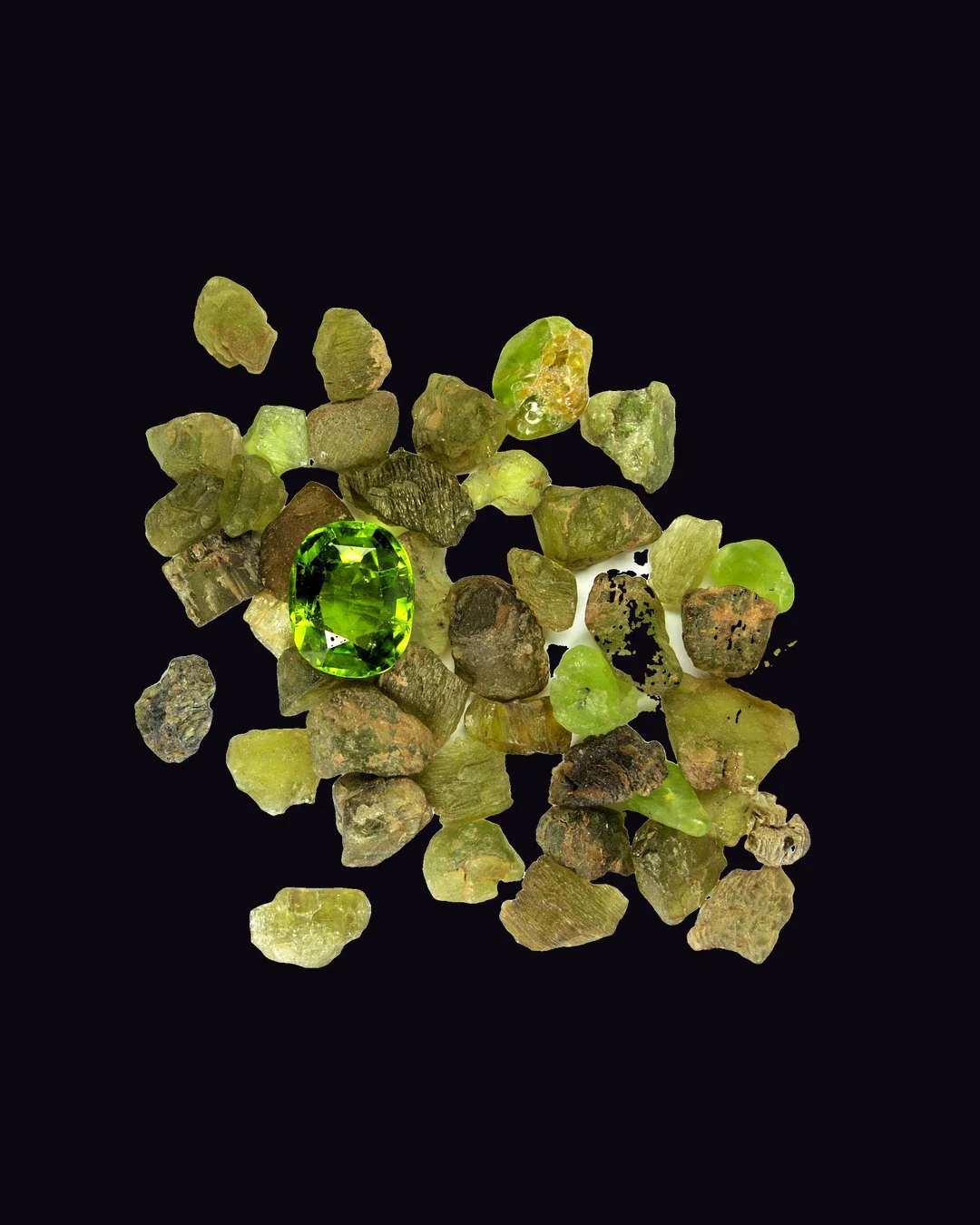
Peridot
Forsteritic olivine
Peridot is olivine. It is one of the main minerals of the mantle, the hot layer under the crust, and it rode up here inside magma. So the green is not decoration. It is the plain stuff most of the planet is built from, sitting on your finger. It comes in one colour and no other. Nobody dyes it and nobody needs to, which is rarer in this trade than the stone is. It cracks with sudden heat, so keep it out of steam. Warm soapy water and a cloth. Somebody once made you feel like the useful version of you was the boring one. You learned to put something on top before walking into a room. You were the common thing the whole world is made of. That was never the insult you took it for.
People carry it for abundance, self-love and protection. Tradition attaches it to the element fire, the heart, solar-plexus chakra, Sun. It is most often given to Leo, Virgo, Libra. It measures 6.5-7 on the Mohs scale.
Seen · you don't have this one yet
Common·Uncommon·Rare·Arcane
What it is confused with
Emerald, prasiolite, green glass, chrome diopside, moldavite, green tourmaline
It gets confused with moldavite and with emerald. Peridot is transparent yellow-green with an oily, greasy shine rather than a crisp glassy one. The tone always has yellow in it and never blue, which sets it apart from other green gems. Its double refraction is strong, so the back facet edges of a cut stone look visibly doubled. The typical inclusions are lily-pad-shaped discs of fracture around a tiny dark crystal, and those are close to unique to peridot. Raw grains are rounded and glassy and sit in dark basalt.
How to tell
Look for yellow-green with an oily shine rather than a crisp glassy one. Then look through a faceted stone at the back facet edges. On peridot they appear doubled. Under a 10x loupe, lily-pad inclusions confirm it. Moldavite is glass, so it shows no doubling and has a corroded surface. Emerald is a bluer green, and its inclusions form a jardin, a mossy garden, rather than lily pads.
Peridot is rarely treated. Heavily included material sometimes has its fractures filled. Otherwise what you see is generally what it is.
The full mineral facts
Hardness, formula, and how the rock is put together.
Hardness
6.5-7 Mohs
Formula
(Mg,Fe)2SiO4
Family
silicate
How it forms
It is olivine, one of the main minerals of the mantle beneath the crust, carried up toward the surface inside rising magma and left behind in the cooled rock.
Where it comes from
Egypt (Zabargad), USA (San Carlos, Arizona), Pakistan (Kohistan), Myanmar, China, Norway
What it means
The moon is in Sagittarius today, so this is the Sagittarius read.
Leaving just became the only move you fully trusted.
Some peridot did not come from this planet. It turns up inside pallasite meteorites, stone and iron that fell out of the sky.
The rest came up from the mantle inside magma. Neither route was gentle, and neither one was chosen.
Sagittarius, you came a very long way up from something, and you have never told anyone where you started.
Somebody spent your childhood telling you what would go wrong, in detail, before you had even asked. You learned to hear caution as a cage, and you have been walking out of rooms ever since.
It has cost you a couple of things you would like back. You were not reckless. Leaving just became the only move you fully trusted.
Not everything that asked you to stay was a cage.
That is today's sky, not your chart. Add your birth details and this stone gets read against your own.
Read it for my chart →You know what this one would do for you. You just don't have it.
Peridot for every sign
AriesQuiet reads as failure to you, so you start something else and call yourself restless.
Peridot is olivine, one of the main minerals of the mantle, the hot layer under the crust. It came up here inside rising magma and got left behind in the cooled rock.
Sudden heat cracks it now. The same force that carried it up is the thing that would ruin it.
Aries, you came up out of something hot and deep and you present it as a funny story.
Somebody clapped for you young. It was for a beginning, and you learned in one afternoon exactly what that sounded like.
Now you get four days into a thing and the room goes quiet. Quiet reads as failure to you, so you start something else and call yourself restless. Nobody else in your life is that hard on you.
The green survived the long part of the trip. Nobody watched that part either.
TaurusInside, you are a person who remembers being fooled.
People have sold green glass under this name for a long time. Glass will be any colour you pay for, and it costs almost nothing.
Peridot comes in one colour and no other. Nobody dyes it because nobody can, which in this trade is rarer than the stone.
Taurus, you stopped trusting anything shiny the day you found out what it actually was.
There was a thing somebody gave you, or sold you, and you believed in it out loud in front of people. Then you found out.
You did not cry about it. You just quietly took the belief back and put it somewhere you could keep an eye on it.
From outside it looks like caution. Inside, you are a person who remembers being fooled.
Hold it up to the lamp tonight. It cannot lie about its colour.
GeminiThe plain version feels like it will not hold anybody, so you never test it.
Look into it under a loupe and you find flat round inclusions the trade calls lily pads, and edges that seem to double. Both were left there while it cooled.
Nobody put them in for looks. They are the marks of the rock it grew inside, and they are how a dealer proves it is not glass.
Gemini, you came from somewhere much deeper than the conversation you are currently having.
It started as a way to keep a table interested. Somebody at home got bored easily, and you learned young to be the one who fixed that.
Now you cannot say a flat true sentence about your own week without decorating it. The plain version feels like it will not hold anybody, so you never test it.
Say one boring true thing tomorrow. Watch who stays.
CancerBeing the common useful one made you feel plain.
Peridot is not something the earth made specially. It is olivine, the ordinary material most of the planet under your feet is built from.
So the green on your hand is not a rarity. It is the common stuff, carried up to where somebody could finally look at it.
Cancer, you are the ordinary steady thing everybody's life is built on and nobody stops to name it.
You were the one who noticed things at home. You could read the mood in a car before anybody spoke, and you got good at it because you had to be.
Nobody thanked you for it, because the whole point was that it looked like nothing. Being the common useful one made you feel plain. You still flinch a little when somebody calls you kind.
Do you know how much of the world is made of the thing you keep apologising for?
LeoThere is a person you keep being fine around.
It cracks if the temperature jumps. Steam splits it, an ultrasonic tank splits it, and acid eats at the surface.
It came out of the mantle at a heat you cannot picture, and now a kettle could undo it. Warm soapy water and a soft cloth is the whole instruction.
Leo, it is not the heat that cracks you, it is how fast the room turns.
You worked out young that if you arrived warm, people relaxed. So you arrived warm. It became the job, and the job does not stop when the door shuts behind you.
There is a person you keep being fine around. You have never told them the true answer to how are you, and they would not know how to hear it now.
The stone that came through fire still goes in the plain soapy water.
VirgoYou have been paying that rent ever since.
Olivine sat in the mantle for longer than the crust has looked like this. It had no purpose down there. It was simply most of what was.
Then the rock melted and carried it up, and only then did anybody decide it was worth something.
Virgo, you came up from somewhere very deep and you talk about it like it was nothing.
The kitchen gets tidied at eleven at night. The spreadsheet gets colour coded. Meanwhile the conversation you have owed somebody since spring sits exactly where you left it.
This started somewhere real. Somebody in that house was unpredictable, and the one thing you could control was whether your part was correct. You have been paying that rent ever since.
The stone was worth something before it was ever useful.
LibraYou have not been asked a question that was only for you in years.
Dealers have called this evening emerald, because under lamplight the green passes for something dearer. The name was a sales tool.
The stone never asked to be mistaken for emerald. It is a plainer mineral with a better story and a worse price.
Libra, you let people call you the easier version of somebody else because correcting them felt rude.
It began as peacekeeping in a house where one person's mood set the weather. You learned to say the version that would land softest, and you got very good at it.
Now you cannot find your own preference in a room with two other people in it. Somebody asks where you want to eat and there is genuinely nothing there. You have not been asked a question that was only for you in years.
Answer one small thing this week before you check anybody's face.
ScorpioSo you learned to give people the smaller version first and watch their face.
Turn it under a lamp and the far edges look doubled, as if the stone is showing you two of every line. That is light splitting as it passes through.
It is not a flaw and it is not a trick. It is the thing a dealer looks for to prove the stone is not glass.
Scorpio, you come in one colour and you have been asked to do a range.
They probably said it kindly. That is the part that stuck, because kindness makes a thing harder to argue with, and you were young enough to take it as information.
So you learned to give people the smaller version first and watch their face. You keep a whole second self for parties. The people who got the real one have never once complained.
The doubling is how they tell it is real.
SagittariusLeaving just became the only move you fully trusted.
Some peridot did not come from this planet. It turns up inside pallasite meteorites, stone and iron that fell out of the sky.
The rest came up from the mantle inside magma. Neither route was gentle, and neither one was chosen.
Sagittarius, you came a very long way up from something, and you have never told anyone where you started.
Somebody spent your childhood telling you what would go wrong, in detail, before you had even asked. You learned to hear caution as a cage, and you have been walking out of rooms ever since.
It has cost you a couple of things you would like back. You were not reckless. Leaving just became the only move you fully trusted.
Not everything that asked you to stay was a cage.
CapricornThat is the work that actually held you together.
It survives being buried at a heat that melts almost everything. It does not survive a steam cleaner or a jump in temperature at the sink.
The enormous pressure was never the problem. It is the small sudden ones that split it.
Capricorn, the enormous years did not break you and one small sudden thing nearly did.
You handled the enormous year. The funeral, the move, the job that ended. You can list what you got done.
What you cannot do is credit yourself for a Tuesday where you got up and were decent to somebody. That is the work that actually held you together. You file it as nothing because there was no result attached.
The small ones are what break people. You have been surviving those quietly for years.
AquariusThen you go home and cannot say what you wanted.
Most of the ground under your feet is olivine. It has been the common material of this place for longer than there has been anything alive to name it.
Only the pieces that got carried up were ever called a gem. The rest is still down there, identical, unnamed.
Aquarius, you were only ever called special in the weeks somebody needed something carried.
You worked out early that if you understood a group you did not have to belong to it. That was a real solution at fourteen.
It is still running now, and nobody has checked in years whether you still need it. You read the table and people call you clever. Then you go home and cannot say what you wanted.
Who in your life has ever asked you first?
PiscesYou still walk into a room and take on whatever is in it.
People sell green glass under this name, and green quartz, and sometimes a chip of anything olive with a good story attached. Glass will be whatever colour you pay for.
Peridot only does one. That is the whole reason it is hard to fake well.
Pisces, you came up from a long way down and you still talk about yourself as ordinary.
Somebody in that house needed managing, and you learned to feel their mood before they said a word, because knowing early was the only protection a child had.
The reading never switched off. You still walk into a room and take on whatever is in it. Then you go home tired and cannot explain what happened to you.
It was a survival skill, and it worked.
Correspondences
What tradition attaches to this stone. Folklore, not chemistry.
Element
fire
Planet
Sun
Chakra
heart, solar-plexus
Signs
leo, virgo, libra, sagittarius
What tradition says
In crystal lore, peridot is kept for warding off envy and nightmares, and for letting go of what is no longer needed. The nightmare attribution appears in classical and medieval sources.
Care
- Water is fine. Dry it afterwards.
- Acids attack it, and a sudden change of temperature cracks it. It will crack in an ultrasonic or steam cleaner. Warm soapy water and a soft cloth only.
Common questions
What does peridot mean?
Peridot is carried for abundance, self-love and protection. Peridot is olivine. Tradition links it to the heart, solar-plexus chakra.
Is peridot real or fake?
Peridot is not faked often, but it is still worth checking. Look for yellow-green with an oily shine rather than a crisp glassy one. Then look through a faceted stone at the back facet edges. Peridot is rarely treated.
Can peridot go in water?
A short rinse is fine for peridot, then dry it.
Uncommon · olive green, yellow-green, lime, bottle green
Where this leads
This stone belongs to
Related crystals
FOR ENTERTAINMENT AND REFLECTION. NOT MEDICAL, PSYCHOLOGICAL, FINANCIAL OR LEGAL ADVICE. How this works