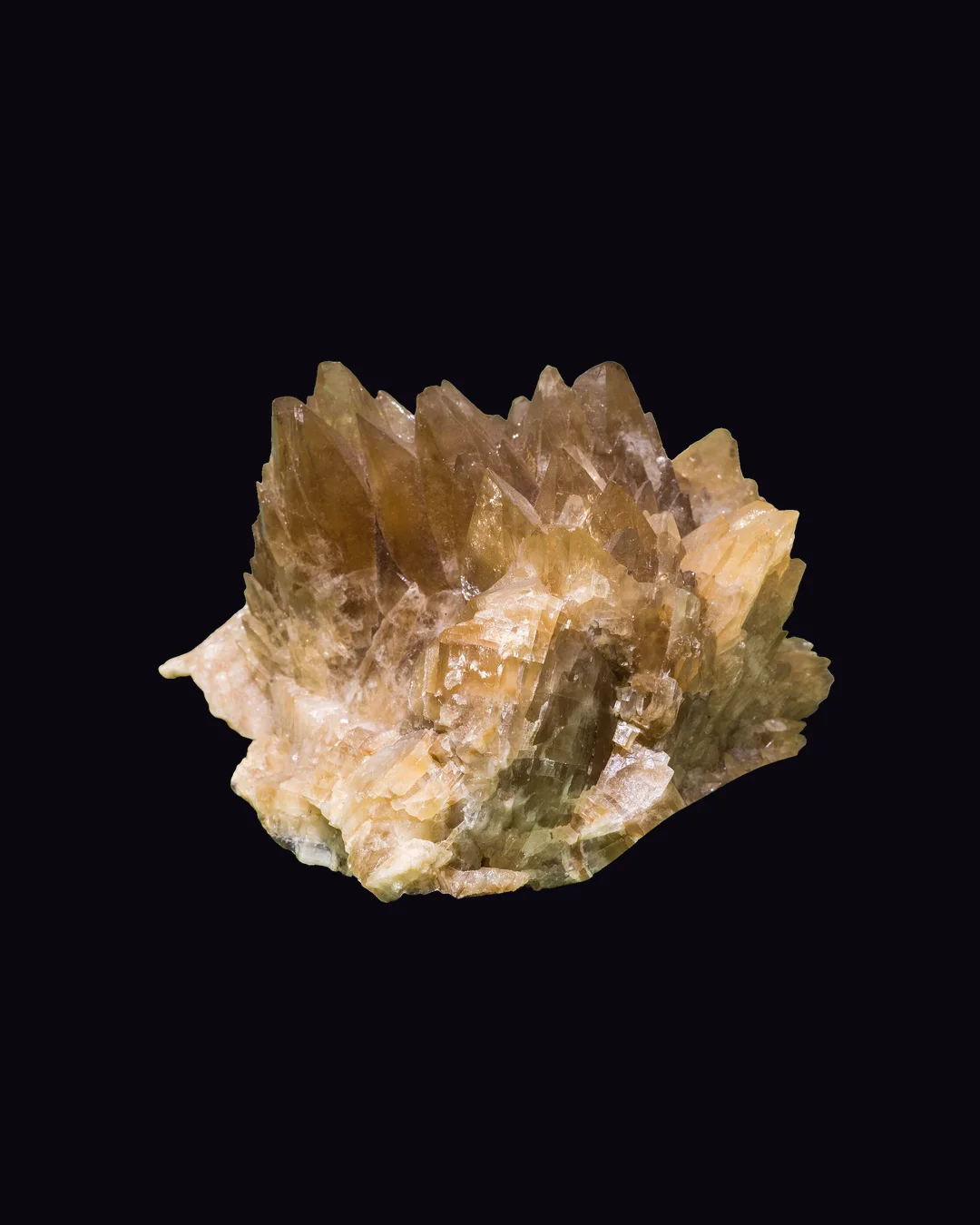
Calcite (Coloured Varieties)
Calcite
Calcite is lime that water carried and put back down in a hole in the rock. It is soft. A copper coin marks it. Drop vinegar on it and it fizzes. That fizz is the stone dissolving. Rain does the same thing slowly, which is how caves get hollowed out. Because it is porous it drinks dye. Bright blue and purple pieces are usually stained, and the colour gives itself away pooling in the cracks and around the drill hole. So keep it out of the sink. No salt, no vinegar, no sunny sill. Everything feels breakable right now, you included. You have been handling yourself the careful way you would handle somebody else's grief, and you are tired of calling it fine. You are allowed to be handled gently.
People carry it for abundance, self-love and calm. Tradition attaches it to the element fire, the sacral, solar-plexus, heart chakra, Sun. It is most often given to Cancer, Leo, Taurus. It measures 3 on the Mohs scale.
Seen · you don't have this one yet
Common·Uncommon·Rare·Arcane
Bright blue, green and purple calcite is very often dyed. Calcite is porous and takes dye readily, so the colour goes in easily. Natural colours are common too. Tell them apart by looking for colour concentrated in cracks and around drill holes.
This one does not go in water. It dissolves.
What it is confused with
Carnelian, aragonite, orange selenite, fluorite, amber, opalite
Calcite is translucent with a waxy to glassy shine, and it glows softly when you hold it to a light. The colour is usually banded, cloudy or zoned rather than uniform. Broken and raw pieces show flat slanted faces that flash like tiny mirrors. Those are cleavage planes, and calcite has three perfect directions of them, which is its structural signature. It is very soft. A steel pin, a copper coin, and on some pieces even a fingernail will mark it. Orange calcite frequently carries a chalky white rind. Mangano calcite, the pink one, often glows bright pink under longwave UV.
Commonly faked · check before you buy
How to tell
Put one drop of vinegar on a hidden spot. Calcite fizzes. Quartz, fluorite and glass do nothing at all. Wipe it off straight away, because vinegar etches calcite. Then try a copper coin. Calcite is 3 on the hardness scale, so the coin marks it, where carnelian and fluorite will not. Look at any broken face too. Calcite splits into slanted flat planes that flash like tiny mirrors.
Natural colours are common in calcite. So is dye. Bright blue, green and purple are the usual dyed shades, because calcite is porous and takes dye readily. Look for colour concentrated in cracks and around drill holes. Dye is permanent and it lowers the value, though the mineral itself is still calcite.
The full mineral facts
Hardness, formula, and how the rock is put together.
Hardness
3 Mohs
Formula
CaCO3
Family
carbonate
How it forms
Calcite is lime carried in water and set down again in cracks and cavities, which is why it is soft and dissolves in anything acidic.
Where it comes from
Mexico, Pakistan, Madagascar, Peru, USA, Brazil, Iceland
What it means
The moon is in Gemini today, so this is the Gemini read.
You worked out early that being interesting kept people in the room.
Calcite survives being torn out of a cave wall and shipped across the world. What finishes it is a rinse in the sink or a bowl of salt or a bright sill.
Vinegar makes it fizz, and that fizz is the stone going. Rain does the same to whole hillsides, only slower.
Gemini, you take on whatever colour the room is and the cracks are where it shows.
You worked out early that being interesting kept people in the room. Being plain did not. So you got quick.
Now somebody asks how you are and you hand them a bit, and it lands, and you go home with the real answer still in your mouth. The plain one was never boring. You just never got to test that.
Say the boring version to one person this week.
That is today's sky, not your chart. Add your birth details and this stone gets read against your own.
Read it for my chart →You know what this one would do for you. You just don't have it.
Calcite (Coloured Varieties) for every sign
AriesNow the third week of anything feels like a punishment you agreed to.
Calcite is lime that water carried through the dark and set down again in a crack. It took thousands of years to fill that hole. None of it was fast.
Then somebody dyed it blue, because plain honey does not sell as well. Look at the cracks and you can see where the colour pooled.
Aries, one sharp remark from you can take a week off somebody, and you rarely find out.
Somewhere early you got clapped for at the beginning, and nobody was in the room for the middle. So you learned where the applause lives. Now the third week of anything feels like a punishment you agreed to.
You call that flaky. It is a kid who only ever got praised at the starting line.
The water in that crack had no audience for any of it.
TaurusYou have quietly stopped believing anyone who is nice to you for free.
Bright blue and purple calcite is nearly always stained. The stone is porous, so it drinks dye like a sugar cube in tea.
The tell is the drill hole. Colour gathers there and in the cracks, darker than anywhere else on the piece.
Taurus, somebody sold you something once, and you decided you would never be that person twice.
You were young and you handed over money you did not really have. The shame of it stayed longer than the loss did. Now you check the seams of everything before you let yourself want it.
You have quietly stopped believing anyone who is nice to you for free. That is not caution. That is a receipt you are still carrying.
You already did the learning. What are you still paying for?
GeminiYou worked out early that being interesting kept people in the room.
Calcite survives being torn out of a cave wall and shipped across the world. What finishes it is a rinse in the sink or a bowl of salt or a bright sill.
Vinegar makes it fizz, and that fizz is the stone going. Rain does the same to whole hillsides, only slower.
Gemini, you take on whatever colour the room is and the cracks are where it shows.
You worked out early that being interesting kept people in the room. Being plain did not. So you got quick.
Now somebody asks how you are and you hand them a bit, and it lands, and you go home with the real answer still in your mouth. The plain one was never boring. You just never got to test that.
Say the boring version to one person this week.
CancerYou are the one who holds it together while everyone else falls apart.
You hold it to the window and turn it, and the light goes soft inside instead of sharp. That is because calcite is soft, soft enough that a copper coin leaves a mark on it.
Which is why it never goes in the sink. Water dulls it and salt eats it, and a bright sill takes the colour out for good.
Cancer, small things leave marks on you that other people would not even feel.
You are the one who holds it together while everyone else falls apart. Afterwards nobody thinks to ask how you did. It has been years of small ones.
A comment at dinner. A birthday somebody forgot. None of it was big enough to bring up, so you carried all of it.
The small ones are the ones that hollow the cave out.
You are allowed to say one of them out loud.
LeoYou clock the exact moment a voice stops meaning it.
This is lime. The same stuff as chalk, set down by water in a hole in the rock.
The bright blue ones are dyed, and the label rarely mentions it. That does not make it a bad stone. It makes it a stone with a history somebody skipped.
Leo, you were made somewhere dark and slow and you have been loud about everything since.
You know who is upset before they do. You clock the exact moment a voice stops meaning it. Somewhere back there being needed was the safest thing you could be, so you got very good at it.
Then you get in the car alone and you genuinely do not know what you want for dinner.
Nobody ever asked you first. Start there.
VirgoThe one conversation you actually need to have stays exactly where it was in March.
Water spent an age dissolving lime in one place and setting it back down in another, grain by grain, in a crack with no light in it. That is the whole method.
It is still soft enough to scratch with a copper coin. All that time and it never got hard.
Virgo, one sharp comment can take the surface off your whole week.
The kitchen gets scrubbed at eleven at night. The spreadsheet gets colour coded. The one conversation you actually need to have stays exactly where it was in March.
You are not avoiding it because you are weak. You are doing the only useful thing within reach. It is just not the thing.
The soft stone lasted anyway.
LibraYou learned in a loud house that having a preference started something.
Somebody put this calcite in a dye bath because honey and white do not leave a shelf as fast as blue does. The stone is porous. It took the colour without complaint.
Look at the drill hole. That is where the dye sat down darkest, and that is how you know.
Libra, you take on the mood of whoever walks in, and you have stopped noticing you do it.
You learned in a loud house that having a preference started something. So you got very good at not having one.
Now the question is where do you want to eat, and your whole body goes quiet while you work out which answer keeps everyone comfortable. You have wanted things this year. You just did not say them where anyone could hear.
Say one this week. Small one is fine.
ScorpioYou learned to bring the smaller version of yourself to dinner.
Calcite comes up out of caves in Mexico and Iceland and crosses an ocean whole. Then a bright windowsill takes the colour out of it in a season.
Salt does it faster. Everything sold as caring for a stone is what wrecks this one.
Scorpio, a soft voice can dissolve you in a way a shouted one never could.
That is what makes it stick. If a stranger says it you drop it. It was somebody who loved you, saying it gently, at a good moment, meaning well.
You learned to bring the smaller version of yourself to dinner. The rest waits in the car. You have got very smooth at it, and nobody has met the whole of you in about six years.
Nothing was ever wrong with the size of you.
SagittariusYou have never fully trusted a no since.
Strip the label off and this is limestone that got a second life. Water dissolved it, carried it, and set it back down in a cavity as crystal.
It is a three on the hardness scale. Softer than a copper coin. The thing that looks solid in the case is the softest object in it.
Sagittarius, you soak up the mood of whoever is nearest and then wonder why you feel thin by Thursday.
You were the kid told no about something that turned out fine. You have never fully trusted a no since. Somebody said you would not last a month, and you lasted.
That was proof enough for a decade of choices. It works until the one time it does not, and you pay that one alone, because you told everyone you had it handled.
Keep it off the sill. That warning is a real one.
CapricornYou were nine when you learned that being useful was the same as being wanted.
Pick one up and it is lighter than it looks. The broken faces flash flat, like tiny steps, because calcite splits along three angles and always has.
It is also porous, so a lot of what you see in shops sat in dye first. The colour tells on itself around the drill hole.
Capricorn, you take on the mood of whoever is in the room and you stopped noticing years ago.
Nobody watched the water do this. It happened in a crack with no light in it. You know the feeling. You did the years and somebody else got asked how they managed.
You were nine when you learned that being useful was the same as being wanted. You have not stopped since, and you have never tested it.
Put it down for one evening. See who is still there.
AquariusYou can tell a friend exactly why her situation is not her fault.
Water worked on this for an age. It dissolved lime out of one place, carried it in the dark, and laid it back down somewhere else as crystal.
Then it got dyed, because plain honey calcite does not sell like bright blue does. Nothing about the mineral changed. Only the price did.
Aquarius, you turned up brighter than you felt so a group would keep you, and the price of that has been quiet.
You can tell a friend exactly why her situation is not her fault. You are right. You have been right for years.
Then it is your own kitchen at midnight and you file the whole thing under later. Explaining things has kept you a step outside every room you have been in, and you did not pick that.
Who would come and stand in that kitchen if you asked?
PiscesSomebody was low all Tuesday and you spent it tired for no reason.
Somebody dropped this in dye and sold it as blue. Calcite is porous, so it took the colour all the way in and never argued.
You can still find the truth of it. The dye sits darkest in the cracks and around the hole they drilled.
Pisces, small things dissolve you and you have been told that is not a real problem.
Other people's moods come in whole and you feel them as your own before you notice they arrived. A room turns and you turn with it. Somebody was low all Tuesday and you spent it tired for no reason.
You started apologising for that young, and by now you do it before anybody has asked you to.
Nothing is leaking. It just comes in.
Correspondences
What tradition attaches to this stone. Folklore, not chemistry.
Element
fire
Planet
Sun
Chakra
sacral, solar-plexus, heart
Signs
cancer, leo, taurus, libra
What tradition says
In crystal lore, calcite is filed by colour. Orange goes to the sacral chakra, green to the heart, blue to the throat, and pink to emotional healing. That is a modern Western colour-coded scheme with no older basis.
Care
- Do not put this one in water. It dissolves or spalls. Dust it dry.
- Keep it out of direct sun. The colour goes and does not come back.
- Salt scratches it. Do not bury it in salt.
- Never soak it. Never use vinegar or any acidic cleaner. Never use salt. All three etch the polish and it does not come back. Some coloured calcites also fade in sun, so keep it off the windowsill. Wipe it with a dry or barely damp cloth.
Common questions
What does calcite (coloured varieties) mean?
Calcite (Coloured Varieties) is carried for abundance, self-love and calm. Calcite is lime that water carried and put back down in a hole in the rock. Tradition links it to the sacral, solar-plexus, heart chakra.
Is calcite (coloured varieties) real or fake?
Bright blue, green and purple calcite is very often dyed. Calcite is porous and takes dye readily, so the colour goes in easily. Put one drop of vinegar on a hidden spot. Calcite fizzes. Natural colours are common in calcite.
Can calcite (coloured varieties) go in water?
No. Calcite (Coloured Varieties) dissolves or spalls in water. Dust it dry instead of soaking it, and keep it out of salt.
- Read: the crystals you cannot put in water →
- Read: the crystals that fade in sunlight →
- Read: fake crystals and the four tests that settle it →
Common · orange, honey amber, mint green, powder blue, pale pink, white
Where this leads
This stone belongs to
Related crystals
From the Grimoire
- How to Cleanse Crystals: 8 Methods, and Which Ones Ruin Certain Stones
- Selenite vs Satin Spar: You Probably Own the Other One
- What Crystal Is This? How to Identify Any Stone From One Photo
- Can Selenite Get Wet? (It Dissolves)
- Can You Put Crystals in Water? The Ones That Turn Toxic or Dissolve
- Can You Shower With Crystals? The Ones That Can't
FOR ENTERTAINMENT AND REFLECTION. NOT MEDICAL, PSYCHOLOGICAL, FINANCIAL OR LEGAL ADVICE. How this works