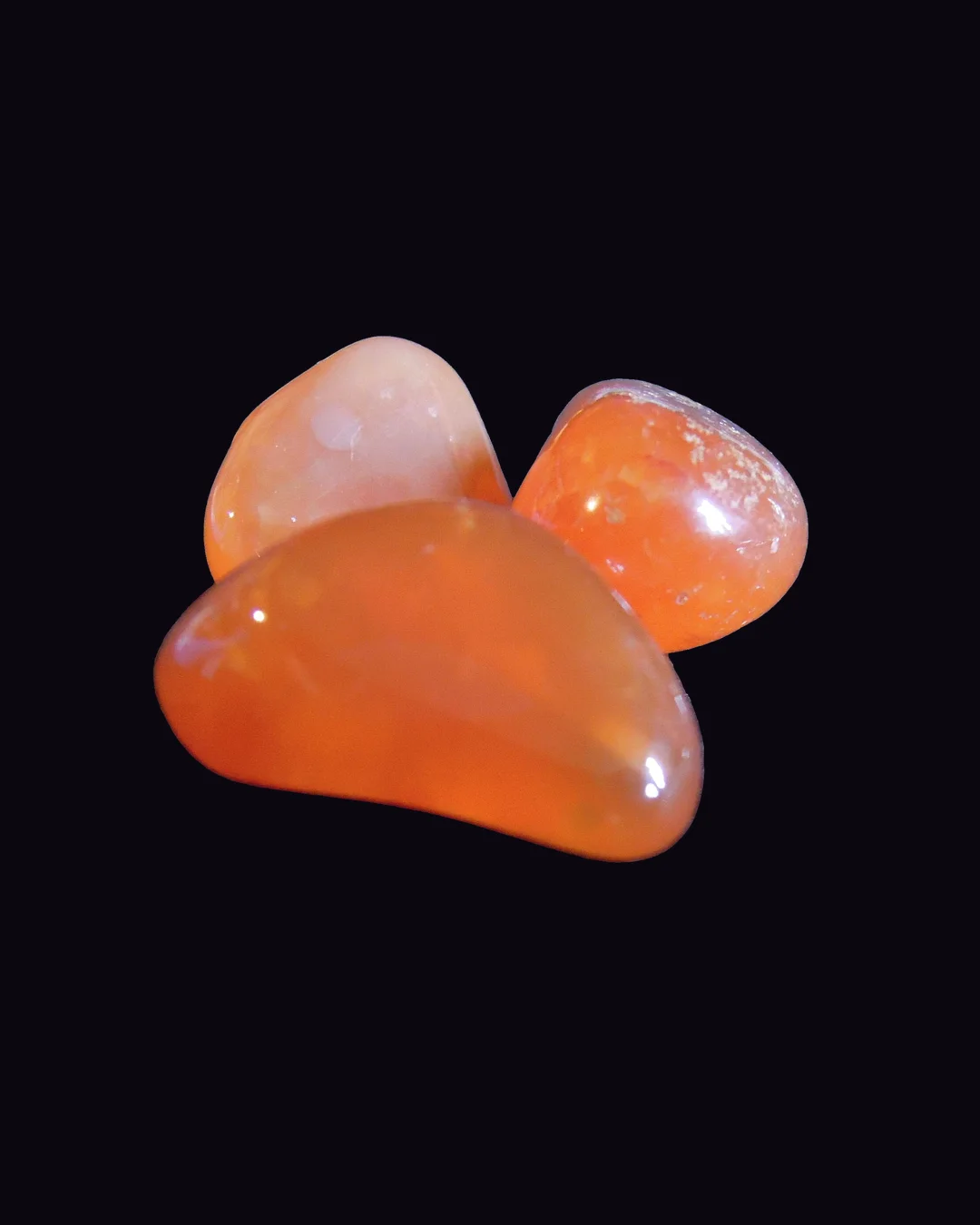
Carnelian
Chalcedony (cryptocrystalline quartz)
Most carnelian was helped. Grey agate gets iron stained and baked until the orange comes up, and people have done that since before Rome. Same mineral either way. The iron was already in there. Heat only finished what the ground started. Under the colour it is silica water that filled a gas pocket in lava and set hard. Hold it to a lamp. Real material glows uneven and cloudy. Dyed agate shows hard edged stripes where colour sank into the soft bands only. You know what you have to do. You have known for weeks. You keep tidying the kitchen instead, because starting means finding out whether you are any good at it. Start badly. Start anyway.
People carry it for courage, abundance and transformation. Tradition attaches it to the element fire, the sacral, root chakra, Mars. It is most often given to Aries, Leo, Taurus. It measures 6.5-7 on the Mohs scale.
Seen · you don't have this one yet
Common·Uncommon·Rare·Arcane
Most commercial carnelian is banded agate with the orange brought out by iron staining and heat, a practice documented since antiquity. It is chemically the same mineral. The colour is assisted. Hard-edged stripes of colour indicate dyeing rather than natural staining.
What it is confused with
Red jasper, sardonyx, dyed agate, amber, orange calcite
Carnelian is translucent orange to red-brown. Unpolished it looks waxy or greasy. Polished it goes glassy. Held to a strong light the edges glow warm orange and show soft cloudy banding, irregular wisps and patches, never sharp lines. It breaks in a smooth, slightly waxy curved shell. Natural material is uneven in tone. A completely flat, uniform, opaque orange usually means dyed agate. Much of the common Indian material has been heated, and it tends to look slightly brick-red and less translucent.
Commonly faked · check before you buy
How to tell
Backlight it. Carnelian is translucent and glows orange. Red jasper is opaque and stays dark. It also scratches glass, where calcite and amber will not. Then look at how the colour sits. Dyed agate packs colour into the porous bands only, which gives hard-edged stripes. Carnelian drifts in soft clouds.
Most carnelian on sale is banded agate that was iron-stained and heat-treated to bring out the orange. People have done this since antiquity. It is chemically the same mineral either way and the change is permanent. The colour was assisted, not invented. Hard-edged stripes of colour are a different matter, because that means dyeing rather than natural staining.
The full mineral facts
Hardness, formula, and how the rock is put together.
Hardness
6.5-7 Mohs
Formula
SiO2
Family
chalcedony
How it forms
Carnelian is chalcedony that filled a gas pocket in lava, with iron oxide caught in the silica to give the orange.
Where it comes from
India (Gujarat), Brazil, Uruguay, Madagascar, Botswana
What it means
The moon is in Sagittarius today, so this is the Sagittarius read.
You booked the flight at two in the morning to get out of a conversation.
Underneath the orange this is quartz, the same family as flint and agate, just too fine grained to see the crystals.
The colour is iron, and in most shop pieces an oven brought it up. Grey went in. Orange came out. Nobody puts that on the tag.
Sagittarius, your warmth is real and it was also learned under heat, and both of those are true.
You were told no as a kid about something that turned out to be completely fine, and you never fully believed a no again. It has served you. You have done things other people only talked about.
You booked the flight at two in the morning to get out of a conversation. You called that being free.
You are allowed to stay and find out.
That is today's sky, not your chart. Add your birth details and this stone gets read against your own.
Read it for my chart →You know what this one would do for you. You just don't have it.
Carnelian for every sign
AriesYou have been proving it wrong in one week bursts ever since.
Somebody baked this. Grey agate goes in an oven with iron and comes out orange, and people have been doing that since before Rome.
The iron was already in the rock. Heat only finished what the ground had started, which is why the label almost never mentions it.
Aries, everybody calls you the fire and nobody asks who lit it.
You start hot. Week one you are unrecognisable, in the best way. Then the middle arrives with nobody clapping in it, and by Thursday you have found a new thing to be excited about.
Somebody called you all talk once. You have been proving it wrong in one week bursts ever since.
The oven only worked because the iron was in there already.
TaurusSomebody was warm to you and it turned out to be a way of getting something.
Before this was a stone it was hot water in a gas bubble inside cooling lava. The silica came out of the water and set hard, with iron caught in it.
Then somebody dug it up grey and put it in an oven to bring the orange out. Same mineral. Better price.
Taurus, you stopped trusting anything shiny the year you found out what it actually cost.
It was a person, not a purchase. Somebody was warm to you and it turned out to be a way of getting something. Now you make people wait, and you feel bad about it, and you do it anyway.
The waiting is not meanness. It is a checkpoint you built after somebody walked through the last one.
Heated carnelian is still carnelian. Some things survive the truth.
GeminiNone of them could tell a doctor what you have been like this year.
Hold it up to a lamp. Real carnelian glows uneven and cloudy, like light coming through a curtain.
Dyed agate does something else. The colour sits in hard edged stripes, because it only soaked into the soft bands.
Gemini, your warmth is assisted and you are the only one who knows what temperature it took.
You found out young that the quick version got you looked at and the true version got you nothing. So you learned the trick. Now people describe you as fun and mean it.
None of them could tell a doctor what you have been like this year. The true version was never going to bore anyone. You have just never risked it.
Hold something up to the light this week and let it be what it is.
CancerYou are still the one who checks everyone got home.
Take the orange away and this is the same stuff as flint. Silica, laid down in a gas pocket, hard enough to scratch glass.
The orange is iron, and in most shop pieces the oven brought it out. Grey agate went in. Carnelian came out.
Cancer, people call you the soft one and they have never once seen what you are made of.
Nothing has gone catastrophically wrong. That is almost the problem. It has been small heat over a long time, and you have adjusted so gradually that you cannot point to the day it changed.
You are still the one who checks everyone got home. That has been true since you were about twelve.
Who checks on yours?
LeoThen Sunday comes and you are flat on the sofa with your phone face down.
This one takes wear. Six and a half on the scale, hard enough to mark glass, worn as a ring for four thousand years without going dull.
Egyptians put it in graves. It survives water and soap and daylight and a life in a pocket.
Leo, you have been worn every day for years and nobody has thought to take you off.
People come to you because you make the room easier to be in. You notice whoever nobody is talking to. You do it without deciding to. Being the warm one was once how you stayed safe.
Then Sunday comes and you are flat on the sofa with your phone face down. Nobody in the building would guess.
Hardness is not the same as never getting worn.
VirgoYou built it at about fourteen and never got to check whether it was fair.
Somebody stained this grey agate and put it in an oven. That is where most shop window orange comes from, and it has been done that way since before Rome.
It is not a fake. The iron was in the rock all along. Heat finished what the ground began.
Virgo, the warmth people praise in you took work, and nobody has ever asked what it cost.
There is a version of you that is calm. She only exists when everything is done, and everything is never done. You keep going anyway, because the alternative is standing still in a room with the actual thing in it.
Nobody handed you that standard. You built it at about fourteen and never got to check whether it was fair.
Some things always needed help. That is not a failure.
LibraBy the time anyone asks what you want, you have already talked yourself out of it.
Lava cooled around a bubble of gas and left a hole in the rock. Water full of silica seeped in for a very long time and filled that hole solid, with iron caught in the mix.
That is the natural way. The other way is an oven, and most orange on a shelf came out of one.
Libra, a gap in you got filled with other people's needs while you were working out your own.
You can feel where a room is heading a full minute before it gets there. So you move first. You soften it, you take the smaller half, you say you do not mind.
By the time anyone asks what you want, you have already talked yourself out of it. You did that so fast it felt like not having an opinion.
You had one. You always do.
ScorpioSo you cut yourself down to a size that fits at dinner.
Put it between your eye and a lamp. It glows cloudy and uneven, never clean, never the same twice across one stone.
Red jasper does not do that. Nor does dyed agate, which shows its colour in hard stripes because the dye only took in the soft bands.
Scorpio, somebody warm brought something out of you that was already sitting there.
That is the part that got in. A stranger you could have shrugged off. This was someone who loved you, at a good moment, saying it gently, meaning it as help.
So you cut yourself down to a size that fits at dinner. You are very good at it now. Nobody at that table has met the whole of you.
The light goes through it uneven. That is how you know it is real.
SagittariusYou booked the flight at two in the morning to get out of a conversation.
Underneath the orange this is quartz, the same family as flint and agate, just too fine grained to see the crystals.
The colour is iron, and in most shop pieces an oven brought it up. Grey went in. Orange came out. Nobody puts that on the tag.
Sagittarius, your warmth is real and it was also learned under heat, and both of those are true.
You were told no as a kid about something that turned out to be completely fine, and you never fully believed a no again. It has served you. You have done things other people only talked about.
You booked the flight at two in the morning to get out of a conversation. You called that being free.
You are allowed to stay and find out.
CapricornYou have not put it down long enough to test whether that was true.
Carnelian holds up. It has been worn as a signet ring for thousands of years and comes back from water and soap and daylight and a lifetime of hands.
The orange, though, was usually helped. Grey agate goes in an oven and comes out this colour, and it has been done that way since antiquity.
Capricorn, you have been useful to people for so long that you cannot remember agreeing to it.
If a day made nothing you file it as wasted. Rest goes in that pile. So does the winter you spent keeping somebody else upright.
You were told, in a hundred small ways, that you would be loved for what you carried. You have not put it down long enough to test whether that was true.
Put it down for one evening. Nothing falls over.
AquariusYou have been the friend people ring at eleven at night for years.
People have been improving this stone since before Rome. Iron stain, then heat, and grey agate comes out orange enough to sell.
The mineral did not change. Only the story on the label did, and almost nobody who buys it is ever told.
Aquarius, you have been improving yourself since you were about fourteen and nobody ever said the first version was faulty.
You can explain somebody else's family to them in four sentences and be right. You have been the friend people ring at eleven at night for years. It is a real gift and it also keeps you a step back from the table.
Nobody ever gets to explain you to you, because you got there first and you got there alone.
Who is allowed to be wrong about you out loud?
PiscesSomebody called you dramatic when you were small.
Silica water sat in a hollow in cooled lava and let go of what it carried, layer over layer, until the hollow was solid.
Most of the orange you see was still brought up in an oven afterwards. The iron was already there. Heat just made it obvious.
Pisces, somebody turned the heat up on you young and then called the result your temperament.
What is in the room comes into you. You get in a car with somebody quiet and you are quiet by the third roundabout, and it took you until this year to work out that some of those moods were never yours.
Somebody called you dramatic when you were small. You have been running the volume down ever since.
It was accurate. You just did not have the words yet.
Correspondences
What tradition attaches to this stone. Folklore, not chemistry.
Element
fire
Planet
Mars
Chakra
sacral, root
Signs
aries, leo, taurus, virgo
What tradition says
Classical sources link carnelian to Mars, and Egyptian funerary use put it with the dead as protection. In crystal lore now it is kept for courage and for drive, and filed under the sacral chakra.
Care
- Water is fine. Dry it afterwards.
- Hard-wearing and stable. Warm water and soap. Keep harsh solvents away from dyed material, because they can pull the colour back out.
Common questions
What does carnelian mean?
Carnelian is carried for courage, abundance and transformation. Most carnelian was helped. Tradition links it to the sacral, root chakra.
Is carnelian real or fake?
Most commercial carnelian is banded agate with the orange brought out by iron staining and heat, a practice documented since antiquity. It is chemically the same mineral. Backlight it. Carnelian is translucent and glows orange. Most carnelian on sale is banded agate that was iron-stained and heat-treated to bring out the orange.
Can carnelian go in water?
A short rinse is fine for carnelian, then dry it.
Common · orange, burnt orange, red-brown, amber-red
Where this leads
This stone belongs to
Related crystals
From the Grimoire
- Best Crystals for a Leo Woman
- Best Crystals for a Taurus: Your Grounding Stones
- Your Birthstone vs Your Zodiac Crystal: Not the Same Thing
- Can You Put Crystals in Water? The Ones That Turn Toxic or Dissolve
- Crystals for Beginners: The 8-Stone Starter Set That Actually Matters
- Crystals for Confidence and Standing Your Ground
FOR ENTERTAINMENT AND REFLECTION. NOT MEDICAL, PSYCHOLOGICAL, FINANCIAL OR LEGAL ADVICE. How this works