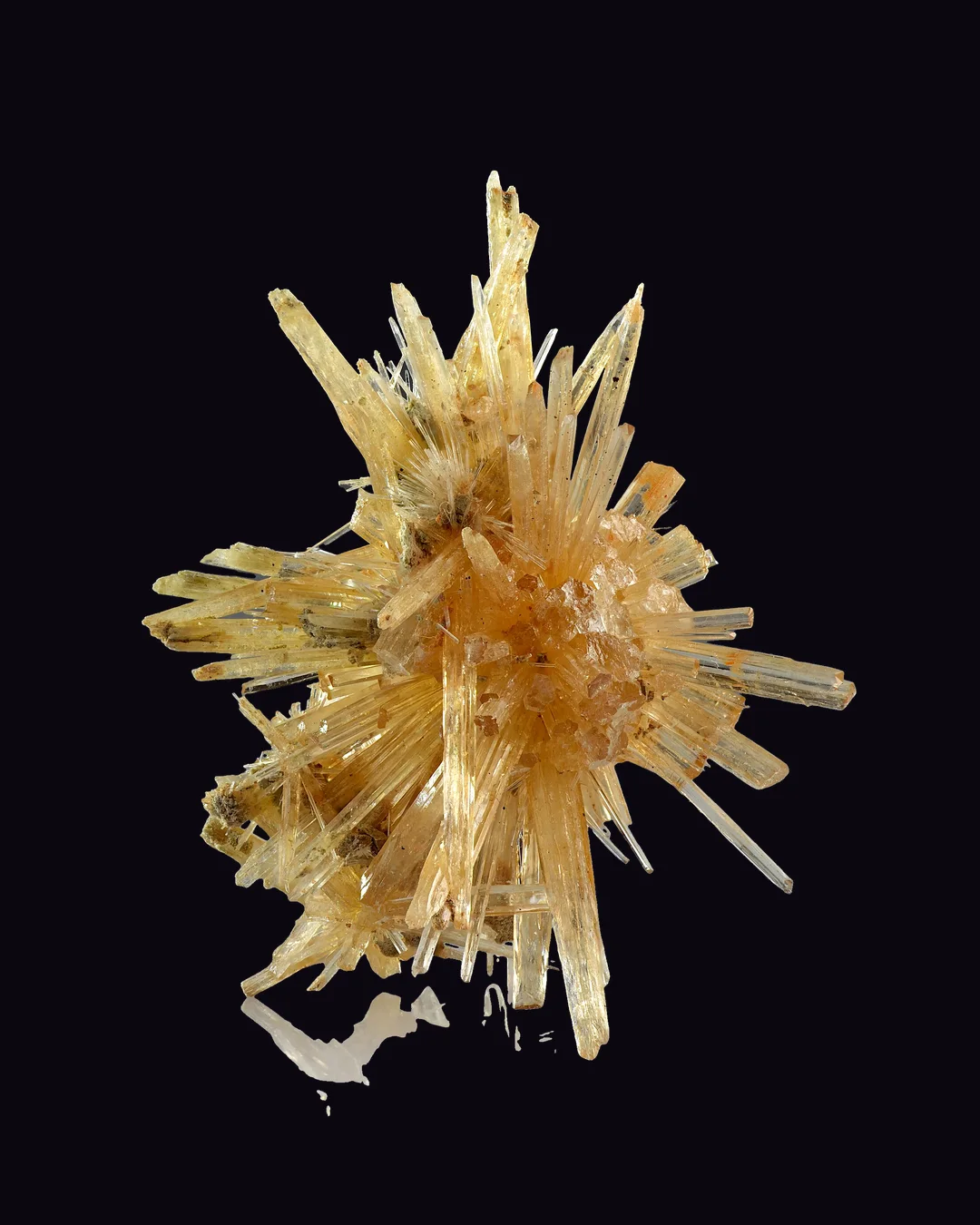
Aragonite
Aragonite
Aragonite builds itself out of mineral water in caves, in rust orange spikes that all shoot from one centre. It is on borrowed time. Given long enough it quietly resets into plain calcite. Water and salt take it apart much faster. The spikes snap if you pack it loose in a bag. You have a hundred tabs open in your head and you cannot close a single one. That is not a flaw in you. You learned early that when you stopped, somebody else paid for it. People have kept this one on a desk for scattered days. Put it somewhere dry where you will see it. Close one tab tonight.
People carry it for grounding, calm and boundaries. Tradition attaches it to the element earth, the root, sacral, solar-plexus chakra, Earth. It is most often given to Capricorn, Taurus, Leo. It measures 3.5-4 on the Mohs scale.
Seen · you don't have this one yet
Common·Uncommon·Rare·Arcane
This one does not go in water. It dissolves.
What it is confused with
Calcite coloured, citrine heat treated, vanadinite, orange selenite, coral
The classic Moroccan aragonite is a spiky ball. Stubby reddish-brown to caramel prisms shoot out from one centre in every direction, like a sea urchin or a thrown jack. The prisms look six-sided in cross section. They are really three crystals grown together, a twin, because the mineral itself is orthorhombic and boxy. The faces are rough and slightly chalky rather than glassy. Other forms look like branching coral, or come as fibrous banded slabs. The shine runs chalky to glassy, and it is softer than glass.
How to tell
A drop of vinegar makes it fizz, but calcite fizzes too, because both are calcium carbonate. Use the shape instead. Aragonite grows as spiky clusters shooting out from a centre, or as fibrous masses. Calcite breaks into little slanted boxes called rhombs. Aragonite never does that. It is also a touch harder, 3.5 to 4 against calcite at 3.
Aragonite is mostly sold as it comes. Pale fibrous types are sometimes dyed, which is permanent and lowers the value. The rust colour on Moroccan clusters is not dye. That is iron staining and it is natural.
The full mineral facts
Hardness, formula, and how the rock is put together.
Hardness
3.5-4 Mohs
Formula
CaCO3 (orthorhombic polymorph)
Family
carbonate
How it forms
Aragonite grows out of mineral rich water in caves and hot springs, building spiky clusters, and over long stretches of time it slowly resets into ordinary calcite.
Where it comes from
Morocco, Spain (Molina de Aragón, type locality), Mexico, Namibia, Slovakia, China
What it means
The moon is in Sagittarius today, so this is the Sagittarius read.
You have driven through the night on four hours sleep.
Aragonite holds up fine in a dry cave for a very long time. Water is what undoes it, and salt water undoes it faster.
There is no warning stage. It does not crack or go cloudy first, it just quietly goes.
Sagittarius, you are afraid that if you stop moving you will settle into something ordinary.
You have driven through the night on four hours sleep. You have said yes to a plan while somebody you trust was still saying wait. You have booked the thing before the argument was over.
It is not recklessness. Careful was the word the people who let you down used about themselves, and you have been running from it since.
Keep it dry. That is the whole instruction.
That is today's sky, not your chart. Add your birth details and this stone gets read against your own.
Read it for my chart →You know what this one would do for you. You just don't have it.
Aragonite for every sign
AriesYou have a drawer of half-finished things and you call yourself lazy for it.
Aragonite did not get made in a rush. It grew out of mineral water in a cave, one thin layer at a time, with every spike pushing out from a single centre.
It is on borrowed time even now. Left alone for long enough it quietly resets into plain calcite, and there is nothing dramatic about it.
Aries, you go spiky first and reasonable about four hours later, and the four hours cost you.
You were the kid who got praised for being fast. Nobody ever clapped on day forty of anything.
So you learned to hunt the opening. You have a drawer of half-finished things and you call yourself lazy for it. That is the one thing you have never been.
Finish one small thing tonight. Nobody has to see it.
TaurusSomebody sold you something once and swore it was real.
Somebody dyes the pale fibrous aragonite you see in some shops. The rust orange in the Moroccan pieces is not dye, it is iron staining that took its time.
It sits on the shelf beside heat treated citrine, which was purple amethyst until an oven got hold of it. Same tray, two different stories.
Taurus, you do not trust anything shiny that came cheap, and you did not decide that on your own.
Somebody sold you something once and swore it was real. You were young enough that the swearing was the part you believed.
Now you check the seams on everything before you let yourself want it. People call that stubborn. It reads more like a scar.
You were not born careful. You were taught.
GeminiThe people close to you have never heard the short version.
Hold the cluster up to a lamp. Every spike is pointing away from one place, the single spot in the cave water where the whole thing started.
Run it under a tap and you are washing it away. Aragonite dissolves in water and in salt, slowly, with no sign that it is happening.
Gemini, you keep restarting so you never have to find out what you would settle into.
You learned early that being quick was the thing people liked about you. In a kitchen at thirteen you got a laugh, and you clocked exactly how you did it.
So now the true answer arrives first and you talk straight past it. The people close to you have never heard the short version.
What would you say if you only got one sentence?
CancerYou have held long hard stretches without complaining once.
Aragonite lives in a damp cave for ages without any trouble, growing slowly out of mineral water. Put it in a bag with your keys and the spikes snap off.
Salt finishes it quicker than anything. What a thing survives and what quietly ends it are almost never the same.
Cancer, you managed years of the hard thing and one careless comment took a piece off you.
You have held long hard stretches without complaining once. Then somebody changes a plan by text and you are sat on the bathroom floor.
That is not weakness. You spent years being the reliable one, and reliable people are the last ones told that something is about to change.
Pack it in something soft. Do the same for yourself.
LeoYou got good at the temperature of other people early.
Aragonite is calcium carbonate, the same stuff as chalk and eggshell. What makes it different from ordinary calcite is only how the atoms sit.
It does not hold that arrangement forever. Given long enough it gives up and becomes the common thing on the shelf, and no cave notices.
Leo, you are made of the same ordinary stuff as everybody else and that thought frightens you.
You got good at the temperature of other people early. Someone at home was unpredictable and you learned to check the weather before you spoke.
Now everybody tells you that you light up a room. Not one of them has asked what it costs to keep the reading going.
Somebody should ask you first, for once.
VirgoYou were small when you worked out that a tidy room made somebody calmer.
Aragonite takes long stretches of time to build, one drop of cave water at a time. Nobody is standing there while it happens.
It does not stay, either. It slowly resets into plain calcite, so the careful work undoes itself no matter how well it was done.
Virgo, you keep going back to a version of yourself that is easier for other people to hold.
The kitchen gets cleaned at eleven at night. The spreadsheet gets colour coded twice.
Meanwhile the conversation you actually need to have is nine months old. You were small when you worked out that a tidy room made somebody calmer. That was true then and it is not your job now.
Leave one thing undone tonight. See if the sky holds.
LibraYou were a child doing a job nobody gave you.
Look at an aragonite cluster from above. Dozens of spikes, every one of them leaving from the same middle, none of them apologising for the direction.
It is soft for a stone. A steel blade marks it without trying, and the thin spikes snap if you pack it loose in a bag.
Libra, you apologise for every direction you pick before anybody has objected to it.
You run every answer through a check first. Who does this hurt, who goes quiet, who brings it up again in a month.
Somebody in your house was moody and you became the one who kept the peace. You were a child doing a job nobody gave you.
Pick the thing you want. Say it out loud once.
ScorpioYou made yourself smaller in that relationship for about two years.
The pale fibrous aragonite in some shops has been dyed. The Moroccan rust orange has not, that colour is iron soaking in over a very long time.
One of those needed a person and a tank of dye. The other needed nothing but time, and nobody has ever thanked it for that.
Scorpio, you got packed down to fit a smaller space and the sharp parts of you snapped off in there.
You made yourself smaller in that relationship for about two years. You went quiet at dinners. You stopped saying the true thing first.
It did not make them love you more. It only taught you that the real version of you is something to be managed.
It never was.
SagittariusYou have driven through the night on four hours sleep.
Aragonite holds up fine in a dry cave for a very long time. Water is what undoes it, and salt water undoes it faster.
There is no warning stage. It does not crack or go cloudy first, it just quietly goes.
Sagittarius, you are afraid that if you stop moving you will settle into something ordinary.
You have driven through the night on four hours sleep. You have said yes to a plan while somebody you trust was still saying wait. You have booked the thing before the argument was over.
It is not recklessness. Careful was the word the people who let you down used about themselves, and you have been running from it since.
Keep it dry. That is the whole instruction.
CapricornSomebody at home made love feel like a wage.
Aragonite and plain calcite are the same chemistry. The difference is only the arrangement, and aragonite is the one holding the harder pattern.
It does not hold it forever. Given enough time it lets go and becomes the ordinary version, and no cave notices the day it happens.
Capricorn, you are holding a harder shape than you need to and nobody has asked you to.
You keep a ledger in your head and only finished things get entered in it. The night you talked somebody down on the phone does not appear anywhere.
Somebody at home made love feel like a wage. You have been working for it ever since and you have never checked whether you had to.
The people who stayed never read the ledger.
AquariusYou have said the sentence that made her cry with relief.
Aragonite builds out of dripping water over stretches of time nobody sits through. Every spike leaves from the same starting point.
The cluster only looks like a system from outside. From inside it was one slow drop after another with no plan at all.
Aquarius, everybody thinks you had a plan, and you were making it up one week at a time.
You can tell a friend exactly why her boss keeps doing that, and you are right every single time. You have said the sentence that made her cry with relief.
Nobody has done it back for you, because you present as fine, and fine is a thing people take at face value.
Who reads the room you are in?
PiscesYou walk into a room and take on whatever is already in it.
Set it on a windowsill and look at it in the morning. The rust colour is iron that soaked into it inside a Moroccan cave.
Do not rinse it. Water dissolves aragonite and salt water is worse, so a wash you meant kindly takes a little of it away for good.
Pisces, you keep resetting to whatever the room needs and calling it being easy to live with.
You walk into a room and take on whatever is already in it. Somebody else's bad afternoon becomes your whole evening.
You were the one at home who could always tell. Being able to tell got treated as a gift, so nobody thought to teach you how to stop.
A door is not a wall. You are allowed one.
Correspondences
What tradition attaches to this stone. Folklore, not chemistry.
Element
earth
Planet
Earth
Chakra
root, sacral, solar-plexus
Signs
capricorn, taurus, leo
What tradition says
In crystal lore, aragonite is kept for patience and for pulling scattered attention back in. It is filed under the earth element. The reading comes from the shape, because everything radiates from one centre.
Care
- Do not put this one in water. It dissolves or spalls. Dust it dry.
- Salt scratches it. Do not bury it in salt.
- Keep it away from acid and salt. It is a carbonate, so vinegar dissolves it, and seawater and salt eat it slowly. The spikes are extremely fragile. Never pack it loose in a bag with other stones. A dry brush is all it should ever get.
Common questions
What does aragonite mean?
Aragonite is carried for grounding, calm and boundaries. Aragonite builds itself out of mineral water in caves, in rust orange spikes that all shoot from one centre. Tradition links it to the root, sacral, solar-plexus chakra.
Is aragonite real or fake?
Aragonite is not faked often, but it is still worth checking. A drop of vinegar makes it fizz, but calcite fizzes too, because both are calcium carbonate. Use the shape instead. Aragonite is mostly sold as it comes.
Can aragonite go in water?
No. Aragonite dissolves or spalls in water. Dust it dry instead of soaking it, and keep it out of salt.
Common · rust orange, caramel brown, white, cream, pale blue-green
Where this leads
This stone belongs to
Related crystals
FOR ENTERTAINMENT AND REFLECTION. NOT MEDICAL, PSYCHOLOGICAL, FINANCIAL OR LEGAL ADVICE. How this works