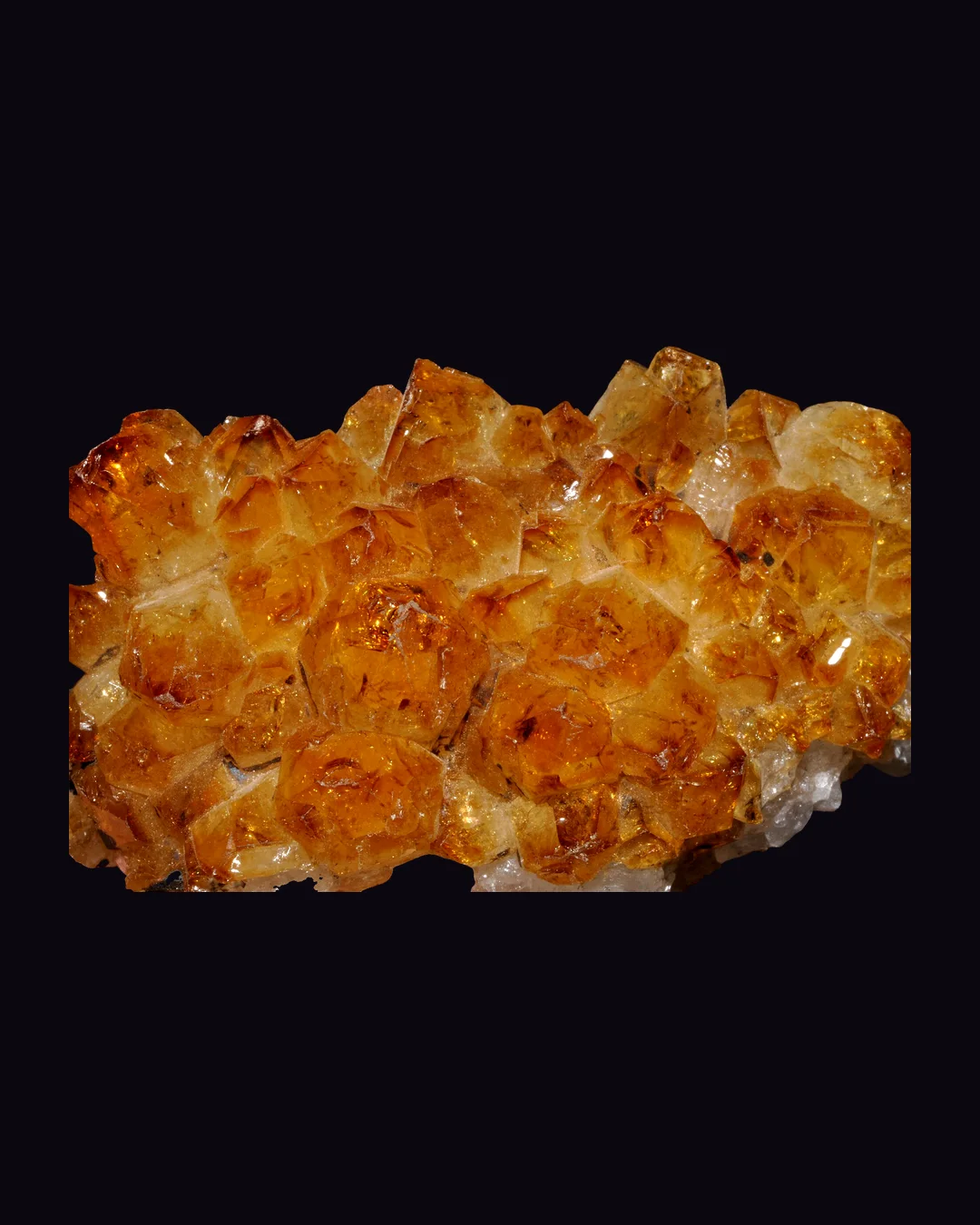
Citrine (Heat-Treated Amethyst)
Quartz
It was amethyst. Purple, out of a geode in Brazil, until it went into an oven at around 450 degrees and came out brandy orange for good. Almost every orange citrine in a shop is this one. Yours very likely is. Chalky white base, hard orange at the tips, that is the roast showing. Nobody says it at the counter. You are not stupid for owning one. You were just never handed the sentence. You bought it because you are tired of waiting to feel like enough, and a gold-coloured stone was the cheapest hope on the shelf that day. It is still quartz. It is still yours. It just has a different history than the label.
People carry it for abundance, courage and transformation. Tradition attaches it to the element fire, the solar-plexus, sacral chakra, Sun. It is most often given to Leo, Aries, Sagittarius. It measures 7 on the Mohs scale.
Seen · you don't have this one yet
Common·Uncommon·Rare·Arcane
The label says citrine. The stone is amethyst, or sometimes smoky quartz, that has been baked at roughly 400 to 550 degrees Celsius. The heat turns the violet iron colour centres orange-brown. It is still real quartz and the change is permanent, but the name is not honest unless the heating is disclosed.
What it is confused with
Citrine natural, ametrine, smoky quartz, amber, orange calcite
The single most recognisable treated stone in the trade. Look for a chalky opaque white or milky base that breaks straight into deep orange-brown at the tips. The line between the two is hard and flat, not a gradual fade. Geode pieces show short stubby points, all the same burnt orange, sitting on a bleached zone underneath. The colour is far deeper and redder than natural citrine ever gets. Surfaces sometimes carry fine crazing, which is cracking from heat shock.
Commonly faked · check before you buy
How to tell
First check it is quartz. It should scratch glass. Then read where the colour changes. A chalky white base that breaks into sharp orange at the tips means heated amethyst, every time. Natural colour never stops on a hard line like that. There is no other test you can run at home. The heat is permanent, and only the colour pattern gives it away.
Amethyst, or sometimes smoky quartz, roasted at roughly 400 to 550 degrees Celsius. The heat turns the iron colour centres from violet to orange-brown. It is stable and permanent. This is not a fake mineral, it is a treated one, and it should be disclosed. Most shops do not disclose it. Treated material is worth much less than natural citrine. That is on the seller, not on you.
The full mineral facts
Hardness, formula, and how the rock is put together.
Hardness
7 Mohs
Formula
SiO2
Family
quartz
How it forms
It formed as amethyst in a quartz-lined cavity, then a person baked it at roughly 400 to 550 degrees Celsius, which turned the iron colouring from violet to orange-brown for good.
Where it comes from
Brazil (Rio Grande do Sul), Uruguay, Zambia (heated material), Madagascar
What it means
The moon is in Gemini today, so this is the Gemini read.
People hand you the tidy version because you make it easy for them.
Turn it over and look at the base. If it is chalky white and the orange only lives at the tips, that is a roast. Heated amethyst, every single time.
The colour boundary is the only tell there is. No consumer test picks it up, because the change is real and permanent.
Gemini, you answer to a name somebody else picked and you have got very good at it.
The plain answer is that this is baked amethyst and it is still lovely. You did not need protecting from that, but somebody decided you did.
That has happened to you before with bigger things. People hand you the tidy version because you make it easy for them. You have never told them you would rather have the real one.
Ask for the real one. Out loud.
That is today's sky, not your chart. Add your birth details and this stone gets read against your own.
Read it for my chart →You know what this one would do for you. You just don't have it.
Citrine (Heat-Treated Amethyst) for every sign
AriesYou bought a gold-coloured stone because you were tired of waiting to feel like enough.
This was purple. It grew as amethyst in a cavity in Brazil, then somebody put it in an oven at about four hundred and fifty degrees.
It came out orange and it will never go back. That is not a fake stone. It is quartz with a history the label left off.
Aries, somebody put you in the heat young and then praised the colour it left.
You bought a gold-coloured stone because you were tired of waiting to feel like enough. That is not a stupid reason. It is the most honest reason there is.
Somewhere early somebody made you feel you were only impressive while you were winning. You have been sprinting ever since to keep that feeling out of the room.
You are not stupid for owning it. You were just never handed the sentence.
TaurusYou are upset about being the last to know, again.
Somebody worked out a long time ago that orange sells better than purple. Amethyst goes in a kiln, comes out brandy coloured, and the price on it goes up.
It is permanent and it is stable and no shop is obliged to tell you. Most of them do not.
Taurus, you stopped trusting the shiny thing the year one of them turned out to be something else.
So finding this out lands harder for you than it would for most people. You are not upset about the rock. You are upset about being the last to know, again.
Somebody once let you carry on believing something for months because it was easier for them. You have been checking labels ever since.
The stone is still yours. Nobody took it back.
GeminiPeople hand you the tidy version because you make it easy for them.
Turn it over and look at the base. If it is chalky white and the orange only lives at the tips, that is a roast. Heated amethyst, every single time.
The colour boundary is the only tell there is. No consumer test picks it up, because the change is real and permanent.
Gemini, you answer to a name somebody else picked and you have got very good at it.
The plain answer is that this is baked amethyst and it is still lovely. You did not need protecting from that, but somebody decided you did.
That has happened to you before with bigger things. People hand you the tidy version because you make it easy for them. You have never told them you would rather have the real one.
Ask for the real one. Out loud.
CancerSomewhere in it you stopped being the person you were at twenty two.
The purple took an age. One trace of iron in plain quartz, worked on by the faint natural radiation of the rock around it, for longer than anything you will ever wait for.
Then it took an afternoon in a kiln to turn it orange. That is the whole difference between the two stones on the shelf.
Cancer, you spent years slowly becoming somebody, and one bad stretch changed the colour for good.
Nothing dramatic has happened to you. There was just a long stretch of being the one who managed. Somewhere in it you stopped being the person you were at twenty two.
You cannot point to the day. That is what makes it hard to talk about, so you do not.
You are allowed to have changed. It was heat, not weakness.
LeoSomewhere young you learned that the warm version of you got looked after.
The colour on this one will not fade. Heat set it permanently, which is more than amethyst can say, because amethyst goes grey-brown in a bright window and does not recover.
What it did give up is toughness at the edges. Crystals that have been through a kiln chip more easily than ones that have not.
Leo, something burned that brightness into you and now it will not come out.
You are golden in company. That is not an act, it is genuinely you, and it is also load bearing.
Somewhere young you learned that the warm version of you got looked after. The tired version got told to cheer up. Only one of them has been out of the house in years.
Both of them are quartz. Same stone, different heat.
VirgoSomewhere back there, catching the mistake was how you earned your place.
Strip the name off and this is amethyst that got cooked. Somewhere around five hundred degrees flips the iron in it from violet to orange, and it stays flipped.
It is not a fake mineral. It is a treated one, and the only dishonest part is that nobody at the counter said so.
Virgo, somebody put you through something and then complimented the result.
Finding this out will make you want to check every other stone you own. Go ahead, that instinct is sound. Just notice what it is doing for you.
Somewhere back there, catching the mistake was how you earned your place. You have never been allowed to just have something without checking it first.
You can keep it and love it. Nothing needs verifying tonight.
LibraYou learned to manage that, and you were far too young to be given the job.
A person decided this should be orange. Amethyst went into a kiln in Brazil, and at about four hundred and fifty degrees the iron in it changed colour for good.
The mineral is unchanged. Still quartz, still hard, still worth having. Only the price and the name moved.
Libra, somebody wanted a warmer version of you and you went into the oven without arguing.
You are going to worry about whether telling a friend this would upset her. That is the shape of your whole life in one small worry.
Somebody in a house you grew up in got hurt easily. You learned to manage that, and you were far too young to be given the job.
Tell her. She can take it.
ScorpioSomebody managed a version of you once and decided what you could handle.
Look at where the orange stops. On a heated piece the base stays chalky white and the colour sits hard at the tips, like something was done to the top of it.
Something was. It was purple, and an oven changed it, and nobody in the shop mentioned that.
Scorpio, you have never minded a change half as much as being the last one told about it.
You will not be offended by this stone. You will be offended by the omission. Being kept out of a truth is the thing that has always got you.
Somebody managed a version of you once and decided what you could handle. It took you years to find out. You have been able to smell it in a room ever since.
You were right about that person. You usually are.
SagittariusYou were lied to about something big when you were young.
It spent an unimaginable stretch becoming purple in the dark, out of one trace of iron in ordinary quartz. Nobody watched and nobody hurried it.
Then a kiln undid the purple in a few hours. Both of those things are true about the same stone, and only one of them is on the label.
Sagittarius, you were handed to people under a name that was not yours and you went along with it.
You will probably like this stone more now that you know. Most people do, once somebody finally levels with them.
You were lied to about something big when you were young. You decided then that you would rather have the ugly truth fast than the nice version late.
Fewer people can do that than you think.
CapricornYou have never asked anyone whether that was fair.
The colour on this one is permanent. It will not fade in a window, it will not wash out, and at seven on the scale almost nothing in your bag will scratch it.
What it lost in the kiln was a little toughness. Heated crystals chip at the edges where untreated ones would hold.
Capricorn, you came out of that year looking fine and something in you chips more easily now.
Nobody watched the purple happen either. It took longer than any human project and there is no record of it, and the only thing anybody sells is what came out of the oven at the end.
You were taught that the finished thing is what counts. So the years that made you have gone unlisted. You have never asked anyone whether that was fair.
It counts. Ask anyway.
AquariusYou have spent your life seeing through things and then not saying anything.
Almost every orange citrine in a shop window is baked amethyst. Not some of it. Almost all of it, and yours very likely too.
Real unheated citrine exists and it is pale and lemony and rare. The brandy orange one in your hand came out of a kiln.
Aquarius, you have been sold as the cheerful one for so long that the purple underneath feels like a secret.
Part of you already suspected this. You will be more annoyed at having gone along with it than at the fact itself.
That is an old feeling. You have spent your life seeing through things and then not saying anything. The last time you did, at about fifteen, it did not go well for you.
Say it this time. You were right.
PiscesIt is the same reflex that has you apologising in shops.
A person put this in an oven. That is the whole event. Purple went in, orange came out, and the change happens at about four hundred and fifty degrees and cannot be undone.
The mineral did nothing wrong and neither did you. It is still quartz and it is still yours.
Pisces, you were something else before, and you have never once been angry about the change.
Your first feeling about this will be a small guilt, as if you should have known. Notice that. It is the same reflex that has you apologising in shops.
Somebody a long time ago made their disappointment your responsibility. You took the job on without ever being offered it, and you have never handed it back.
Hand it back tonight. Keep the stone.
Correspondences
What tradition attaches to this stone. Folklore, not chemistry.
Element
fire
Planet
Sun
Chakra
solar-plexus, sacral
Signs
leo, aries, sagittarius
What tradition says
In crystal lore it is sold under citrine's attributions of prosperity and will. Practitioners disagree sharply over whether heat treatment changes anything. We will give you both positions rather than settle it for you.
Care
- Water is fine. Dry it afterwards.
- The colour is already heat-set, so it will not fade the way amethyst does. Breakage is the risk here instead. Heating leaves fine stress in the crystal, so these chip more easily than untreated quartz. Handle geode points gently.
Common questions
What does citrine (heat-treated amethyst) mean?
Citrine (Heat-Treated Amethyst) is carried for abundance, courage and transformation. It was amethyst. Tradition links it to the solar-plexus, sacral chakra.
Is citrine (heat-treated amethyst) real or fake?
The label says citrine. The stone is amethyst, or sometimes smoky quartz, that has been baked at roughly 400 to 550 degrees Celsius. First check it is quartz. It should scratch glass. Amethyst, or sometimes smoky quartz, roasted at roughly 400 to 550 degrees Celsius.
Can citrine (heat-treated amethyst) go in water?
A short rinse is fine for citrine (heat-treated amethyst), then dry it.
Common · deep orange, orange-brown, amber, reddish caramel
Where this leads
This stone belongs to
Related crystals
FOR ENTERTAINMENT AND REFLECTION. NOT MEDICAL, PSYCHOLOGICAL, FINANCIAL OR LEGAL ADVICE. How this works