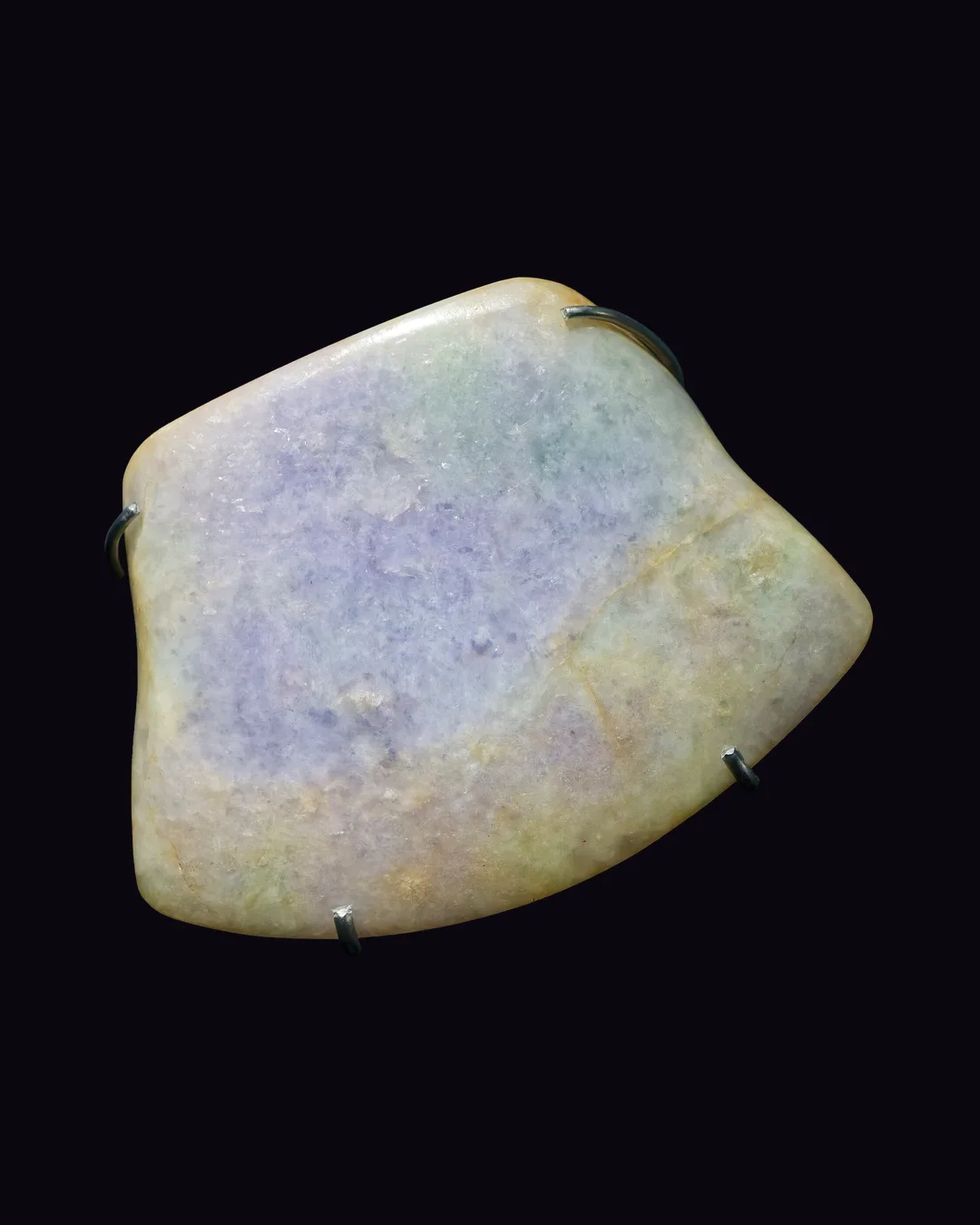
Jadeite Jade
Jadeite (pyroxene group)
In China, jade has stood for virtue for thousands of years. Not luck. Virtue. Mesoamerican carvers valued it above gold. Most fine jadeite today comes out of Kachin State in Myanmar, where the mining is dangerous and people die in the pits. Here is what the counter does not volunteer. Jadeite is graded by treatment. Type A is natural. Type B is soaked in acid and filled with plastic, and it dulls and cracks over the years. Type C is dyed. Only Type A holds value, and it is a thin slice of any shelf. You want one thing in your life that will not turn out to have been treated. Ask for Type A. Ask for it in writing.
People carry it for abundance, protection and calm. Tradition attaches it to the element earth, the heart chakra, Venus. It is most often given to Taurus, Libra, Virgo. It measures 6-7 on the Mohs scale.
Seen · you don't have this one yet
Common·Uncommon·Rare·Arcane
Jade is two different minerals, and this one is jadeite. What the label needs to tell you is the treatment grade. Type A is natural with surface wax only. Type B has been acid-bleached and polymer-impregnated, which looks better than it is and degrades over years. Type C is dyed. Type B plus C is both. Untreated Type A is the only material with lasting value, and it is a small share of the market.
What it is confused with
Nephrite jade, serpentine, dyed quartzite, green glass, chrysoprase, hydrogrossular
Jadeite takes a brighter, glassier polish than nephrite, the other mineral sold as jade. Under a 10x loupe the polished surface shows a grainy, sugary texture. Those are small interlocking crystals, and they give a subtle dimpled or orange-peel effect. The colour is usually uneven, sitting in patches, streaks and cloudy zones rather than spread evenly. The finest imperial green is intensely saturated and translucent. It is dense and cold to the touch, and it rings with a high clear tone when struck against another piece.
Commonly faked · check before you buy
How to tell
It should scratch glass and resist a knife, because jadeite is 6 to 7 on the hardness scale. It is dense for its size, and the polish has a grainy, sugary texture. The question that matters is not the species, though. It is the treatment grade. Hold it up to a light and look for a fine net of etched surface cracks filled with polymer. That means Type B. Under a 10x loupe, dye sitting in the fissures means Type C.
Jadeite is graded by treatment. Type A is natural, with surface wax only. Type B has been acid-bleached and polymer-impregnated, so it looks better than it is and it degrades over years. Type C is dyed. Type B plus C is both at once. Untreated Type A is the only material with lasting value, and it is a small share of the market. Ask for the grade in writing before you pay a Type A price.
The full mineral facts
Hardness, formula, and how the rock is put together.
Hardness
6-7 Mohs
Formula
NaAlSi2O6
Family
silicate
How it forms
Jadeite forms only where one slab of the earth's crust dives beneath another, under crushing pressure at surprisingly low heat, which is why it comes from very few places.
Where it comes from
Myanmar (Kachin State, Hpakant), Guatemala (Motagua Valley), Russia, Japan (Itoigawa), Kazakhstan
What it means
The moon is in Sagittarius today, so this is the Sagittarius read.
You were told no about small things for years by people who could not explain why.
Type A jade survives water, soap and a hundred years of being worn. Type B does not survive heat, solvents or a strong light left on it.
None of that shows on the day you buy it. The damage runs on a delay.
Sagittarius, you only ever get made under pressure and you have arranged your whole life to keep supplying it.
You were told no about small things for years by people who could not explain why. So no stopped meaning danger and started meaning obstacle.
It has served you well, and it built most of what you like about yourself. It has also walked you into a few rooms you knew about in advance.
Some warnings are only weather reports. You can go and still listen.
That is today's sky, not your chart. Add your birth details and this stone gets read against your own.
Read it for my chart →You know what this one would do for you. You just don't have it.
Jadeite Jade for every sign
AriesNow the first day of anything is the only place you feel sure of yourself.
Jadeite only forms where one slab of the earth's crust dives beneath another. It needs crushing pressure and surprisingly little heat, which is why almost nowhere on earth makes it.
The counter will not volunteer that jade is graded by treatment. Type B was bleached in acid and filled with plastic, and it dulls and crazes over the years.
Aries, the thing that made you strong was slow pressure, which is the one method you refuse to use on yourself.
Somebody praised how fast you began things and said nothing at all about the ninth week. You heard that.
Now the first day of anything is the only place you feel sure of yourself. The half done things in your flat are not laziness. They are the spots where the clapping stopped.
Jadeite took a continent moving to get made. Nobody watched that part either.
TaurusSomebody sold you something once and let you find out later.
Take it to the window and tilt it slowly. If you can see a fine net of etched cracks sitting under the polish, that is plastic, and a person put it there.
Type A jade is natural. Type B was soaked in acid and filled, and it goes on the same tray at nearly the same price.
Taurus, you distrust anything too shiny for what it costs, and you did not come by that suspicion for free.
Somebody sold you something once and let you find out later. You were young enough that it stuck.
Now you check the label twice and you still feel foolish for wanting the nice version. There is nothing greedy in that.
Ask for Type A. Ask for it in writing.
GeminiYou learned early that being clever kept people in the room longer than being honest did.
Somebody bleaches a poor piece of jadeite in acid, then forces resin into the gaps under pressure. It comes out brighter than it was born.
The trade calls that Type B. It looks better than it is, and in ten years it yellows and crazes and tells on itself.
Gemini, you can make yourself look better than you are and it does not hold up over years.
You learned early that being clever kept people in the room longer than being honest did. A funny version of a bad week gets you company.
The flat version gets you a change of subject. So the true answer sits underneath the good one, and nobody has asked for it in a long time.
Say the boring version out loud to one person tonight.
CancerYou still scan a room before you sit down in it.
Type A jade takes warm water and mild soap and keeps going for centuries. Type B is the one that cannot take heat, solvents or strong light.
The filled stone looks identical on the day you buy it. It only fails later, quietly, in a drawer.
Cancer, you can tell which people last and which ones only look it, and you keep choosing anyway.
Somebody in your house needed managing when you were small, and you got good at reading the weather before anyone spoke. That skill never turned off.
You still scan a room before you sit down in it. You call the ache afterwards nothing.
A slow leak does not look like damage until the year is over. You are allowed to say when it is costing you.
LeoYou got very good at the performance of fine, and you cannot tell where it ends.
Jadeite is a pyroxene, a hard granular mineral, and nephrite is a different stone entirely. Both get sold as jade and only one of them is this.
Then there is the grading. Type C is dyed, and the colour pools in the cracks where a loupe can find it.
Leo, you have been mistaken for somebody easier and you let it go every single time.
You were the reliable one at fourteen. Bright, easy, no trouble at all.
People started bringing you their weeks, and nobody thought to ask about yours. You got very good at the performance of fine, and you cannot tell where it ends.
Somebody would stay for the flat version of you. You have never let them try.
VirgoYou still sort the drawer when the real thing is sitting in the next room.
This stone was made where two plates met and one went under. Crushing pressure, low heat, an age of it, and no way to hurry any part of it.
What people do hurry is the finish. Acid, resin and dye, all of it applied so a poor piece can sit beside a good one.
Virgo, you know exactly how much of yourself is real and you have never told anyone the number.
There was a stretch when everything at home was going wrong and the only thing you could control was the kitchen. So you controlled the kitchen.
It worked, in the sense that it gave your hands somewhere to be. You still sort the drawer when the real thing is sitting in the next room.
The real thing is patient. It will wait for you.
LibraYou learned to find the answer that keeps everyone in the room.
Put it under a loupe and look into the fissures. If the colour sits in the cracks instead of running through the stone, it was dyed.
That is Type C. The dye fades, and the person who sold it knew the word jade would do the rest.
Libra, the warmth you show people sits in the cracks, and you know exactly where it stops.
You grew up where a raised voice meant something was about to break. You learned to find the answer that keeps everyone in the room.
It works. It works so well that you stopped noticing you are the one paying for it.
Somebody should ask what you actually wanted for dinner. What did you want?
ScorpioYou run every real feeling through a filter first to see what it will cost you.
Somebody takes a dull piece of jadeite, soaks it in acid until the stains lift, then pushes plastic into the holes that are left. It comes out looking honest.
The trade calls it Type B and prices it near the real thing. In ten years it yellows and gives itself away.
Scorpio, you were treated as valuable long before anybody asked what it cost to get you.
It started with one person who could not hold what you brought them and decided the problem was the size of it. You believed them.
You run every real feeling through a filter first to see what it will cost you. That filter has been on since you were about nineteen.
You are not too much. You were handed to people who were too small for it.
SagittariusYou were told no about small things for years by people who could not explain why.
Type A jade survives water, soap and a hundred years of being worn. Type B does not survive heat, solvents or a strong light left on it.
None of that shows on the day you buy it. The damage runs on a delay.
Sagittarius, you only ever get made under pressure and you have arranged your whole life to keep supplying it.
You were told no about small things for years by people who could not explain why. So no stopped meaning danger and started meaning obstacle.
It has served you well, and it built most of what you like about yourself. It has also walked you into a few rooms you knew about in advance.
Some warnings are only weather reports. You can go and still listen.
CapricornYou were small and you took the maths as given.
In China jade has stood for virtue for thousands of years. Not luck. Virtue, which is a much harder thing to sell.
The grading is where the counter goes quiet. Type A is untouched. Type B was bleached and filled, and untouched jade is a thin slice of any shelf.
Capricorn, you keep a ledger of your own days and most of them come out short.
Somebody in your family measured worth by what got done, out loud, at the table, for years. You were small and you took the maths as given.
Now a slow day reads as debt. Rest gets filed as a loss, and so does most of what actually made you.
The people who love you are not reading that ledger. Close it for one evening.
AquariusYou do not know what you want on a Tuesday.
Jadeite comes from a handful of places, because it needs one plate driving under another to exist at all. Most of the fine material comes out of Kachin State in Myanmar, where the mining is dangerous and people die in the pits.
The shop tells you the colour and the price. It does not tell you that part.
Aquarius, you always want to know what a thing cost somebody, and it has made you difficult at dinner.
You worked out young that if you understood the system you could not be blindsided by it. That was true, and it saved you.
It also put a pane of glass between you and the rest of it. You know exactly why people do what they do. You do not know what you want on a Tuesday.
Start there. Nowhere else.
PiscesYou still walk out of a room carrying somebody else's afternoon.
To make Type C jade, somebody drops a pale stone in dye and lets the colour creep into every crack. It sells as the good green.
The dye fades in the end. The stone underneath was always the stone underneath.
Pisces, you got handed the role of the good one at eleven and nobody offered you a way out.
You were the one people told things to, from about eleven, because you did not flinch and you did not repeat it. Nobody checked what that was doing to you.
You still walk out of a room carrying somebody else's afternoon. You cannot work out why you are so tired by six.
A door is not a wall. You are allowed one room nobody gets into.
Correspondences
What tradition attaches to this stone. Folklore, not chemistry.
Element
earth
Planet
Venus
Chakra
heart
Signs
taurus, libra, virgo, gemini
What tradition says
In crystal lore, jadeite carries jade's attributions of prosperity, protection and moral integrity. Chinese tradition ties jade specifically to virtue rather than to luck. Mesoamerican traditions valued it above gold.
Care
- Water is fine. Dry it afterwards.
- Type A is durable. Warm water and mild soap. Type B is polymer-filled and will yellow, craze and dull over years. Type C dye fades. Keep anything other than Type A away from heat and solvents, and away from ultrasonic cleaners and strong light.
Common questions
What does jadeite jade mean?
Jadeite Jade is carried for abundance, protection and calm. In China, jade has stood for virtue for thousands of years. Tradition links it to the heart chakra.
Is jadeite jade real or fake?
Jade is two different minerals, and this one is jadeite. What the label needs to tell you is the treatment grade. It should scratch glass and resist a knife, because jadeite is 6 to 7 on the hardness scale. It is dense for its size, and the polish has a grainy, sugary texture. Jadeite is graded by treatment.
Can jadeite jade go in water?
A short rinse is fine for jadeite jade, then dry it.
Rare · emerald green, apple green, lavender, white, yellow, orange, black, blue-green
Where this leads
This stone belongs to
Related crystals
FOR ENTERTAINMENT AND REFLECTION. NOT MEDICAL, PSYCHOLOGICAL, FINANCIAL OR LEGAL ADVICE. How this works