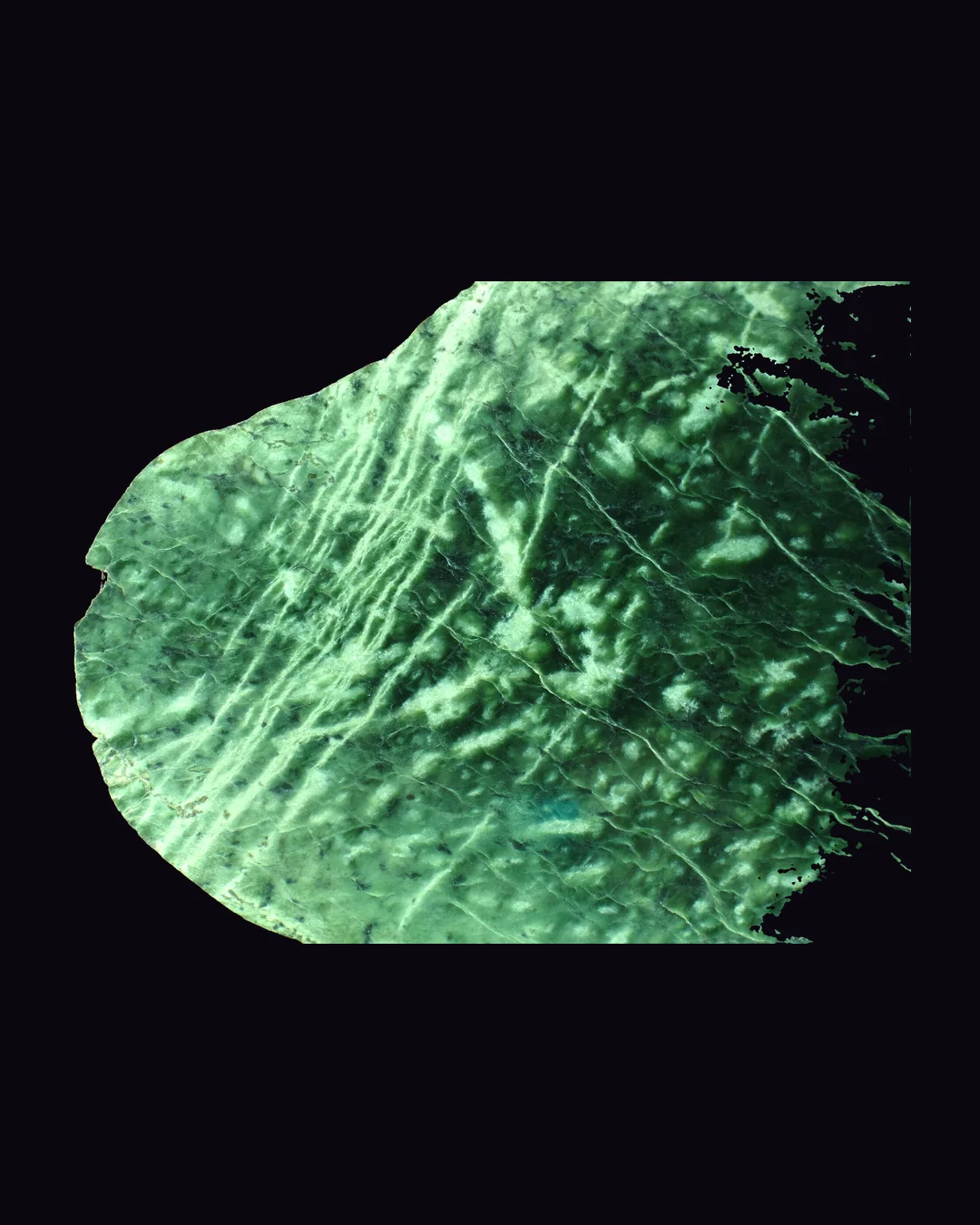
Nephrite Jade
Nephrite (tremolite-actinolite amphibole)
In Aotearoa New Zealand, pounamu is nephrite. Māori tradition holds it as taonga, treasure that carries everyone who held it before you. In China it has been carved for thousands of years. Long before jewellery, people made axe heads of it, because it does not break. Nephrite is a felt of tangled fibres rather than a block of crystal. A blow spreads out instead of splitting it. Tap a real piece and it rings. The trouble here is not treatment. It is swaps. Serpentine and dyed quartzite get sold as jade, and so does glass. You want to be harder to knock over. Not colder, not meaner. Just harder to knock over. Tough and hard are not the same thing.
People carry it for protection, abundance and calm. Tradition attaches it to the element earth, the heart chakra, Venus. It is most often given to Taurus, Libra, Virgo. It measures 6-6.5 on the Mohs scale.
Seen · you don't have this one yet
Common·Uncommon·Rare·Arcane
Serpentine, dyed quartzite and glass are all sold as jade. None of them is jade. The name covers two minerals only, nephrite and jadeite, and both of those are genuine.
What it is confused with
Jadeite jade, serpentine, green aventurine, prehnite, dyed quartzite, bowenite
It gets confused with serpentine, dyed quartzite, glass and jadeite. Nephrite is dense and even, with a waxy, oily shine and a soft glow from inside rather than a glassy surface. Its fibres interlock like felt, which makes it exceptionally tough, so it does not chip along edges the way most stones do. The colour is usually even or cloudy with soft mottling, not sharply veined. Broken or unpolished edges look splintery and fibrous, never curved and shell-like. Tap it and it rings with a clear bell-like tone. It feels heavy and cold in the hand.
Commonly faked · check before you buy
How to tell
Try a steel knife on a hidden spot. Nephrite is 6 to 6.5 on the Mohs scale, so the knife leaves no mark, and the stone will scratch glass. It is also extremely tough, with a waxy, oily shine. Serpentine, the usual substitute, is far softer and the knife bites straight into it. Against jadeite, look at a broken edge. Nephrite breaks splintery and fibrous, jadeite breaks grainy. Both are properly called jade and both are the real thing.
Nephrite is treated far less than jadeite, but dyeing and wax coating do happen. The bigger problem is substitution. Serpentine, dyed quartzite and plain glass are all sold as jade.
The full mineral facts
Hardness, formula, and how the rock is put together.
Hardness
6-6.5 Mohs
Formula
Ca2(Mg,Fe)5Si8O22(OH)2
Family
silicate
How it forms
Nephrite formed where serpentine rock met silica-rich rock under heat and pressure, growing as a dense felt of interlocked amphibole fibres rather than single crystals.
Where it comes from
China (Xinjiang, Hetian), New Zealand (Te Waipounamu / South Island), Canada (British Columbia), Russia (Siberia), Taiwan, USA (Wyoming, Alaska)
What it means
The moon is in Gemini today, so this is the Gemini read.
Somebody asks how you actually are and you have four funny replies loaded already.
Nephrite is one of the toughest things in the trade. It is genuinely hard to break, which is why people made axe heads of it thousands of years before they made ornaments.
What harms it is not a knock. It is long heat, which dries out a waxed piece. Raw amphibole rock should also never be dry-ground, because of the dust.
Gemini, you can talk your way out of anything, including the conversation you need.
You learned young that a quick answer ended the questioning, and it worked so well you never stopped. Somebody asks how you actually are and you have four funny replies loaded already.
They wanted the slow one. You did not know that was on offer.
What would happen if you answered second?
That is today's sky, not your chart. Add your birth details and this stone gets read against your own.
Read it for my chart →You know what this one would do for you. You just don't have it.
Nephrite Jade for every sign
AriesNow you take the blow, keep walking, and fall apart alone at eleven at night.
Nephrite grew where serpentine rock met silica-rich rock under heat and pressure. Instead of single crystals it came out as a dense felt of tangled fibres.
In Aotearoa New Zealand this stone is pounamu, and Māori tradition holds it as taonga, treasure that carries everyone who held it before you. That is a living practice with its own protocols, not shop symbolism.
Aries, you would rather take the hit than admit that one landed.
Somewhere young you learned that flinching got you laughed at, so you stopped doing it where anyone could see. Now you take the blow, keep walking, and fall apart alone at eleven at night.
You call that strength. It is a private version of the same bruise.
Tough and hard are not the same thing.
TaurusYou had let yourself want it out loud first.
Pick it up and tap it against something. Real nephrite rings, and it has a waxy oily look rather than a glassy one.
Serpentine, dyed quartzite and glass all get sold as jade. A steel knife will not scratch nephrite, and nephrite scratches glass straight back.
Taurus, you have a very long memory for the time somebody sold you a story.
It was not even expensive. It was the being fooled that stayed. You had let yourself want it out loud first.
Since then you check everything twice and you buy almost nothing. Wanting quietly feels safer than wanting where anybody can watch.
Want one thing out loud this week.
GeminiSomebody asks how you actually are and you have four funny replies loaded already.
Nephrite is one of the toughest things in the trade. It is genuinely hard to break, which is why people made axe heads of it thousands of years before they made ornaments.
What harms it is not a knock. It is long heat, which dries out a waxed piece. Raw amphibole rock should also never be dry-ground, because of the dust.
Gemini, you can talk your way out of anything, including the conversation you need.
You learned young that a quick answer ended the questioning, and it worked so well you never stopped. Somebody asks how you actually are and you have four funny replies loaded already.
They wanted the slow one. You did not know that was on offer.
What would happen if you answered second?
CancerThey think you do not need anything, because you have never once shown them otherwise.
Nephrite is not one crystal. It is a mass of interlocked amphibole fibres, matted together like felt.
That is why a blow spreads out through it instead of splitting it. In Chinese tradition it has been carved for thousands of years, and the axes came long before the ornaments.
Cancer, you absorb what other people throw and you call it being close.
It started in a house where somebody's bad night became everybody's, and you were the youngest one capable of holding it. So you got very good at taking it and staying pleasant.
The cost is that nobody has ever seen you go first. They think you do not need anything, because you have never once shown them otherwise.
Go first once. It does not have to be big.
LeoNobody has ever asked what the morning looks like.
Somebody dyed a lump of quartzite green and put it in a case marked jade. Somebody else waxed a dull piece of real nephrite to make the colour look richer.
Neither of them mentioned it. Wax comes off with heat, and then the stone underneath looks like the one they did not want you to see.
Leo, you have been polishing the outside since you were about nine.
There was a year when the attention stopped, or moved to somebody else, and you quietly worked out what to do about that. Ever since, you arrive already at your best and the room never sees the setting-up.
It works. People love the finished version. Nobody has ever asked what the morning looks like.
Let one person see it unwaxed.
VirgoYou found the only lever you could reach and you have been pulling it ever since.
Nephrite formed where serpentine met silica-rich rock under heat and pressure. What came out was not a crystal but a knot of fibres grown through each other.
In Aotearoa New Zealand it is pounamu, and Māori tradition holds it as taonga, carrying the people who held it before. That is a living practice with its own protocols, not crystal-shop symbolism.
Virgo, nothing has managed to break you, so you have started keeping score of the scratches instead.
The night the real thing hurt, you cleaned the oven. The week somebody went quiet on you, you re-did every folder on your phone.
It started at about nine, in a house where something was wrong that no child was allowed to name. You found the only lever you could reach and you have been pulling it ever since.
Nothing on that list is the thing.
LibraBy the time you finish you are too tired to want anything.
Hold it up and turn it in the light. Nephrite looks waxy and slightly oily, and a broken edge shows splinters rather than grains.
Serpentine looks close enough and is far softer. It is the commonest swap in the case, and plenty of sellers do not know either.
Libra, you look smooth right up until you break, and then it comes out in splinters.
Every choice you make has somebody's face on it. You do the arithmetic on who gets hurt by which version. By the time you finish you are too tired to want anything.
You learned that at a table where one person's mood decided the whole evening. Reading it early was survival then. It is not survival now.
Whose face is on the thing you are not saying?
ScorpioYou do not tell people the whole size of a thing.
Nephrite survives what breaks other stones. A steel knife will not mark it, and it takes a hit without splitting, because the fibres inside are tangled instead of stacked.
The danger is heat over time. A waxed piece dries out, and the coating that was hiding the flaws goes first.
Scorpio, you carry every person who held you and you have never handed one of them over.
You do not tell people the whole size of a thing. You hand over the first quarter, watch their face, and if it flickers you stop there.
So they get a version, and then they complain that you are private. The ones who could have taken all of it never got the chance to prove it.
Give one person the second quarter.
SagittariusWhenever something got real you found a reason to be elsewhere by spring.
Somebody soaked a piece of quartzite in green dye and sold it as jade. It is the oldest swap in the trade and it still works on nearly everyone.
Real nephrite scratches glass and a steel knife will not mark it. Serpentine, the other common stand-in, is far softer than both.
Sagittarius, you are held together by hundreds of small things and you give one away every week.
The people doing the warning were unhappy, and you noticed that before you were old enough to say it out loud. So you decided caution was a symptom and went hard the other way.
It has been a good life. Whenever something got real you found a reason to be elsewhere by spring.
Not everyone who wants you to stay is trying to shrink you.
CapricornYou learned that you would be kept for what you carried.
This is not a crystal in any normal sense. It is a felt of amphibole fibres, grown through each other so tightly that the whole thing behaves as one piece.
People made axe heads of it thousands of years before anyone made a pendant. Being useful is the older half of its history.
Capricorn, being useful is the older half of you and you have never tried the other half.
The days that produced nothing get written off. So do the evenings you spent making somebody else's crisis survivable, and the year you held a household together while working full time.
You learned that you would be kept for what you carried. Nobody has offered to take a corner of it since, and you have stopped expecting it.
The load was never the reason they stayed.
AquariusYou learned to watch from outside because inside was not safe to be.
Nephrite grew slowly, where two kinds of rock met under pressure, and it never formed one clean crystal. It formed a tangle instead.
In China it has been worked for thousands of years, and in Aotearoa New Zealand it is pounamu, held by Māori tradition as taonga. Both are living practices with their own protocols.
Aquarius, nothing about how you got here is tidy and it is the tangle that has kept you standing.
You can name a friend's whole situation in two sentences and be right about it. Then you go home and cannot describe your own last three years at all.
You learned to watch from outside because inside was not safe to be. Nobody ever told you the watching was allowed to stop.
Who gets to tell you what is happening to you?
PiscesSomebody else's mood is in you before you have worked out it was theirs.
Put it in your hand and keep it there a minute. Nephrite warms slowly, and the surface has an oily softness that glass never quite copies.
Glass is one of the things sold as jade. So is dyed quartzite. A piece that turns up too green and too cheap usually is one of those.
Pisces, you carry everyone who held you, and no one has ever asked whether that is heavy.
Somebody else's mood is in you before you have worked out it was theirs. You have been told to harden up by people who have never once had to do that sorting.
The wall is not going to happen for you. What you can learn is the moment it walked in, and whose coat it was wearing.
Tonight, when it lands, ask whose it was.
Correspondences
What tradition attaches to this stone. Folklore, not chemistry.
Element
earth
Planet
Venus
Chakra
heart
Signs
taurus, libra, virgo, aries
What tradition says
Chinese and Māori jade traditions are living cultural practices with their own protocols. They are not generic crystal-shop symbolism. Within crystal lore more broadly, nephrite is kept for protection, for long life and for inherited good fortune.
Care
- Water is fine. Dry it afterwards.
- This is one of the toughest materials in the trade and is genuinely hard to break. Warm water and mild soap. Keep it away from long spells of heat, which dries out waxed pieces.
Nephrite is an amphibole mineral. Solid massive nephrite is not asbestos-like and is safe. Do not dry-grind raw amphibole rock.
Common questions
What does nephrite jade mean?
Nephrite Jade is carried for protection, abundance and calm. In Aotearoa New Zealand, pounamu is nephrite. Tradition links it to the heart chakra.
Is nephrite jade real or fake?
Serpentine, dyed quartzite and glass are all sold as jade. None of them is jade. Try a steel knife on a hidden spot. Nephrite is 6 to 6.5 on the Mohs scale, so the knife leaves no mark, and the stone will scratch glass. Nephrite is treated far less than jadeite, but dyeing and wax coating do happen.
Can nephrite jade go in water?
A short rinse is fine for nephrite jade, then dry it.
Uncommon · spinach green, creamy white, olive, grey-green, black-green, yellow-brown
Where this leads
This stone belongs to
Related crystals
FOR ENTERTAINMENT AND REFLECTION. NOT MEDICAL, PSYCHOLOGICAL, FINANCIAL OR LEGAL ADVICE. How this works