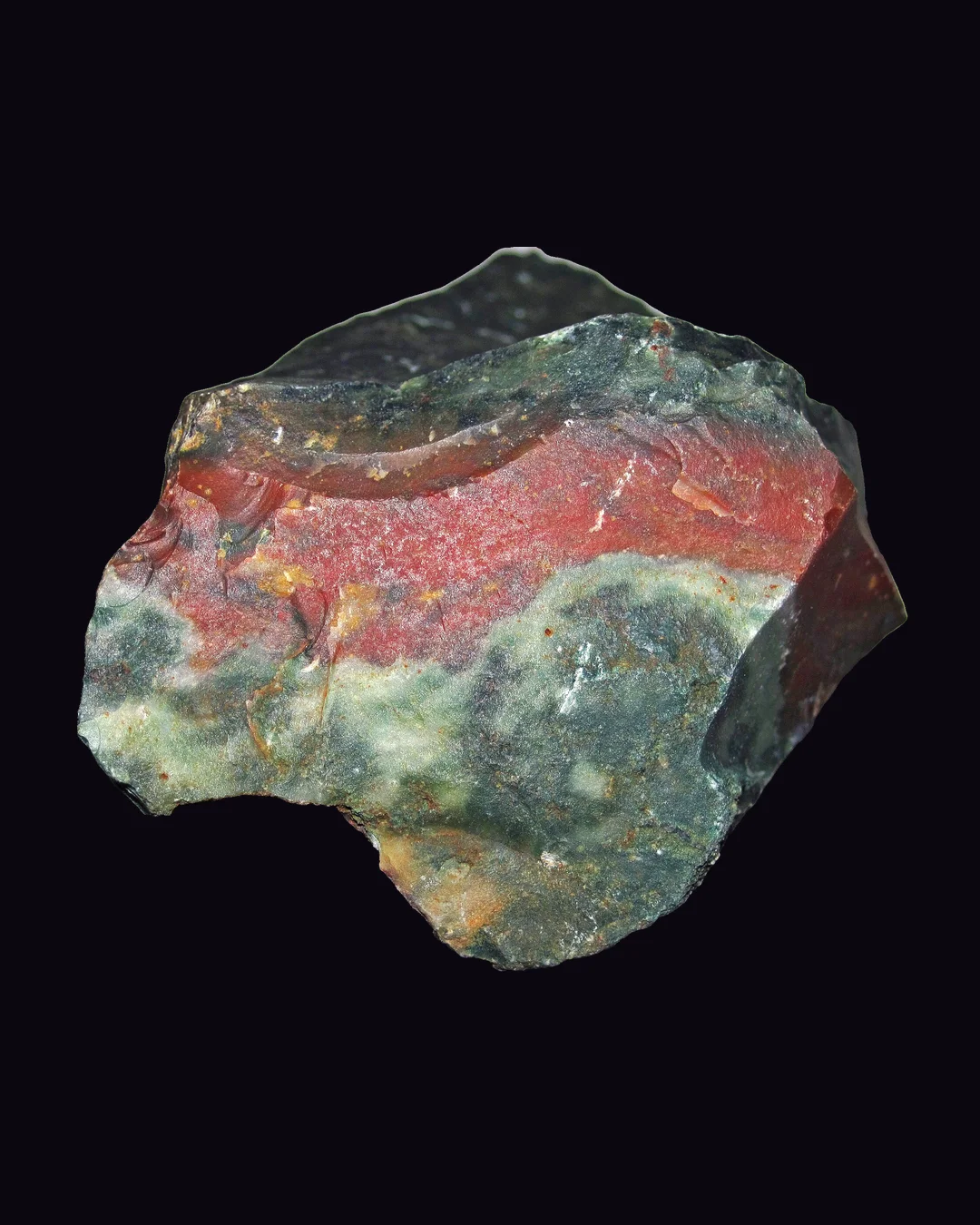
Bloodstone
Green jasper/chalcedony with hematite inclusions
Bloodstone set inside old lava. Hot water full of silica filled the gas pockets and stiffened, catching green flecks and rust red iron as it went. Medieval writers looked at the red and decided it was blood fallen at the cross. The name held for six hundred years. The spots have to be inside the stone. Break an edge and real red sits in the body in three dimensions, while dyed copies show red only in surface cracks. You are getting through something you never agreed to. Not fixing it. Getting through it, one morning at a time. And you are pleasant to everyone while you do it, because being a burden was never an option in your house. Put it where your keys land.
People carry it for courage, protection and grounding. Tradition attaches it to the element fire, the root, heart chakra, Mars. It is most often given to Aries, Pisces, Scorpio. It measures 6.5-7 on the Mohs scale.
Seen · you don't have this one yet
Common·Uncommon·Rare·Arcane
What it is confused with
Green jasper, moss agate, unakite, serpentine, dyed jasper
Bloodstone is a dark, nearly black-green opaque chalcedony flecked with blood-red to rust-orange spots and streaks of hematite. The red marks sit at random. They are not banded, not in rings and not evenly spread, and they run from pinhead specks to broad smears. The body colour is a deep chrome to olive green with a waxy shine, and thin edges may pass dark green light. A piece with no red spots at all is properly called plasma.
How to tell
It scratches glass. Then look at the red spots on a broken or chipped edge. On real bloodstone the red is opaque hematite sitting inside the body of the stone, and you can see it has depth. Dyed imitations carry red only in surface cracks. Unakite is a different rock again. Its pink is feldspar in separate grains, and the texture is grainy rather than waxy.
The full mineral facts
Hardness, formula, and how the rock is put together.
Hardness
6.5-7 Mohs
Formula
SiO2 + Fe2O3
Family
chalcedony
How it forms
Bloodstone formed when silica rich water filled gas pockets in old lava and set, with green mineral flecks and red iron oxide caught inside it.
Where it comes from
India (Deccan Traps), Brazil, Australia, Scotland (Isle of Rum), USA
What it means
The moon is in Sagittarius today, so this is the Sagittarius read.
Now when someone who loves you says be careful, what reaches you is be smaller.
Old lava sat empty for a long time before anything filled it. Silica water crept into the gas pockets and hardened, and the rust came in with it, unhurried.
None of that could be rushed. The one part everybody wants, the red, was the slowest part of all.
Sagittarius, you carry the red bits where everyone can see them and still say nothing happened.
You were told no about a hundred harmless things when you were small. The nos were wrong so often that you stopped sorting them and binned the lot.
Now when someone who loves you says be careful, what reaches you is be smaller. So you go anyway, and a few of those cost you more than you have ever said.
Not every closed door was built against you.
That is today's sky, not your chart. Add your birth details and this stone gets read against your own.
Read it for my chart →You know what this one would do for you. You just don't have it.
Bloodstone for every sign
AriesNow the second month of anything feels like a room with the lights off.
Hold it up. The dark green is old lava, and the red flecks are rust that got caught while hot water set inside a gas pocket.
Medieval writers saw the red and called it blood from the cross. That name stuck for six hundred years to a rock full of iron.
Aries, you keep proving you can take it, and nobody set that test but you.
You were praised for the sprint. Somebody in your family loved you loudest at the beginning of things, and you learned to keep supplying beginnings.
Now the second month of anything feels like a room with the lights off. You call it losing interest. It is closer to losing the audience.
Stay through one boring stretch. That is where it gets real.
TaurusNow you make everyone prove it over a year before you exhale.
It is green jasper with iron oxide spots inside it. No blood, no miracle, just rust that was there before anyone had a story about it.
Here is the test the shop skips. Real red sits deep in the body of the stone. Dyed copies show red only in the surface cracks.
Taurus, you stopped trusting anything cheap and shiny because somebody made you pay to learn it.
There was a person who arrived generous and left fast. Or a job, or a flat, or a promise made in a kitchen. You were young enough that it rewrote how you look at people.
Now you make everyone prove it over a year before you exhale. Most of them do not stay that long.
Some of the good ones left in month four.
GeminiNone of them could say what happened to you last year.
This one survives nearly everything. Warm water, soap, sunlight, a pocket full of keys for twenty years without a mark.
What ruins it is nothing dramatic. It gets swapped for a dyed one on a market stall, and the buyer never checks the broken edge.
Gemini, you make the hard part small by mentioning it quickly, and it is not small.
In your house the honest sentence made things worse, so you learned to be interesting instead of clear. It worked then. It still works now.
People describe you as easy company. None of them could say what happened to you last year.
The good version is not the true one.
CancerYou got calm at eight years old and stayed there.
The lava was already cold and dead when this started. Water full of silica crept into the empty gas pockets and set, one thin layer at a time, over an age.
Nothing about it was fast. The red only got there because iron was carried in slowly and left behind.
Cancer, you moved into somebody's empty life and filled it slowly, and now they cannot tell you apart.
You were the one who read the room before anyone spoke. Somebody at that table needed you calm. You got calm at eight years old and stayed there.
Now the feeling turns up on a Thursday, in the car, three days late. You think that means you are making it up.
What would happen if you let it land on the day?
LeoAsk you how you are and you will genuinely have to think about it.
Somebody in a workshop in India cut this out of the Deccan lava, polished it and priced it. The green and the red were already there.
What was added was the story. Six hundred years of calling the rust holy, because holy sells better than iron.
Leo, somebody else set your price and you have never once argued with it.
You were the good mood at home. Someone there was struggling, and a bright child made the house survivable, so you became one.
Now you can tell a friend is off from one text. Ask you how you are and you will genuinely have to think about it.
Nobody trained you to be the one checked on.
VirgoYou were an easy child in a house where easy was the safest thing to be.
Turn it to the light. The red is not painted on, it sits down inside the green in three dimensions, which is how you know it is real.
The dyed ones only show red in the surface cracks. That is the whole difference between the honest stone and the one that was helped.
Virgo, you have been carrying a small red worry about your body for months and you have told nobody.
The drawer gets sorted at eleven at night. The list gets rewritten neater. Underneath is one thing with no fix, and you have known that since spring.
You were an easy child in a house where easy was the safest thing to be. That was clever then. It is exhausting now.
Some things are only survivable, not solvable.
LibraYou learned the weather report before you learned your own preferences.
Strip the name off and it is chalcedony with rust in it. Green quartz and iron, made when water set inside a hole in cold lava.
The blood story came later and from someone else. The stone has carried a name it did not choose since the twelfth century.
Libra, you keep the green on the outside and the rust where nobody else has to deal with it.
One person's mood ran your whole house growing up. You learned the weather report before you learned your own preferences.
Now you can talk for an hour about what everyone else would like. Someone asks where you want to eat and you go blank, and the blank frightens you.
The blank is not emptiness. It is a habit.
ScorpioWhole years of you have gone unwitnessed because of one sentence.
It takes water and hard use without complaint. Six and a half on the hardness scale, which means it scratches glass and shrugs off a pocket.
What it does not survive is being fake. A dyed copy looks identical until you break an edge, and then the red is only in the cracks.
Scorpio, a wrong reading of you has been in circulation so long that people quote it as fact.
You were young. They meant it as help. Too much, too intense, and it landed like a diagnosis instead of an opinion.
Now you test a feeling for what it will cost before you let anyone see it. Whole years of you have gone unwitnessed because of one sentence.
Who decided the volume, and why do you still obey them?
SagittariusNow when someone who loves you says be careful, what reaches you is be smaller.
Old lava sat empty for a long time before anything filled it. Silica water crept into the gas pockets and hardened, and the rust came in with it, unhurried.
None of that could be rushed. The one part everybody wants, the red, was the slowest part of all.
Sagittarius, you carry the red bits where everyone can see them and still say nothing happened.
You were told no about a hundred harmless things when you were small. The nos were wrong so often that you stopped sorting them and binned the lot.
Now when someone who loves you says be careful, what reaches you is be smaller. So you go anyway, and a few of those cost you more than you have ever said.
Not every closed door was built against you.
CapricornYou were taught that being useful was how you stayed wanted.
Medieval writers gave this stone its name. They saw red inside green, decided it was blood from the cross, and wrote it down firmly enough to hold for six hundred years.
Nobody credited the water and the iron that actually did the work. The story got the name. The rock got the labour.
Capricorn, somebody else got the credit and you told yourself the work was its own reward.
If a day produced nothing you file it as a loss. Rest goes in that file. So does the year you spent keeping other people upright.
You were taught that being useful was how you stayed wanted. You have never once run the experiment.
Nobody who stayed was keeping score.
AquariusYour own wanting arrives as a theory, with sources, and never as a plain sentence.
Look at the broken edge, not the polished face. The red goes down into the body of the stone, which is the only proof that nobody dyed it.
That is the test almost no shop mentions. The fakes are convincing on the outside and empty two millimetres in.
Aquarius, you are asked constantly how you are and you answer two millimetres deep every time.
You were the child who explained the family to itself and got called cold for the accuracy. So you stepped back a pace and watched, because watching did not get you in trouble.
Now you know what everyone in your life needs. Your own wanting arrives as a theory, with sources, and never as a plain sentence.
What do you want, said in six words or fewer?
PiscesYou had to know it before it walked in.
It is green chalcedony with rust inside it. Water carried iron into a hole in dead lava and left it there, and that is all the red ever was.
People needed it to be blood. Six centuries of wanting a stone to mean something is its own kind of evidence, just not about the stone.
Pisces, somebody once decided what your marks meant and the story outlived them.
The mood of one adult filled your whole childhood house. You had to know it before it walked in. So you got very good at feeling things early and quietly.
Now you carry a stranger's bad afternoon home and cannot find the moment you picked it up. People call it sensitivity. It was a survival skill.
Put it where your keys land and touch it on the way out.
Correspondences
What tradition attaches to this stone. Folklore, not chemistry.
Element
fire
Planet
Mars
Chakra
root, heart
Signs
aries, pisces, scorpio, libra
What tradition says
In crystal lore, bloodstone is kept for courage, for vitality and for holding on through a hard stretch. Medieval Christian tradition read the red flecks as the blood of Christ. It is still an alternative March birthstone.
Care
- Water is fine. Dry it afterwards.
- Very durable. Warm water and soap will do. Very little troubles it.
Common questions
What does bloodstone mean?
Bloodstone is carried for courage, protection and grounding. Bloodstone set inside old lava. Tradition links it to the root, heart chakra.
Is bloodstone real or fake?
Bloodstone is not faked often, but it is still worth checking. It scratches glass. Then look at the red spots on a broken or chipped edge.
Can bloodstone go in water?
A short rinse is fine for bloodstone, then dry it.
Common · dark green with red spots, olive-green, green with yellow flecks
Where this leads
This stone belongs to
Related crystals
FOR ENTERTAINMENT AND REFLECTION. NOT MEDICAL, PSYCHOLOGICAL, FINANCIAL OR LEGAL ADVICE. How this works