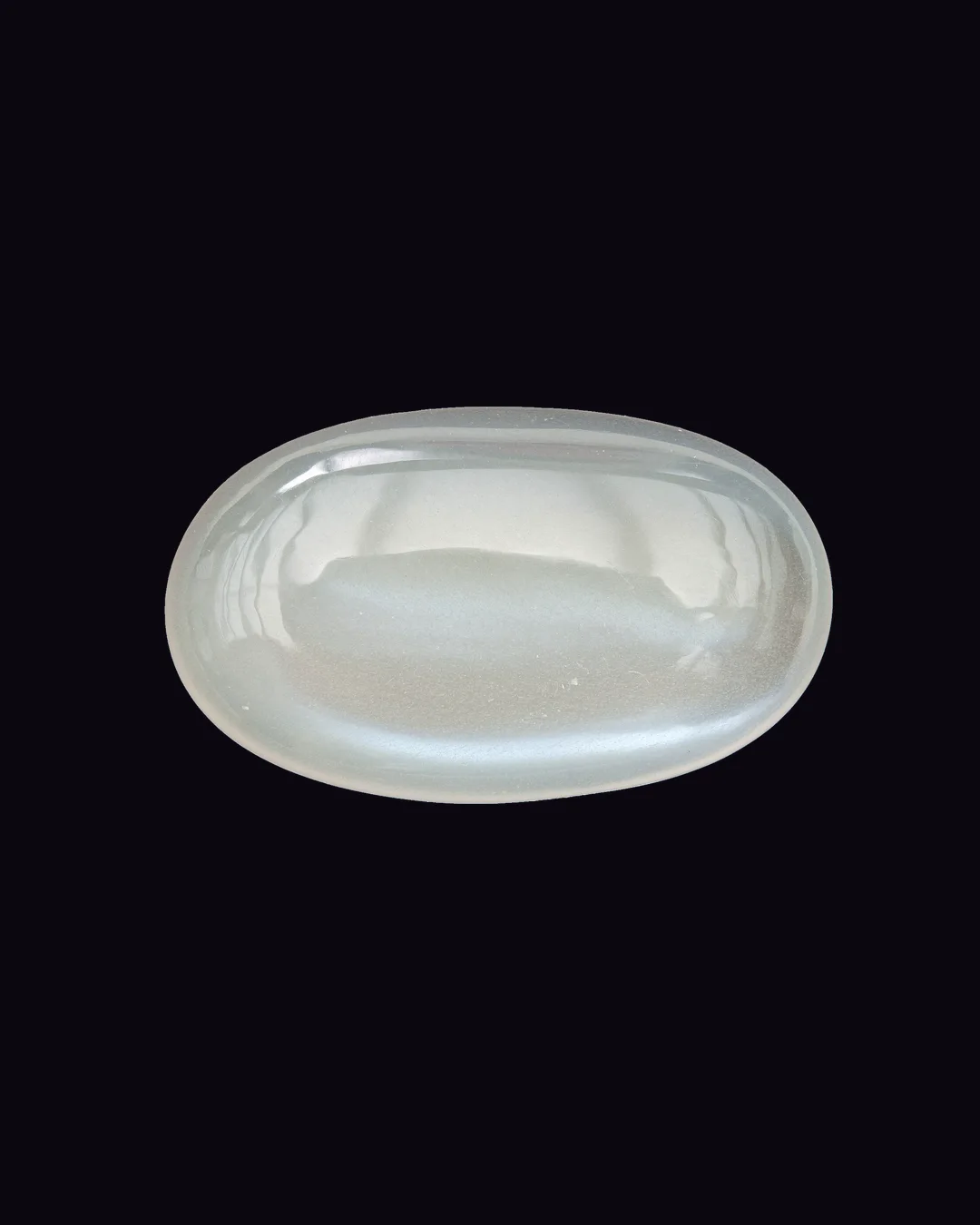
Rainbow Moonstone
Labradorite (plagioclase), NOT orthoclase moonstone
This is white labradorite, a feldspar. It is not moonstone at all. Moonstone is a different feldspar. Somebody in the trade renamed it, because moonstone sells and white labradorite does not. The name stuck so hard it is now what everybody searches for, us included. The blue flash is real and nobody added it. As the stone cooled it separated into very fine layers inside, and light bouncing between them comes back blue. True moonstone glows soft and all over. This one flashes in patches and carries black needles. You have answered to a name that was never quite yours. Correcting people felt rude, and then it felt too late. The flash was always yours. The label was somebody's marketing.
People carry it for intuition, calm and protection. Tradition attaches it to the element water, the third-eye, crown, sacral chakra, Moon. It is most often given to Cancer, Pisces, Libra. It measures 6-6.5 on the Mohs scale.
Seen · you don't have this one yet
Common·Uncommon·Rare·Arcane
What it is confused with
Moonstone, labradorite, opalite, aura quartz, milky quartz
It gets sold as moonstone, and mineralogically it is labradorite. The body is clear to milky white and flashes sharp electric blue, often with violet, gold and green. The flash comes in defined patches or streaks rather than a soft all-over glow. That patchiness is the tell. It is labradorescence in a pale plagioclase feldspar, not the adularescence of true moonstone. It almost always holds obvious black needle-like inclusions and internal fracture veils that throw genuine spectral rainbows. There are two cleavages at about 90 degrees and fine parallel twinning striations.
How to tell
Watch how the light behaves, not how hard the stone is. Sharp blue flash in separate patches on a white body, together with black needle inclusions, means labradorite sold as rainbow moonstone. True moonstone glows soft, continuous and billowy right across the stone. Both are feldspars at 6 to 6.5 on the Mohs scale, so hardness will not separate them.
It is not treated, but it is persistently misnamed. Mineralogically this is white labradorite. The crystal trade sells it as moonstone, so that is the name on the label and the name you will search. It is a real stone and a good one. It is just not moonstone.
The full mineral facts
Hardness, formula, and how the rock is put together.
Hardness
6-6.5 Mohs
Formula
(Ca,Na)(Al,Si)4O8
Family
feldspar
How it forms
It crystallised out of cooling magma as plagioclase feldspar, and as it cooled it separated inside into very fine alternating layers that bounce light back blue.
Where it comes from
India, Madagascar, Sri Lanka, Tanzania
What it means
The moon is in Gemini today, so this is the Gemini read.
You say I am fine so often that the true one would sound strange.
Hold it up and turn it. The flash arrives in patches, then leaves, because inside the stone light is bouncing off layers thinner than a hair.
True moonstone glows soft and all over. This one flashes and hides, and carries black needles you can see if you look.
Gemini, you go by the name that gets the best response and you have almost forgotten the other one.
Somewhere back there, plain got you nothing. Being clever got you the room.
So you learned to arrive with a better version, funnier and quicker. The cost is that nobody has met the flat answer in years. You say I am fine so often that the true one would sound strange.
What would you say if the room did not need entertaining?
That is today's sky, not your chart. Add your birth details and this stone gets read against your own.
Read it for my chart →You know what this one would do for you. You just don't have it.
Rainbow Moonstone for every sign
AriesSo you learned that the good part of you was the launch.
This started as magma, cooling underground with no rush and no witness. As it cooled it split inside into layers so fine that light bounces between them and comes back blue.
Nobody added that flash. Somebody did add the name, because moonstone sells and white labradorite does not.
Aries, you have been called difficult since you were about seven and you decided to be good at it.
You were the kid who got praised for being quick. Fast at reading, fast at running, fast with an answer.
So you learned that the good part of you was the launch. Nobody clapped for week six. Now you drop things at week six and call it boredom.
The blue took the slow part to arrive.
TaurusYou paid for it in a currency you cannot get back.
Somebody in the trade looked at white labradorite and decided it needed a better name. Moonstone sold. White labradorite did not.
So this became rainbow moonstone, and the name stuck so hard it is now what everybody searches for, us included.
Taurus, you stopped trusting anything shiny and cheap for a reason, and the reason has a name.
Somebody sold you something once. Maybe a person, maybe a flat, maybe a version of a year that never turned up. You paid for it in a currency you cannot get back.
Now you check the seams on everything. People read that as slow. It is not slow.
The stone is real. Only the label lied.
GeminiYou say I am fine so often that the true one would sound strange.
Hold it up and turn it. The flash arrives in patches, then leaves, because inside the stone light is bouncing off layers thinner than a hair.
True moonstone glows soft and all over. This one flashes and hides, and carries black needles you can see if you look.
Gemini, you go by the name that gets the best response and you have almost forgotten the other one.
Somewhere back there, plain got you nothing. Being clever got you the room.
So you learned to arrive with a better version, funnier and quicker. The cost is that nobody has met the flat answer in years. You say I am fine so often that the true one would sound strange.
What would you say if the room did not need entertaining?
CancerNow you read everyone, all day, and you call it being close to people.
This is labradorite. It is a feldspar that cooled out of magma, went white, and learned to throw blue from the layers inside it.
It is not moonstone. Moonstone is a different feldspar, and the shop knows that.
Cancer, you give people something lovely to look at so they stop asking about the layers.
You were the one who noticed early when a room went wrong. Somebody's face changed at dinner and you felt it before anybody spoke.
That is not a gift you asked for. It is a thing a house teaches a child. Now you read everyone, all day, and you call it being close to people.
Put it on the sill tonight and let something else keep watch.
LeoYou got very good very young at being the reason a room felt better.
It survives more than you would think. Water is fine, salt is fine, and it holds up in a pocket for years.
What breaks it is one knock on a corner. Feldspar splits along a hidden line, all at once, and the shop rarely mentions that.
Leo, you have survived more than anybody in your life has the faintest idea about.
You got very good very young at being the reason a room felt better. Somebody at home needed that from you and you delivered it.
It worked, so you kept it. Now you leave a party knowing exactly how everyone else is doing, and you get in the car with no idea how you are. Nobody asked, because you are the one who asks.
You crack on the corner, not the face.
VirgoNow grief arrives and you reorganise a drawer.
The blue took the whole cooling of a body of magma to arrive. Layers separated inside the stone over a stretch of time nothing living was around for.
Nobody dyed it. What people did was rename it, because moonstone sells.
Virgo, you have been called the wrong thing for so long that correcting it now feels rude.
There was a year when everything was going wrong and none of it was yours to solve. So you cleaned.
You made lists, you sorted a cupboard, you finished the one small thing you could actually finish. It worked, so it stayed. Now grief arrives and you reorganise a drawer.
Some of it was never yours to fix.
LibraYou just pick their comfort, and then you drive home wondering why you feel thin.
Somebody renamed this stone to sell it. White labradorite went in one end and rainbow moonstone came out the other, and the name outlived everyone who chose it.
The flash underneath is genuine and untouched. Only the sticker was ever a lie.
Libra, somebody gave you a nicer name once and you have been answering to it since.
You worked out young that a disagreement in your house did not end in ten minutes. It ended in three days of a certain quiet.
So you got fast at spotting the answer nobody would go quiet about. Everyone thinks you cannot pick. You just pick their comfort, and then you drive home wondering why you feel thin.
You are allowed a preference nobody has to approve.
ScorpioYou are not private, you are just expensive to be honest around.
Take it to a window and move it a few degrees. The blue arrives, then vanishes, and it depends entirely on where you are standing.
The shop calls it moonstone. It is labradorite, and the trade has known that the whole time.
Scorpio, somebody renamed you at a kitchen table and the new name is the one people use.
It might have been a partner. It might have been your mother at a kitchen table saying you feel things too hard.
You were maybe eleven. You did not argue, you filed it. Now the real feeling goes through a filter first, to see what it will cost you to say out loud.
You are not private, you are just expensive to be honest around.
SagittariusSome of the doors you kicked open cost you things you have not counted yet.
What this actually is: white labradorite, a feldspar that cooled out of magma and split into fine layers inside.
Those layers are why it flashes blue. The name on the label is why it sells.
Sagittarius, you have gone by the wrong name so long that correcting it now would feel rude.
Somebody told you no once when the no was really about them. Their fear, their small life, their idea of what a girl does.
You clocked it, and you decided all caution smells like that. So you stopped sorting the real warnings from the cowardly ones. Some of the doors you kicked open cost you things you have not counted yet.
Not everyone who slowed you down was afraid of you.
CapricornYou were loved for what you carried and you noticed.
It puts up with water, salt and years of handling. One drop on a hard floor and it splits along a line you could not see.
That is feldspar. It does not wear down slowly, it goes all at once.
Capricorn, there is a line running through you that nobody can see, and you are counting on nobody testing it.
You were loved for what you carried and you noticed. So you carried more. Nobody ever asked you to stop, because it was working for them.
The year you held a family together does not appear anywhere on a list you would call an achievement. You still measure a day by what came out of it. Rest goes in the wasted pile.
You are not a machine with a good attitude.
AquariusYou feel almost none of it while you talk.
The blue was not painted on. It came from the stone separating inside itself as it cooled, into layers so fine that light bounces between them.
That took a slow underground age. It took four seconds for somebody to rename it moonstone.
Aquarius, it took you an age to become this and about four seconds for somebody to sum you up.
You were the child who noticed how the adults actually worked. Who was performing, who was frightened, who was lying pleasantly.
Seeing it early kept you safe, and it put a pane of glass between you and everything. Now you can explain your own life beautifully to a friend. You feel almost none of it while you talk.
Who is watching the room you are in?
PiscesYou call yourself dramatic before anybody else gets there, because getting there first hurts less.
Somebody decided this would sell better under another stone's name. It has answered to moonstone ever since, and the trade never corrected it.
The flash is real and nobody added it. The word on the tag is the only manmade part.
Pisces, you were relabelled by people who found the truth about you inconvenient.
Other people hear a bad story and put it down. You take it home, and it sits in the room with you at two in the morning.
You were told this was a flaw by somebody who benefited from you not having a door. So you apologise for feeling it. You call yourself dramatic before anybody else gets there, because getting there first hurts less.
Say the true one to one person this week.
Correspondences
What tradition attaches to this stone. Folklore, not chemistry.
Element
water
Planet
Moon
Chakra
third-eye, crown, sacral
Signs
cancer, pisces, libra, scorpio
What tradition says
In crystal lore, rainbow moonstone takes on the lunar and intuitive attributions of true moonstone and adds labradorite's protective reading. Practitioners generally treat the two as interchangeable, which the mineralogy does not support.
Care
- Water is fine. Dry it afterwards.
- Like all feldspar it cleaves and chips when knocked. Water is fine. No ultrasonic cleaner.
Common questions
What does rainbow moonstone mean?
Rainbow Moonstone is carried for intuition, calm and protection. This is white labradorite, a feldspar. Tradition links it to the third-eye, crown, sacral chakra.
Is rainbow moonstone real or fake?
Rainbow Moonstone is not faked often, but it is still worth checking. Watch how the light behaves, not how hard the stone is. Sharp blue flash in separate patches on a white body, together with black needle inclusions, means labradorite sold as rainbow moonstone. It is not treated, but it is persistently misnamed.
Can rainbow moonstone go in water?
A short rinse is fine for rainbow moonstone, then dry it.
Common · translucent white body with blue flash, white with rainbow flashes, smoky white
Where this leads
This stone belongs to
Related crystals
From the Grimoire
FOR ENTERTAINMENT AND REFLECTION. NOT MEDICAL, PSYCHOLOGICAL, FINANCIAL OR LEGAL ADVICE. How this works