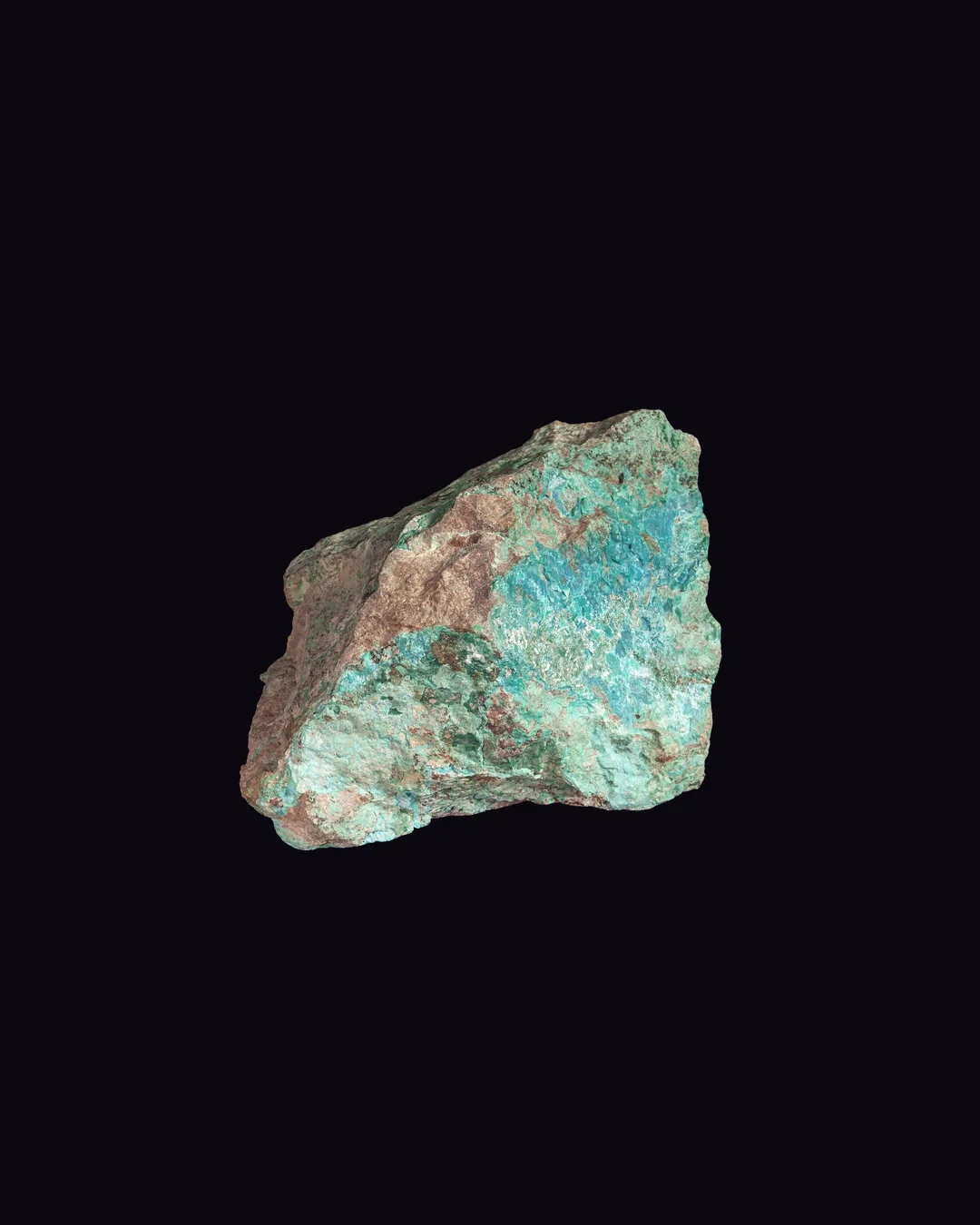
Chrysocolla
Chrysocolla
Rain got into a copper deposit and worked on it for ages. It broke the ore apart and left this blue-green crust in the cracks. It is the colour of shallow water because copper does that. That is the whole reason. Here is what the till never says. It is a copper mineral, and the chalky kind gives way under a fingernail. Never in your mouth and never in water. Wash your hands after the raw pieces. You keep swallowing the sentence. You get right to the edge of saying it, then you make it smaller so the room stays calm. Somebody taught you early that keeping the peace was your job. It was not. People have kept this one close for the breath before speaking, not the swallowed word.
People carry it for communication, calm and self-love. Tradition attaches it to the element water, the throat, heart chakra, Venus. It is most often given to Taurus, Gemini, Virgo. It measures 2.5-7 on the Mohs scale.
Seen · you don't have this one yet
Common·Uncommon·Rare·Arcane
Eilat stone is not a separate mineral. It is a natural mix of chrysocolla, malachite and turquoise. Soft chrysocolla is often resin-stabilised or backed to make it workable, and reconstituted versions exist. Ask which one you are buying.
This one does not go in water. It dissolves.
Contains metals you should not drink. Never make an elixir with it.
What it is confused with
Turquoise, amazonite, dyed howlite, malachite, larimar, shattuckite
A bright cyan to blue-green with a soft, cloudy, watercolour look. The colour bleeds out into browns and blacks at the edges instead of stopping at a sharp line. It grows as bubbly rounded crusts, as earthy masses, and best of all soaked through chalcedony, which makes it see-through and hard. Pure chrysocolla is chalky and very soft. Silicified material is glassy and hard. It often grows tangled with malachite, azurite and black manganese, which gives the mottled look the trade calls parrot wing.
Commonly faked · check before you buy
How to tell
Hardness varies wildly, so test the piece in your hand rather than the species. Chalky material scratches with a fingernail. Hard silicified material, sold as gem silica, will scratch glass. Against turquoise, the colour is the tell. Chrysocolla leans cyan and bleeds into the host rock in soft clouds. Turquoise sits in separate nodules with hard veins.
Soft material is routinely soaked in resin or glued to a backing so it can be cut. That is standard practice and honest sellers disclose it. Stabilised pieces are worth less than solid hard material. Eilat stone is not a treatment. It is a natural mix of chrysocolla, malachite and turquoise. Reconstituted versions, ground up and pressed back together, also exist.
The full mineral facts
Hardness, formula, and how the rock is put together.
Hardness
2.5-7 Mohs
Formula
(Cu,Al)2H2Si2O5(OH)4·nH2O
Family
silicate
How it forms
Chrysocolla forms near the surface of a copper deposit, where water breaks the copper ore down and leaves a blue-green crust in the cracks.
Where it comes from
USA (Arizona, Ray, Inspiration), Peru, DR Congo, Israel (Timna, Eilat stone), Chile, Mexico
What it means
The moon is in Sagittarius today, so this is the Sagittarius read.
You have been answering that one sentence ever since, mostly by doing things nobody advised.
Take the goddess-stone talk away and this is what happens when rain gets into a copper mine. Blue-green crust in the cracks, that is the mechanism.
It is also copper, so it does not go in water you intend to drink, and the soft kind should not be ground at all.
Sagittarius, you are best in the cracks and you need more holding than you let anybody give you.
Somebody underestimated you out loud once. You have been answering that one sentence ever since, mostly by doing things nobody advised.
Plenty of them worked. The ones that did not, you kept quiet about, because you had already told everybody you would be fine.
You are allowed to have not been fine.
That is today's sky, not your chart. Add your birth details and this stone gets read against your own.
Read it for my chart →You know what this one would do for you. You just don't have it.
Chrysocolla for every sign
AriesSomewhere young, saying it plainly got you called difficult.
Rain got into a copper deposit and worked on the ore for an age, breaking it down and leaving a blue-green crust in the cracks. That is all this is.
The colour is copper, which also means it is poisonous to eat. No elixirs, no soaking, and wash your hands after a chalky piece.
Aries, you are softer than the way you move and almost nobody has been shown it.
You say the thing. You are one of the few who actually does. Then you spend two days going over the exact wording. Somewhere young, saying it plainly got you called difficult.
So you keep going first and paying for it afterwards, in private, where nobody sees that part.
Say it again anyway. It was not too much.
TaurusYou did not see it because you had no reason to look.
Most chrysocolla on a shelf has been helped. The soft stuff is soaked in resin or glued to a backing, because otherwise it crumbles when anybody cuts it.
That is not a scandal. It is just something the label leaves out, along with the fact that it is a copper mineral and belongs nowhere near your mouth.
Taurus, you stopped believing bright and cheap the year one of them cost you properly.
It was not money. It was somebody who was warm right up until they got what they wanted. You did not see it because you had no reason to look.
Now you hold everyone at arm's length for a while, and you call it being careful, and you are right to.
Look at the backing. There usually is one.
GeminiYou have never once said that you are not okay.
Run a fingernail across it. On a lot of pieces it marks, because chalky chrysocolla is softer than your nail. On others it will scratch glass.
Whichever you have, keep it dry and keep it out of your mouth. Copper is fine in the ground and not fine in a person.
Gemini, you are held together by other people's patience and you have never thanked anyone for it.
You have never once said that you are not okay. You have said forty amusing versions of it. People laugh and change the subject.
That started because the plain version, the first time you tried it, was met with a silence you have never forgotten.
Try it on one person. Pick the quiet one.
CancerYou learned to work out the temperature of a room from the hallway.
Chrysocolla sat in the cracks of a copper deposit for an age. What ruins it is a rinse under the tap and a bowl of salt.
Water leaches the colour and dulls it. Salt goes straight for the copper. Dry cloth, always.
Cancer, ordinary daily things wear you out and the crisis never does, and that has always confused people.
Nothing enormous happened. It was one small swallowed sentence, then another, over about six years, until you stopped noticing you were doing it.
Somebody in your family got upset easily. You learned to work out the temperature of a room from the hallway. You have never been off duty since.
Say the smallest true thing tonight.
LeoNobody knows you went home last Thursday and did not speak for a day.
Strip the name off and this is a copper mineral. The same element that goes green on a church roof makes this the colour of shallow water.
That is also why it is toxic to swallow, and why the soft kind should never be ground or soaked. Wash your hands after the raw pieces.
Leo, you are ashamed of the plain thing that makes you lovely.
You are the one who fills the silence. You have been doing it since you were small and the silence in a particular house meant something bad was coming.
Now you carry the conversation everywhere, and everyone finds you warm. Nobody knows you went home last Thursday and did not speak for a day.
Who would sit through your silence?
VirgoBeing precise was how you kept trouble away as a kid.
Water spent a very long time taking a copper deposit apart near the surface, and what it left behind settled into the cracks as this blue-green crust.
Nothing about it is uniform. One piece scratches glass, the next gives way to a fingernail, and both of them are chrysocolla.
Virgo, you are held together for other people's convenience and you agreed to that.
You will rewrite an email four times to get the tone exactly right. Meanwhile the sentence you actually need to say to somebody has been drafted in your head since February and never sent.
Being precise was how you kept trouble away as a kid. It worked so well you never stopped.
What have you been drafting since February?
LibraNow you can talk for an hour and give away nothing.
Reconstituted chrysocolla exists. So does dyed howlite pretending to be it, and resin-soaked material sold without a word about the resin.
The real one bleeds. Its colour clouds out into the matrix in soft edges, where turquoise sits in hard little nodules with sharp veins.
Libra, you have been holding yourself together with something you have never told anybody about.
You do not have soft edges by accident. There was a house where saying what you wanted made things worse for somebody you loved, so you stopped doing it and called it being easy going.
Now you can talk for an hour and give away nothing. People leave thinking they know you.
They know the edges. Not the middle.
ScorpioSince then you have run everything you feel through a filter first.
Press a nail into the chalky part and it powders. That dust is copper, which is why nobody should be grinding it dry or putting it in a drink.
The hard silicified pieces are different. They scratch glass and stay put. Same name on both labels.
Scorpio, one soft sentence has been working on you for longer than most of your friendships.
That is why it stayed. A stranger would have bounced off. This was a person who loved you, being gentle, picking a good afternoon to say it.
Since then you have run everything you feel through a filter first. You work out what it will cost. By the time it comes out it is half the size it was.
The full size was never the problem.
SagittariusYou have been answering that one sentence ever since, mostly by doing things nobody advised.
Take the goddess-stone talk away and this is what happens when rain gets into a copper mine. Blue-green crust in the cracks, that is the mechanism.
It is also copper, so it does not go in water you intend to drink, and the soft kind should not be ground at all.
Sagittarius, you are best in the cracks and you need more holding than you let anybody give you.
Somebody underestimated you out loud once. You have been answering that one sentence ever since, mostly by doing things nobody advised.
Plenty of them worked. The ones that did not, you kept quiet about, because you had already told everybody you would be fine.
You are allowed to have not been fine.
CapricornYou keep looking for the year that will finally count.
This survives being buried in a mine and does not survive a wash. Water pulls the colour out of it. Salt gets at the copper.
Dry cloth, dark shelf, hands washed afterwards. That is the whole care list, and every bit of it is about restraint.
Capricorn, you can survive a great deal and you cannot survive being handled gently.
There were years where you held something together and no one has ever said a word about it. No title came with it. It does not appear on anything.
So you filed it as time you wasted. You keep looking for the year that will finally count. There is always another one after it.
It counted. All of it.
AquariusNaming things has been your way of staying safe in a room.
Groundwater spent an age dismantling a copper deposit from the top down, and the leftovers set into the cracks as this. Arizona, Peru, the Congo, wherever the copper was.
The throat-chakra label came much later and it was chosen because the stone is blue. That is the only reason.
Aquarius, you got called the calm one because of how you look, and nobody has asked since.
You can tell a friend exactly what her boss is doing and be right. People rely on you for that. It has been true since you were about sixteen.
Naming things has been your way of staying safe in a room. It has quietly meant that nobody ever gets to name anything about you.
Let one person try.
PiscesSomebody called you too sensitive when you were young.
Somebody soaked this in resin to stop it falling apart, or glued it to a backing so it could be cut. That is standard, and almost nobody mentions it.
Underneath, it is a copper mineral that powders when it is dry. Keep it out of water and out of your mouth.
Pisces, something has been slowly working on you since long before you noticed the change.
Whatever is in the room comes in. You have gone quiet in a car because the driver was quiet, and you did not work out until much later that the mood was never yours.
Somebody called you too sensitive when you were young. You took it as a diagnosis. It was them being tired.
It comes in. That is the whole mechanism.
Correspondences
What tradition attaches to this stone. Folklore, not chemistry.
Element
water
Planet
Venus
Chakra
throat, heart
Signs
taurus, gemini, virgo
What tradition says
In crystal lore, chrysocolla is linked with speech, teaching and the cooling of anger, and it is often called a goddess stone. The throat chakra placement is a modern assignment made on colour alone.
Care
- Contains copper or heavy metals. Do not make elixirs. Wash your hands.
- Do not put this one in water. It dissolves or spalls. Dust it dry.
- Salt scratches it. Do not bury it in salt.
- It is porous and often soft, so water is the danger. Water can leach the stone and dull it. Salt attacks the copper in it. Use a dry cloth and nothing else. Even resin-stabilised pieces should stay out of solvents and ultrasonic cleaners.
Chrysocolla is a COPPER silicate. Copper compounds are toxic if swallowed, and soft material powders very easily. Do not make elixirs. Do not soak it. Do not grind it dry. Wash your hands after handling raw or chalky pieces. Hard silicified gem silica is much more stable, but still keep it out of drinking water.
Common questions
What does chrysocolla mean?
Chrysocolla is carried for communication, calm and self-love. Rain got into a copper deposit and worked on it for ages. Tradition links it to the throat, heart chakra.
Is chrysocolla real or fake?
Eilat stone is not a separate mineral. It is a natural mix of chrysocolla, malachite and turquoise. Hardness varies wildly, so test the piece in your hand rather than the species. Chalky material scratches with a fingernail. Soft material is routinely soaked in resin or glued to a backing so it can be cut.
Is chrysocolla toxic?
Chrysocolla is a COPPER silicate. Copper compounds are toxic if swallowed, and soft material powders very easily. Do not make elixirs. Do not soak it. Do not grind it dry. Wash your hands after handling raw or chalky pieces. Hard silicified gem silica is much more stable, but still keep it out of drinking water.
- Read: toxic crystals, the compounds, and what it actually means →
- Read: the crystals you cannot put in water →
- Read: fake crystals and the four tests that settle it →
Common · cyan, turquoise blue, blue-green, sea green, with black or brown matrix
Where this leads
This stone belongs to
Related crystals
From the Grimoire
- Can You Put Crystals in Water? The Ones That Turn Toxic or Dissolve
- Crystals That Can't Get Wet: The List That Saves Your Collection
- Are Crystals Toxic to Cats?
- Are Crystals Toxic to Dogs?
- Is Malachite Toxic? What the Copper Actually Does (and Water Rules)
- Real vs Fake Malachite: Spotting the Resin Fakes
FOR ENTERTAINMENT AND REFLECTION. NOT MEDICAL, PSYCHOLOGICAL, FINANCIAL OR LEGAL ADVICE. How this works