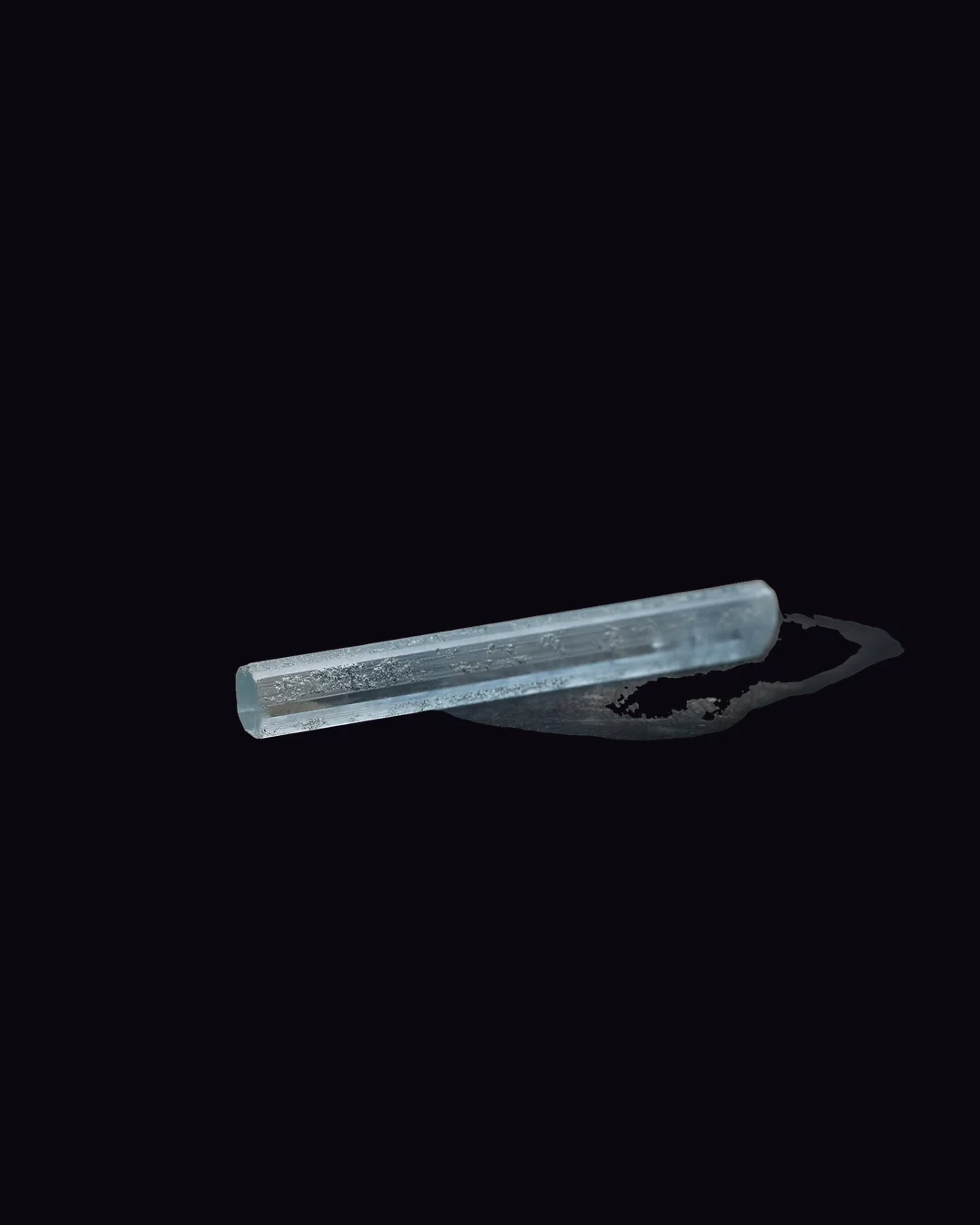
Aquamarine
Beryl
Nearly every blue aquamarine in a shop window has been in an oven, at around 400 degrees, to burn the green out. It is permanent. No test you can do at home will catch it. The honest ones keep a little green in them. That is what untreated looks like. You hold the whole room together, then fall apart in the car with the engine off. Nobody ever told you that you were allowed to shake in front of people. So you schedule it for later, alone. People have carried this one for a voice that has to stay level anyway. Never sand or saw it dry. The dust carries beryllium.
People carry it for communication, calm and courage. Tradition attaches it to the element water, the throat, heart chakra, Neptune. It is most often given to Pisces, Aquarius, Gemini. It measures 7.5-8 on the Mohs scale.
Seen · you don't have this one yet
Common·Uncommon·Rare·Arcane
Nearly all blue aquamarine is heated aquamarine. Around 400 degrees Celsius drives off the green-yellow part of the colour and leaves pure blue. The change is permanent and stable, and no consumer test will spot it. A slightly greenish blue is the untreated look, and that material is increasingly sought after.
What it is confused with
Blue topaz, blue glass, apatite, blue quartz, synthetic spinel, fluorite
Aquamarine is pale blue and see-through to slightly cloudy. Crystals are long six-sided prisms with a flat top and fine parallel lines running along the length. The colour is usually pale and a little uneven, often stronger at one end. Look inside for thin hollow tubes running the same way as the crystal. Those parallel tubes are close to proof of beryl. You may also see flat streaky inclusions the trade calls rain. The shine is glassy, there are no flat cleavage flashes, and it scratches glass easily.
Commonly faked · check before you buy
How to tell
Try a steel knife first. Blue apatite is much softer at 5 and the knife will mark it. Aquamarine at 7.5 to 8 will not, and it scratches quartz. Topaz scratches quartz too, so look at any broken edge. Topaz splits clean and flat across the base because it has one perfect cleavage. Aquamarine does not. Then check the shape. Look for a six-sided prism with fine lines running along its length, and thin hollow tubes inside running the same way.
Most aquamarine on sale has been heated to around 400 degrees Celsius. That drives off the green-yellow part of the colour and leaves a clean blue. It is permanent, it is stable, and no test you can do at home will detect it. It is standard practice across the trade and it is not a fraud. Untreated stones keep a greenish blue, and more buyers are asking for them now.
The full mineral facts
Hardness, formula, and how the rock is put together.
Hardness
7.5-8 Mohs
Formula
Be3Al2Si6O18
Family
silicate
How it forms
Aquamarine is beryl that grew in the last watery pockets of a cooling granite, where rare beryllium had nowhere else to go.
Where it comes from
Brazil (Minas Gerais), Pakistan, Nigeria, Madagascar, Mozambique, Russia (Ural)
What it means
The moon is in Sagittarius today, so this is the Sagittarius read.
You are keeping a promise you made at about fifteen.
Drag it across a piece of quartz. Aquamarine will mark the quartz, which is one of the few things you can genuinely check yourself.
Topaz does that too, but topaz splits on one flat plane when it breaks and beryl does not. Blue glass just scratches.
Sagittarius, somebody edited the awkward part out of you young and nobody can tell any more, including you.
You got out of somewhere. There was somebody in your early life who was frightened of nearly everything, and you saw exactly what that cost them.
So now every rule sounds like the first step into that life, and you take the risk on principle. You are not reckless. You are keeping a promise you made at about fifteen.
The promise has been kept. You can stop now.
That is today's sky, not your chart. Add your birth details and this stone gets read against your own.
Read it for my chart →You know what this one would do for you. You just don't have it.
Aquamarine for every sign
AriesYou bail at the point where it stops being exciting and starts being work.
Almost every blue aquamarine in a shop window has been in an oven at about four hundred degrees. The heat burns the green out and leaves the pure blue people want.
It is permanent, and no test you can do at home will catch it. The honest ones keep a little green in them.
Aries, somebody took the heat out of you once and called it an improvement.
You were praised for being quick before you could question it. Somebody clapped when you were fast, and nobody said much when you were steady.
So the long unglamorous stretch of anything feels like a mistake. You bail at the point where it stops being exciting and starts being work. Then you call yourself flaky for it.
You are not flaky. You were trained.
TaurusNow you read everyone's face, all the time, and you cannot switch it off.
The blue you paid for is usually not the colour it grew. Aquamarine comes out of the ground greenish blue, and the trade burns that green off in an oven.
Nobody is exactly hiding it. It is standard, it is permanent, and no test you can run will prove it either way. The green ones are the untouched ones.
Taurus, you paid full price and found out later what had been done to it, and you have not trusted a nice thing since.
You can spot a lie in a room in about four seconds, and you have been able to since you were a teenager. That skill did not come free.
Somebody at home said one thing with their mouth and another with their face, and you learned to read the face. Now you read everyone's face, all the time, and you cannot switch it off.
The green ones are the honest ones. You already knew that.
GeminiNobody ever told you that you were allowed to shake in front of people.
Aquamarine takes daily wear better than almost anything. It sits at nearly eight for hardness, which means it scratches quartz and shrugs off a handbag.
The one thing you must never do is cut or sand it dry. Beryl dust carries beryllium, and that is genuinely dangerous to breathe.
Gemini, you edit the murky part out before you speak and nobody has ever heard the first version.
You hold a whole room together. Somebody is upset, you are funny, the temperature drops, everybody relaxes again.
Then you get in the car with the engine off and it comes out of you. Nobody ever told you that you were allowed to shake in front of people. So you schedule it for later, alone.
Somebody would sit in the car with you.
CancerIt is the years of nobody checking that thin you out.
This grew in the very last watery pockets of a cooling granite. Beryllium is rare and it had nowhere else to go, so it ended up here.
Then almost all of it went into an oven at about four hundred degrees to take the green out. That heat cannot be undone and cannot be detected.
Cancer, you ended up holding everything because there was genuinely nowhere else for it to go.
You are the one people ring at two in the morning. You are very good at it, everybody knows, and it is genuinely one of the best things about you.
It is the years of nobody checking that thin you out. Nobody is being unkind. You built a version of yourself that seemed not to need asking, and everybody believed it.
What would you say if somebody asked?
LeoThe costing happens afterwards, and you do it on your own.
Look down the length of a raw crystal. It is a six-sided column with fine lines running down it and tiny parallel tubes inside, like rain on a window.
That is what beryl does. Blue glass has round bubbles instead, and blue apatite is soft enough to scratch with a knife.
Leo, you look flawless from across a room and you know exactly what is running through you.
You keep your voice level when it matters. In the meeting, at the hospital, on the phone with the person who needed you calm.
People have carried this one for exactly that, a voice that has to stay steady anyway. Nobody sees what it costs. The costing happens afterwards, and you do it on your own.
The steadiness was real. So is the bill.
VirgoYou were raised somewhere that getting it right kept you safe.
The oven does the work. About four hundred degrees drives the green-yellow out of a beryl and leaves the even blue that sells.
There is no consumer test for it. You cannot check, a jeweller cannot check, and any seller who claims certainty about a plain blue stone is guessing.
Virgo, somebody preferred the calmer version of you and you have been doing that voice ever since.
Some things do not have a test. You have spent months hunting an answer that does not exist, because working is more bearable than not knowing.
You were raised somewhere that getting it right kept you safe. So uncertainty still feels like a personal failure instead of an ordinary condition of being alive.
You cannot check this one either. It is still beautiful.
LibraYou say nothing because you already know which person goes quiet for a week.
Aquamarine handles warm soapy water, daily wear and years on a hand. It is one of the tougher stones you can own.
It does not handle an ultrasonic cleaner if it is cracked or included, and it does not handle more heat. More heat changes the colour again, and that does not come back.
Libra, being the one who copes well is the reason nobody has ever asked how you are doing.
You have the sentence ready. Short, true, and it would settle the whole thing, and you have been holding it since the spring.
You say nothing because you already know which person goes quiet for a week. That job was given to you before you were ten, in a house where one person's mood decided the weather.
Who told you it was yours to hold?
ScorpioSo you turned the heat down on yourself and handed out the easier version.
Beryllium is a rare element with almost nowhere to sit in ordinary rock. It waited for the very last watery pocket of a cooling granite, and that is where this grew.
Then somebody put it in an oven to make it a more marketable colour. The green it grew with is gone and it cannot be brought back.
Scorpio, you burned the green out of yourself on somebody else's advice and called it growing up.
It was said kindly. That is why it stuck, and why you have never once argued with it.
So you turned the heat down on yourself and handed out the easier version. It worked. People find you much less trouble now, and something you actually liked about yourself went out with the green.
The untreated ones are the ones people want now.
SagittariusYou are keeping a promise you made at about fifteen.
Drag it across a piece of quartz. Aquamarine will mark the quartz, which is one of the few things you can genuinely check yourself.
Topaz does that too, but topaz splits on one flat plane when it breaks and beryl does not. Blue glass just scratches.
Sagittarius, somebody edited the awkward part out of you young and nobody can tell any more, including you.
You got out of somewhere. There was somebody in your early life who was frightened of nearly everything, and you saw exactly what that cost them.
So now every rule sounds like the first step into that life, and you take the risk on principle. You are not reckless. You are keeping a promise you made at about fifteen.
The promise has been kept. You can stop now.
CapricornYou wrote it, and you have kept every line of it since.
This is beryl, and beryl contains beryllium. Solid and polished it is completely safe to hold, but the dust is not, so nobody ever cuts or sands it dry.
It also spent time in an oven, almost certainly. That blue is a decision somebody made about how it ought to look.
Capricorn, somebody decided early what colour you were supposed to be and you have kept to it.
You kept your voice level through the whole thing. Nobody at work had any idea. That was the point, and you achieved it.
The rule you set yourself at about nineteen was that you would never be the one who needed carrying. Nobody offered you that rule. You wrote it, and you have kept every line of it since.
Somebody would have carried you. You never gave them the chance.
AquariusBeing the clever one meant nobody asked you the soft questions.
The trade heats nearly all of it. About four hundred degrees in an oven takes the green-yellow out and leaves a clean even blue that photographs well.
That is not a scandal. It is standard, it is permanent, and the only tell is that a stone with a little green left in it was probably let alone.
Aquarius, you have edited the odd parts out of yourself so often that you cannot find the ones worth keeping.
You can name what somebody else is doing to protect themselves within ten minutes of meeting them. You are usually right.
Your own version has been running since school and you have never turned it over. Being the clever one meant nobody asked you the soft questions. That was exactly the point.
What would you say to a soft question?
PiscesIt is the reason you still cannot say no to a person who is upset.
This one is tough. Warm soapy water, daily wear, years of it, and it comes through fine.
The rule is the dust. Beryl carries beryllium, so nobody grinds or saws it dry, and nobody sensible makes a drink out of rough material.
Pisces, the part of you people call difficult is the part that was never taken out.
You take on what is in a room before you have sat down. Half of tonight's mood is somebody else's and you will never know which half.
You were the one who kept a house calm by feeling it first and adjusting. It was useful to everybody in that house. It is the reason you still cannot say no to a person who is upset.
People have carried this one for a voice that has to stay level anyway. Yours is allowed to shake.
Correspondences
What tradition attaches to this stone. Folklore, not chemistry.
Element
water
Planet
Neptune
Chakra
throat, heart
Signs
pisces, aquarius, gemini, scorpio
What tradition says
In crystal lore, aquamarine is kept for courage under pressure, for clear speech and for safe travel over water. The sea link is not a modern invention. It goes back to classical writers.
Care
- Water is fine. Dry it afterwards.
- Keep it away from strong heat. Heat is what set the colour in the first place and more of it can change the colour again. Skip ultrasonic cleaners if the stone has inclusions or fractures, because the shaking can open them up. Otherwise it is hard and durable. Warm soapy water and a soft cloth.
Aquamarine is a beryl, and beryl contains beryllium. Beryllium dust is hazardous to breathe. Solid crystals are safe to handle. Never grind, saw or sand beryl dry. Do not make elixirs from rough material.
Common questions
What does aquamarine mean?
Aquamarine is carried for communication, calm and courage. Nearly every blue aquamarine in a shop window has been in an oven, at around 400 degrees, to burn the green out. Tradition links it to the throat, heart chakra.
Is aquamarine real or fake?
Nearly all blue aquamarine is heated aquamarine. Around 400 degrees Celsius drives off the green-yellow part of the colour and leaves pure blue. Try a steel knife first. Blue apatite is much softer at 5 and the knife will mark it. Most aquamarine on sale has been heated to around 400 degrees Celsius.
Can aquamarine go in water?
A short rinse is fine for aquamarine, then dry it.
Uncommon · pale sea blue, blue-green, sky blue, greenish blue
Where this leads
This stone belongs to
Related crystals
FOR ENTERTAINMENT AND REFLECTION. NOT MEDICAL, PSYCHOLOGICAL, FINANCIAL OR LEGAL ADVICE. How this works