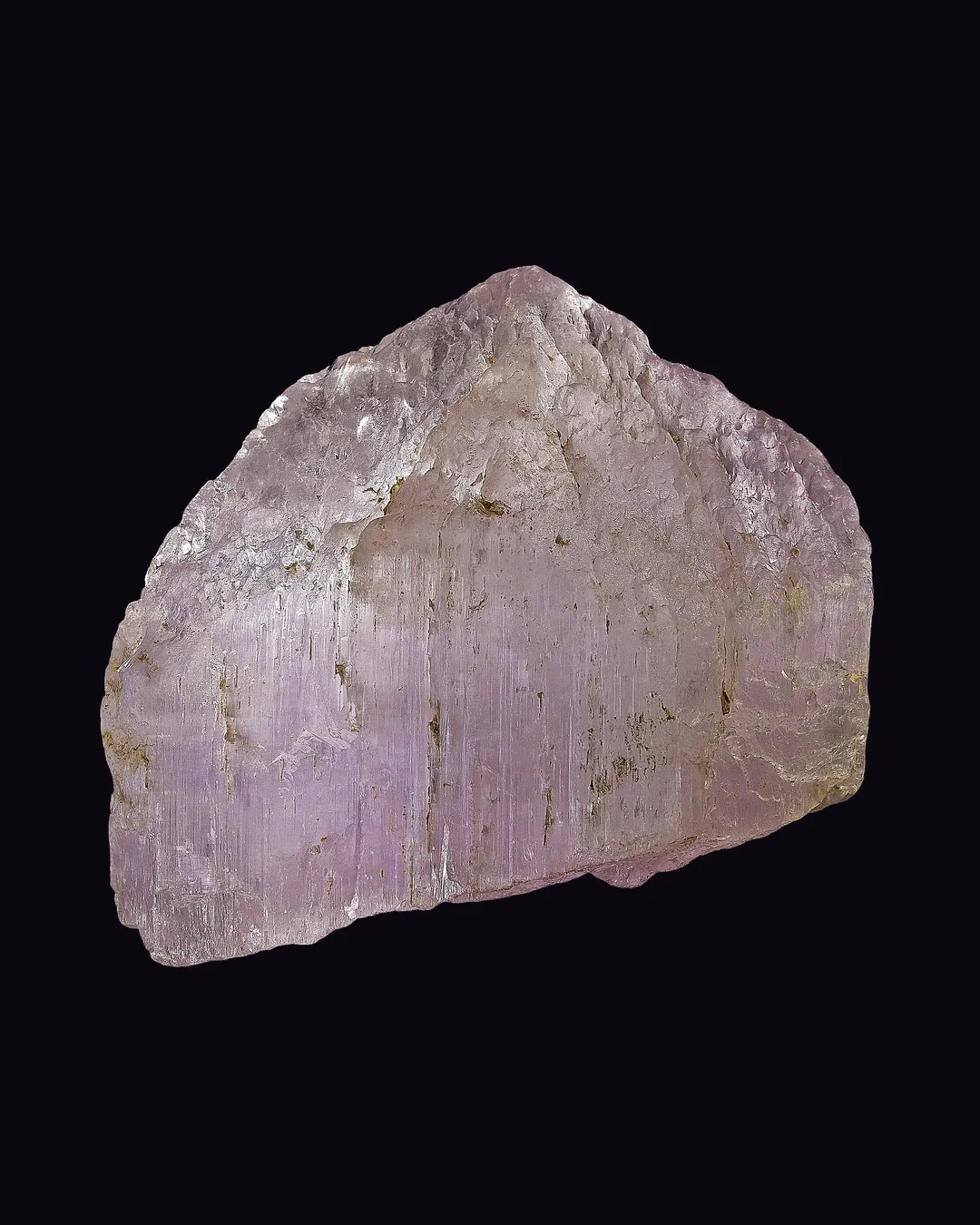
Kunzite
Spodumene
Light takes the colour out of it. Leave kunzite on a bright sill and the pink drains away, quite fast, and it never comes back. It grew in pegmatite, the last hot fluid of a cooling granite, where lithium gathered and let big crystals form. Plenty of it is irradiated to deepen that pink, and the treated colour fades fastest of all. The shop selling it often does not know. It also splits two ways at once, so a knock on the tap takes a corner off. You have been holding everything together so long that soft started to feel like a risk. Someone once made you pay for showing it. So you got competent instead, and everyone stopped asking how you were. Keep this one in a drawer, not the window.
People carry it for love, self-love and grief. Tradition attaches it to the element water, the heart chakra, Venus. It is most often given to Taurus, Leo, Scorpio. It measures 6.5-7 on the Mohs scale.
Seen · you don't have this one yet
Common·Uncommon·Rare·Arcane
Frequently irradiated to deepen the pink, and that irradiated colour fades faster than the natural one. Some material is heat-treated. Neither treatment is detectable without lab work.
What it is confused with
Rose quartz, morganite, pink topaz, amethyst, dyed quartz, pink glass
Transparent to translucent pale pink-lilac, in flattened, elongated prismatic crystals with strong lengthwise striations. The decisive feature is pleochroism. Look down the long axis and the pink deepens dramatically. Look across it and the colour nearly vanishes. Two perfect cleavages meet at about 87 degrees, giving flat mirror-like planes inside and stepped breaks outside. The shine is glassy, and the crystal often looks etched or fluted along its length.
Commonly faked · check before you buy
How to tell
Look down the long axis of the crystal, then across it. Kunzite is deep pink one way and pale the other. That strong colour change is pleochroism, and rose quartz has none. Rose quartz is also hazy and has no cleavage. Kunzite has two flat cleavage directions meeting at about 87 degrees. It scratches glass, but it chips the instant you knock an edge.
Frequently irradiated to deepen the pink, and the irradiated colour fades faster than the natural one does. Some material is heat-treated instead. Neither treatment is detectable without lab work, so judge the seller and the price rather than the colour.
The full mineral facts
Hardness, formula, and how the rock is put together.
Hardness
6.5-7 Mohs
Formula
LiAl(SiO3)2
Family
silicate
How it forms
It grew in pegmatite, the last watery leftover of a cooling granite, where lithium gathered and let large spodumene crystals form.
Where it comes from
Afghanistan (Nuristan), Pakistan, Brazil (Minas Gerais), USA (Pala, California), Madagascar, Myanmar
What it means
The moon is in Sagittarius today, so this is the Sagittarius read.
You have never once put something soft down carefully.
Somebody puts kunzite in a radiation source to push the pink up a grade. It sells better that way and the treatment leaves no mark anyone can see.
The irradiated colour is the first to die in daylight. The person selling it usually does not know that either.
Sagittarius, the version of you that got the most attention is the one fading fastest.
You were told no for years by people who never explained it. So no stopped meaning careful and started meaning somebody trying to make you smaller.
It got you out, and it built most of what you like about yourself. You have never once put something soft down carefully. A few people who mattered got dropped.
Some of them are still standing there. Are you going to say anything?
That is today's sky, not your chart. Add your birth details and this stone gets read against your own.
Read it for my chart →You know what this one would do for you. You just don't have it.
Kunzite for every sign
AriesYou leave before the soft part every time, and wonder why nothing lasts past four months.
Turn it slowly under a lamp. Look down the long axis and the pink is deep. Look across it and the same stone goes almost pale.
Now leave it on a bright sill for one summer. The pink drains out of it and it never comes back.
Aries, you love the part where a thing starts, and tenderness is all middle.
Somebody took a long time to answer you once, at an age when you needed the answer fast. So you built a life where you never have to wait on anybody again.
It works. You leave before the soft part every time, and wonder why nothing lasts past four months.
Nobody is coming to hurry you. Slow down and see what turns up.
TaurusIt was the moment you realised you had believed them because you wanted to.
Kunzite is spodumene, a mineral mostly dug up for lithium rather than for looking at. The gem pink is a thin piece of luck on top of an industrial rock.
Plenty of what is on sale was irradiated to push that pink deeper. Treated colour fades fastest, and no shop can tell by eye.
Taurus, you distrust anything too shiny for the price, and somebody taught you that in person.
You were sold something once by a person you liked. It was not the money that stayed with you.
It was the moment you realised you had believed them because you wanted to. Now you check twice and still feel small for wanting the pretty one at all.
Ask whether it was irradiated. Watch the face that answers you.
GeminiYou have not said a bare sentence about yourself in months.
Kunzite splits two ways at once, cleanly, at almost a right angle. One knock against the edge of a tap and a corner is gone.
It survives being worn and cannot survive being dropped. Nobody mentions that at the till.
Gemini, the brightest version of you is the one with the shortest life, and you keep leading with it.
Somewhere around thirteen you found out that being funny about a thing stopped people asking about the thing. It worked so well you kept it.
Now the good version arrives on its own. You have not said a bare sentence about yourself in months. You know exactly which month it stopped.
Say one flat true thing tonight. No joke on the end of it.
CancerYou are still the person who asks everyone else how they slept.
A great deal of kunzite goes into a machine and gets irradiated to push the pink further. It comes out looking more loved than it was.
That colour is the first to go. Six months on a sill and the treated stone is paler than the one nobody touched.
Cancer, you can make a life look more loved than it has been, and you have been doing it for years.
You kept the house calm when you were small, and you got good at reading a room before anybody spoke in it. That never switched off.
You are still the person who asks everyone else how they slept. You cannot remember the last time somebody asked you back and waited for the answer.
Store it in the dark. Not everything that fades makes a sound.
LeoYou would not know how to answer if they did.
Kunzite grew in pegmatite, the last hot leftover of a cooling granite, where lithium collected and crystals got room to grow large. It only got a name in 1902.
So every tradition attached to it is younger than your grandmother. The lore turned up after the selling did.
Leo, you got big because somebody gave you room, and you have never said thank you out loud.
You were the easy child. Bright and funny and no trouble at all, and it got you loved on terms nobody ever read out to you.
So you kept being easy. People bring you their weeks and nobody thinks to ask about yours. You would not know how to answer if they did.
Somebody would stay for the tired version. You have never tested it.
VirgoYou spot the small fault in a good day and go straight to it.
Hold it up and tilt it. Deep pink one way, nearly colourless the other. The same stone twice, depending where you stand.
Leave it in a sunny room and you lose the pink half for good. Fading is the one thing about kunzite nobody can repair.
Virgo, the softness you forced yourself into is the part that keeps running out.
You were the one who noticed things at home before anybody else did, and you got praised for catching them early. So catching things became the job.
You spot the small fault in a good day and go straight to it. You call that being useful. It started as a way of getting ahead of something that used to arrive without warning.
Nothing is about to happen tonight. Put it down.
LibraYou have a whole list of preferences nobody has ever heard.
Rose quartz and kunzite sit side by side in shops and they are not the same thing. Rose quartz is cloudy and takes a knock. Kunzite is clear, harder, and chips if you look at it wrong.
The counter puts them under one word anyway. Only one of them survives your handbag.
Libra, people mistake you for the soft one, and the real damage happens where nobody is watching.
You grew up where a raised voice meant something was about to break. You got fast at finding the answer that keeps everybody seated.
It works. It works so well that people stopped checking whether you wanted any of it. You have a whole list of preferences nobody has ever heard.
Say one of them out loud this week. Start with dinner.
ScorpioYou give them the manageable version and watch what they do with it.
Kunzite gets called an evening stone because daylight takes it apart. The pink is real and it is not permanent.
It can go in a matter of months on a bright sill. Nothing brings it back.
Scorpio, one person could not take the full colour of you and you dimmed it on the spot.
There was somebody who could not hold what you brought them and told you the problem was the size of it. You were young enough to take that as information.
Now you test people with small things first. You give them the manageable version and watch what they do with it. Most of them never find out there was more.
You were not too much. They were not built for it.
SagittariusYou have never once put something soft down carefully.
Somebody puts kunzite in a radiation source to push the pink up a grade. It sells better that way and the treatment leaves no mark anyone can see.
The irradiated colour is the first to die in daylight. The person selling it usually does not know that either.
Sagittarius, the version of you that got the most attention is the one fading fastest.
You were told no for years by people who never explained it. So no stopped meaning careful and started meaning somebody trying to make you smaller.
It got you out, and it built most of what you like about yourself. You have never once put something soft down carefully. A few people who mattered got dropped.
Some of them are still standing there. Are you going to say anything?
CapricornYou have been holding everything together so long that soft started to feel like a risk.
It formed in the last watery leftover of a granite as it cooled, in a pocket where lithium gathered and crystals had room to get big. Nothing about that was hurried.
Then it reaches a shop and the only question anybody asks is how deep the pink runs. Nobody asks what it took.
Capricorn, you keep a ledger of your own days and softness earns nothing in it.
Somebody at home measured people by what they produced, out loud, for years. You were nine and you wrote the rule down.
Now a tender day reads as a wasted one. You have been holding everything together so long that soft started to feel like a risk. Somebody did once make you pay for showing it.
You were not wrong to stop. You are allowed to start again.
AquariusYou have been watching your own life from behind it since about sixteen.
Take it out of the box tonight and look at the edges. Two flat splits run through it at almost a right angle, and one knock on a tap takes a corner off.
It scratches glass and it still chips like sugar. Hard and fragile are not opposites.
Aquarius, you are hard to knock over and easy to chip, and people only ever notice the first one.
You worked out young that understanding a thing meant it could not blindside you. That was true and it saved you more than once.
It also put glass between you and everything else. You have been watching your own life from behind it since about sixteen. You can explain exactly why you are like this.
What would happen if you stopped explaining?
PiscesYou just hold it until you are alone in the car.
Somebody heats or irradiates a pale kunzite so it will look like it feels more than it does. It works, briefly.
The stone nobody touched keeps its colour longer than the one that got pushed. That is the whole trick.
Pisces, being out in the open too long takes something out of you that has never come back.
You cried easily as a child and somebody made a joke of it in front of a room. You have been managing that ever since, and you are very good at it now.
The feeling still arrives on time. You just hold it until you are alone in the car. Then you let a third of it out and drive home.
None of it was ever too much. It was only early.
Correspondences
What tradition attaches to this stone. Folklore, not chemistry.
Element
water
Planet
Venus
Chakra
heart
Signs
taurus, leo, scorpio, libra
What tradition says
In crystal lore, kunzite is linked with the heart, with tenderness and with emotional release. The stone was only discovered in 1902, so its tradition is entirely twentieth century.
Care
- Water is fine. Dry it afterwards.
- Keep it out of direct sun. The colour goes and does not come back.
- Sunlight is what takes the colour, and the fade is genuine and permanent. Kunzite is sometimes called an evening stone for that reason. Store it in the dark. Its perfect cleavage also makes it one of the most easily shattered stones in the trade. Never use an ultrasonic cleaner and never knock it.
Common questions
What does kunzite mean?
Kunzite is carried for love, self-love and grief. Light takes the colour out of it. Tradition links it to the heart chakra.
Is kunzite real or fake?
Frequently irradiated to deepen the pink, and that irradiated colour fades faster than the natural one. Some material is heat-treated. Look down the long axis of the crystal, then across it. Kunzite is deep pink one way and pale the other. Frequently irradiated to deepen the pink, and the irradiated colour fades faster than the natural one does.
Can kunzite go in water?
A short rinse is fine for kunzite, then dry it. Keep it out of direct sun, because the colour fades and does not come back.
Uncommon · pale pink, lilac-pink, violet-pink, near colourless
Where this leads
This stone belongs to
Related crystals
FOR ENTERTAINMENT AND REFLECTION. NOT MEDICAL, PSYCHOLOGICAL, FINANCIAL OR LEGAL ADVICE. How this works