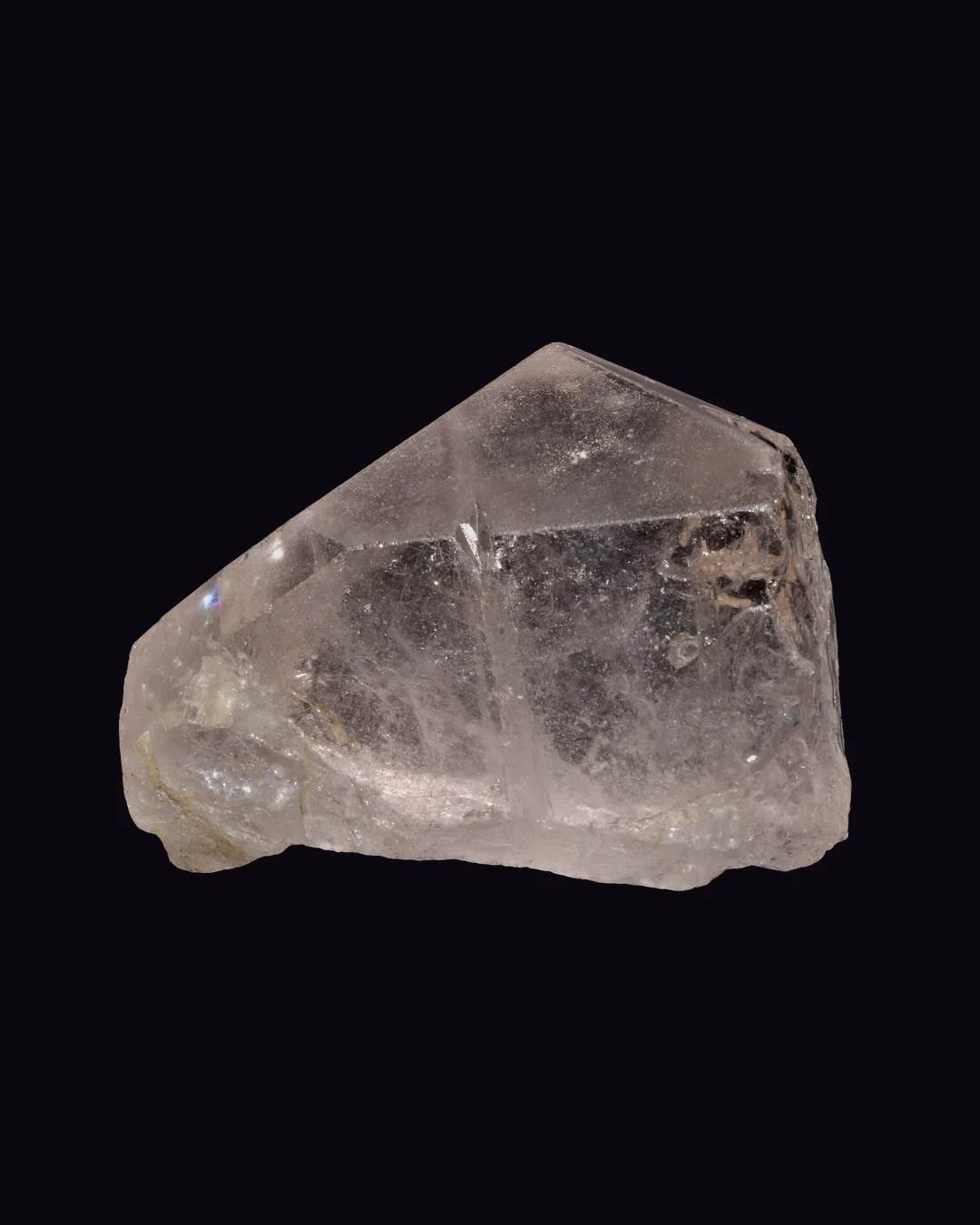
Morganite
Beryl
Almost every morganite in a case went into an oven at about four hundred degrees. The heat pulls the yellow out and leaves a cleaner pink. It is permanent and no test can find it. So the stone in the rose gold ring is quietly treated and nobody technically lied. Under the treatment it is beryl, the same family as emerald, grown slowly in a hot pocket at the edge of granite. Manganese made it pink. Cheaper pinks wear the name. Rose quartz is hazy and softer. Glass has bubbles. You are tired of love that arrives like a storm and calls itself passion. You want the steady kind, and you have stopped apologising for that.
People carry it for love, self-love and grief. Tradition attaches it to the element water, the heart chakra, Venus. It is most often given to Libra, Taurus, Pisces. It measures 7.5-8 on the Mohs scale.
Seen · you don't have this one yet
Common·Uncommon·Rare·Arcane
Morganite is pink beryl, the same mineral as emerald and aquamarine. Nearly all of it in shops was heated to around 400 degrees Celsius to make that pink. Some of it was irradiated instead.
What it is confused with
Kunzite, rose quartz, pink topaz, pink glass, dyed quartz, pink sapphire
It gets confused with rose quartz, kunzite and aquamarine. Morganite is transparent pale pink to peach and grows as flat six-sided plates. Those squat plates are the giveaway against aquamarine, which grows as long prisms. The colour is soft and slightly grey-peach and is rarely strong. Inside it you can see beryl's parallel hollow tubes, and it takes a bright glassy polish. It is clearly harder than any pink quartz and far more see-through than rose quartz.
Commonly faked · check before you buy
How to tell
Hold it to a light. Morganite is properly transparent where rose quartz is hazy, and it is harder, 7.5 to 8 on the Mohs scale against quartz at 7. That hardness and clarity rule out glass as well. Kunzite is the other lookalike. Kunzite is softer, changes colour noticeably as you turn it, which is called pleochroism, and it has two flat cleavage directions meeting at about 87 degrees. Morganite has no obvious cleavage and grows as flat six-sided plates.
Almost all morganite in shops has been heated to around 400 degrees Celsius. That burns off the yellow-orange tones and leaves a purer pink. The change is permanent, stable and impossible to detect. Some material is irradiated instead. Heating beryl is accepted trade practice and is assumed unless a seller tells you otherwise. Because nearly all of it is treated, this does not make your stone worth less than the next one.
The full mineral facts
Hardness, formula, and how the rock is put together.
Hardness
7.5-8 Mohs
Formula
Be3Al2Si6O18 with Mn
Family
silicate
How it forms
Morganite grew as beryl in pegmatite, the slow-cooling pockets of hot fluid left at the edge of a granite body, where a trace of manganese turned it pink.
Where it comes from
Brazil (Minas Gerais), Madagascar, Afghanistan, Mozambique, Namibia, USA (California, Maine)
What it means
The moon is in Sagittarius today, so this is the Sagittarius read.
It has also meant you never stayed long enough anywhere to be known.
Morganite is beryl with a trace of manganese in it. That single metal is the whole difference between this and an emerald.
Nearly all of it has been through a kiln. The warmer tone it came out of the ground with was quietly removed.
Sagittarius, somebody cooked the difficult colour out of you and told you it was an improvement.
Somebody spent your childhood telling you what would go wrong, and the loudest ones were the least happy people in the room. So you decided caution was catching and left before anyone could hand it to you.
It has taken you good places. It has also meant you never stayed long enough anywhere to be known.
Not every closed door was a cage.
That is today's sky, not your chart. Add your birth details and this stone gets read against your own.
Read it for my chart →You know what this one would do for you. You just don't have it.
Morganite for every sign
AriesNobody ever showed you the boring part, so you assume it means something died.
Somebody put your morganite in an oven at about four hundred degrees. The heat pulled the yellow out and left a cleaner pink.
It is permanent and no test can find it. The shop did not lie. It just did not say.
Aries, somebody wanted you gentler and you did it, and you have been angry underneath since.
Somewhere back there you learned that being wanted was a thing you had to keep winning. So you go in hot and give the first three weeks everything.
Then the middle arrives with no applause in it, and you read the quiet as the end. Nobody ever showed you the boring part, so you assume it means something died.
Stay through one dull Tuesday. See what is still there.
TaurusYou just decided that slow was the only honest way to want something.
Morganite grew as beryl in a pegmatite, a slow pocket of hot fluid at the edge of a granite body. A trace of manganese turned it pink over a stretch of time nobody was around for.
Then it went in a kiln at four hundred degrees to clean the colour up. The pink you love is half patience and half a person with a schedule.
Taurus, you have a hard time believing anything that arrives that easily.
There was a thing you saved a year for, and somebody got handed the same thing in a weekend. You never said anything out loud.
You just decided that slow was the only honest way to want something. It made you steady, and it also made you slow to let good things in.
This one is both. Most real things are.
GeminiThe people who love you are still waiting for the flat version.
Under the pink, morganite is beryl. Same family as emerald, same building blocks, one different trace metal.
Rose quartz gets sold under its name constantly. Rose quartz stays hazy and softer, and glass shows round bubbles if you turn it to the light.
Gemini, somebody took the difficult tone out of you at about fourteen and everyone says you are lovely now.
It started as a way to be interesting in a house where quiet got you overlooked. You learned that a good story kept people at the table.
Now you cannot say you had a bad week without turning it into a bit. The people who love you are still waiting for the flat version.
What would you have to give up to be believed the first time?
CancerYou have carried a treated version of yourself so long it feels like the original.
Almost every morganite in a case has been heated to about four hundred degrees. It comes out a purer pink and the change never reverses.
No test finds it. The stone carries a treatment it cannot mention.
Cancer, somebody put you through something, and the softness it left is now what people love you for.
You are the one people tell things to. It started young, in a house where somebody needed you to be fine, and you got very good at being fine.
So the small hurts go in a drawer instead of a sentence, and nobody knows the drawer is there. You have carried a treated version of yourself so long it feels like the original.
Somebody would sit through the untreated one.
LeoBy the time you get home there is nobody left to ask.
Hold it up to a window and turn it slowly. Real morganite is properly see-through, and it grows in flat six-sided plates.
Then remember the oven. Four hundred degrees pulled the yellow out, and the trade counts that as finishing.
Leo, you are more see-through than you think and the people who love you already know.
You learned that a mood in you takes up more room than a mood in anyone else. So you check the temperature first, adjust, and hand everyone the version that keeps the evening easy.
By the time you get home there is nobody left to ask. You call that being generous, and some of it is.
The rest is a habit that began as cover.
VirgoYou were being useful, because useful was the only lever you had.
Morganite formed in pegmatite, the last hot fluid to cool at the edge of a granite body. Manganese slipped in and made it pink, and that took longer than any deadline you have ever kept.
Then a kiln finished the job in an afternoon. Both facts are true about the stone in your hand.
Virgo, somebody took the warm part out of you to make you easier to look at.
The spare room gets sorted on the night the real thing is hurting. The kitchen drawer gets emptied out the week somebody stops calling you back.
It has worked since you were about eleven and something in the house was going wrong that you could not touch. You were being useful, because useful was the only lever you had.
What is the thing tonight that no amount of tidying will reach?
LibraYou check who gets hurt by which version before you answer.
Morganite is hard, around 7.5 to 8, and the heated colour holds up in sunlight. Warm soapy water is all it needs.
What harms it is an ultrasonic cleaner on a piece with a hidden fracture. The damage starts inside, from a flaw nobody could see.
Libra, the warmth people love in you was put there by somebody else, and it has never come off.
Every option you weigh has a face attached to it. You check who gets hurt by which version before you answer. By the time you land you are worn out, and it reads as flakiness.
It began in a house where one person's mood set the weather, and you got good at forecasting. That skill saved you then. It is eating you now.
Answer one thing tonight without checking a face first.
ScorpioThen people get the edited one, and they say you are hard to know.
Somebody heated your morganite to about four hundred degrees to take the yellow out. The pink that was left sells better.
It is permanent, and no instrument can prove it happened. So the stone gets called natural and technically nobody lied.
Scorpio, the treatment done on you was never declared and you have been carrying the difference alone.
Somebody said you were a lot, years ago, in a voice they have probably forgotten using. You heard it. Now every real feeling goes through a filter first, to see what the full size of it costs.
Then people get the edited one, and they say you are hard to know. That is the exact thing you were trying to avoid.
You were never too much. You were unaccompanied.
SagittariusIt has also meant you never stayed long enough anywhere to be known.
Morganite is beryl with a trace of manganese in it. That single metal is the whole difference between this and an emerald.
Nearly all of it has been through a kiln. The warmer tone it came out of the ground with was quietly removed.
Sagittarius, somebody cooked the difficult colour out of you and told you it was an improvement.
Somebody spent your childhood telling you what would go wrong, and the loudest ones were the least happy people in the room. So you decided caution was catching and left before anyone could hand it to you.
It has taken you good places. It has also meant you never stayed long enough anywhere to be known.
Not every closed door was a cage.
CapricornYou learned young that you would be kept for what you could carry.
Put it on the sill and look through it. Morganite is genuinely clear, where rose quartz stays cloudy and glass gives itself away with bubbles.
The pink itself came out of an oven. Four hundred degrees, one afternoon, and the trade calls that normal.
Capricorn, the softness people love in you was put there by something that hurt.
A day that produced nothing gets filed as a wasted one. Rest goes in that file. So does grief, and the whole year you spent holding a family together while nobody thought to ask how you were.
You learned young that you would be kept for what you could carry. Nobody has offered to take any of it, so you decided the offer does not exist.
It exists. Test it on one person this week.
AquariusYou built the watching from the outside because inside was not safe to be.
Morganite grew in a pegmatite pocket at the edge of cooling granite, where the last hot fluid had room to make big crystals. Manganese was the only reason it came out pink at all.
Then a kiln at four hundred degrees took the yellow out for good. It is undetectable, so every case of it is quietly a little untrue.
Aquarius, the softest thing about you was arranged, and because nobody can tell, you have never admitted it.
You can tell a friend exactly why her situation keeps repeating, kindly, in one paragraph, and be right. Then you go home to the thing you have been doing for six years and cannot see the shape of it.
You built the watching from the outside because inside was not safe to be. You never came back in.
Who is allowed to describe you to yourself?
PiscesSomebody's bad afternoon becomes yours before you have taken your coat off.
Morganite survives most things. It is hard, the colour holds in daylight, and warm soapy water will not touch it.
Cutting it is the only real danger, and only for the cutter. Beryl dust carries beryllium and must never be breathed. Solid, in your hand, it is safe.
Pisces, the warm parts got cooked out of you and everyone agreed the result was prettier.
Somebody's bad afternoon becomes yours before you have taken your coat off. You have been told to toughen up by people who never had to sort their own feelings out from the room's.
You cannot build the door. You can learn to notice the moment a mood walked in with somebody else.
Tonight, name one feeling and say whose it is.
Correspondences
What tradition attaches to this stone. Folklore, not chemistry.
Element
water
Planet
Venus
Chakra
heart
Signs
libra, taurus, pisces, cancer
What tradition says
In crystal lore, morganite is kept for even-tempered love, and for grief that has settled rather than grief that is still raw. Those attributions are entirely twentieth-century.
Care
- Water is fine. Dry it afterwards.
- It is hard and it lasts. The heat-treated colour is stable and will not change. Warm soapy water is fine. Keep fractured pieces out of an ultrasonic cleaner.
Morganite contains beryllium. As a solid stone it is safe to hold and to wear. The only hazard is the fine dust from cutting, which must not be breathed in.
Common questions
What does morganite mean?
Morganite is carried for love, self-love and grief. Almost every morganite in a case went into an oven at about four hundred degrees. Tradition links it to the heart chakra.
Is morganite real or fake?
Morganite is pink beryl, the same mineral as emerald and aquamarine. Nearly all of it in shops was heated to around 400 degrees Celsius to make that pink. Hold it to a light. Morganite is properly transparent where rose quartz is hazy, and it is harder, 7.5 to 8 on the Mohs scale against quartz at 7. Almost all morganite in shops has been heated to around 400 degrees Celsius.
Can morganite go in water?
A short rinse is fine for morganite, then dry it.
Uncommon · peachy pink, salmon, pale rose, violet-pink
Where this leads
This stone belongs to
Related crystals
From the Grimoire
- Is Your Rose Quartz Real or Dyed Glass?
- Start Here If You Don't Like Yourself Yet: Self-Love Crystals
- Best Crystals for a Cancer: Water-Sign Stones for Big Feelings
- Best Crystals for a Cancer Woman (Soft, Not Small)
- Best Crystals for a Libra (Your Sign's Power Stones)
- Best Crystals for a Libra Woman (Boundaries, Not Just Balance)
FOR ENTERTAINMENT AND REFLECTION. NOT MEDICAL, PSYCHOLOGICAL, FINANCIAL OR LEGAL ADVICE. How this works