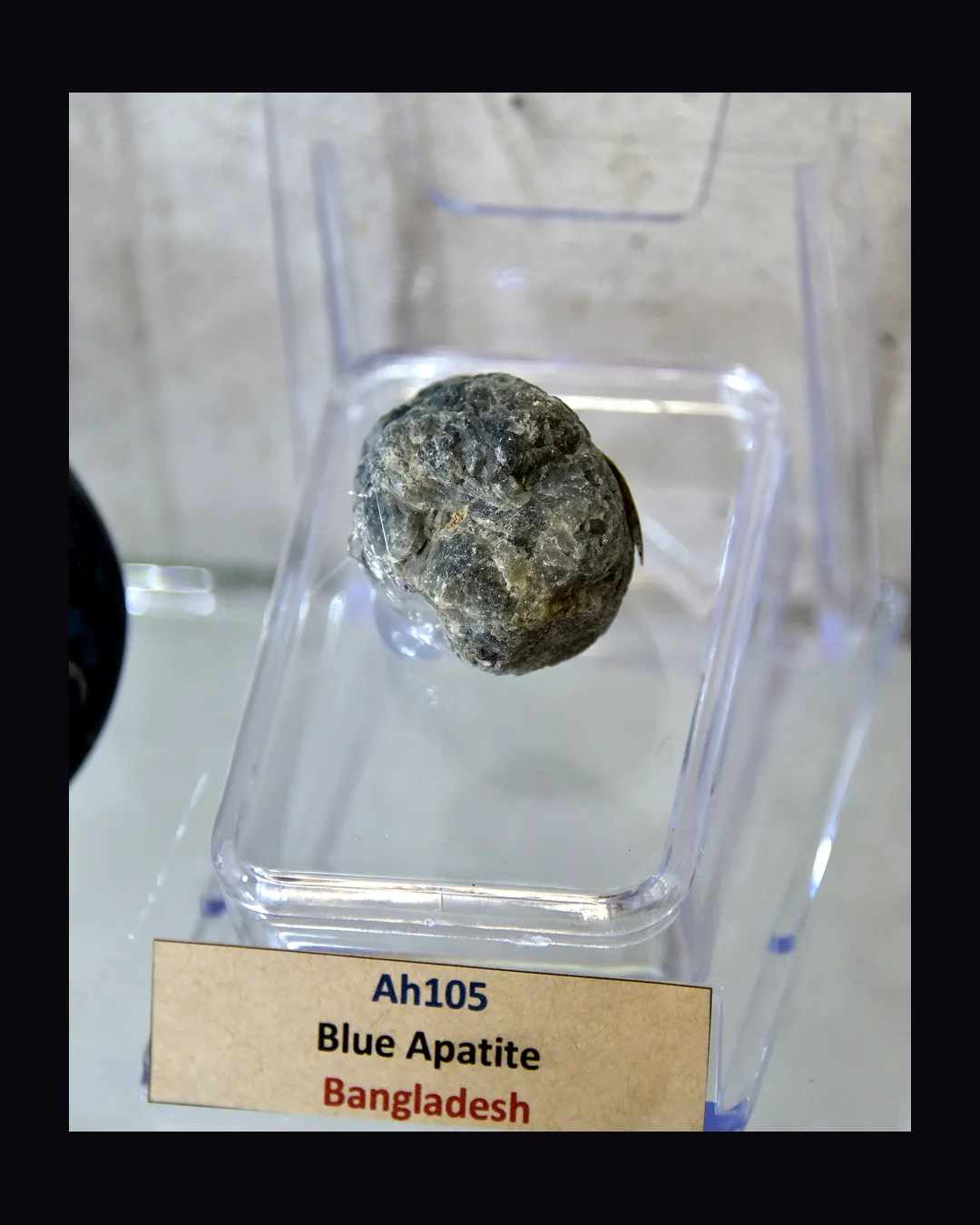
Blue Apatite
Fluorapatite / chlorapatite / hydroxylapatite
Blue apatite is the mineral your teeth are made of. Your bones too. One version grows in cooling rock, the other grows in you. The name comes from a Greek word for deceive. Miners kept mistaking it for other stones, so it got named after the mistake. Most of the neon blue was helped along with heat or radiation. It is soft for a coloured stone, so a pocket scuffs it in a week and a bright sill pulls the colour back out. You have the sentence ready. You have had it ready for weeks. It gets as far as your throat and stops. Then you say the easier thing, and you replay it in the car all the way home. Warm water briefly, then dry it straight away. It scratches on almost anything, including household dust. Who taught you that saying it plainly costs more than swallowing it?
People carry it for communication, clarity and intuition. Tradition attaches it to the element air, the throat, third-eye chakra, Mercury. It is most often given to Gemini, Libra, Aries. It measures 5 on the Mohs scale.
Seen · you don't have this one yet
Common·Uncommon·Rare·Arcane
Blue apatite is a real mineral, but the vivid neon shades are often helped along. Some blue and neon material is heat-treated or irradiated to intensify the colour. Heavily included stones are fracture-filled with resin. Both should be disclosed on the label.
This one does not go in water. It dissolves.
What it is confused with
Aquamarine, blue tourmaline, blue topaz, fluorite, blue glass, kyanite
Blue apatite is a vivid teal to neon blue-green with a glassy shine. Crystals are short six-sided prisms ending in a flat top or a low pyramid. The colour is intense and slightly cloudy, often streaky or patchy, with cracks visible inside. The giveaway is hardness. Apatite is the reference mineral for 5 on the Mohs scale, so a steel knife marks it easily and a copper coin does not. That window is very narrow and it belongs to apatite. Tumbled pieces pick up scuffs and scratches surprisingly quickly.
Commonly faked · check before you buy
How to tell
Apatite sits at exactly 5 on the hardness scale, and that narrow window is the test. A steel knife scratches it. A copper coin does not. It will not scratch glass. Aquamarine at 7.5 to 8 and topaz at 8 both scratch glass easily, so either of those is ruled out. Fluorite at 4 is soft enough for a copper coin to mark, so a coin scratch means fluorite, not apatite.
Some blue and neon apatite has been heated or irradiated to push the colour further. Both are permanent and neither shows up in any test you can do at home. Heavily included stones are fracture-filled with resin to hide the cracks. Filling is normal trade practice, it should be disclosed, and a filled stone is worth less.
The full mineral facts
Hardness, formula, and how the rock is put together.
Hardness
5 Mohs
Formula
Ca5(PO4)3(F,Cl,OH)
Family
phosphate
How it forms
Apatite crystallises out of cooling magma and hot fluids in the crust, and the same mineral is what your bones and teeth are built from.
Where it comes from
Madagascar, Brazil, Mexico (Durango), Myanmar, Canada (Ontario, Quebec), Russia (Kola)
What it means
The moon is in Sagittarius today, so this is the Sagittarius read.
Now someone who loves you says be careful and what lands is be smaller.
It lives through a lot of handling and dies of small things. Dust scratches it. A bright shelf bleaches it, and a rinse under a hot tap is enough to dull it.
The danger is never the dramatic one. It is the ordinary Tuesday nobody warned you about.
Sagittarius, this is the stuff your bones are actually made of, and you treat your body like a hire car.
You were told no about a hundred harmless things when you were small. So many of those nos were wrong that you binned the whole category rather than sort it.
Now someone who loves you says be careful and what lands is be smaller. A couple of those trips cost you more than you have ever said out loud.
Which of those warnings was actually about you?
That is today's sky, not your chart. Add your birth details and this stone gets read against your own.
Read it for my chart →You know what this one would do for you. You just don't have it.
Blue Apatite for every sign
AriesNow the flat middle of a job or a love reads to you as failure.
Most of the neon blue in a shop was helped. Heat or a dose of radiation pushed the colour up, because the natural teal did not sell as fast.
Nobody puts that on the tag. The stone was already interesting. Somebody decided interesting was not loud enough.
Aries, you have been running on a body you keep treating as a rented one.
Somebody at home only really looked up when you arrived with news. Good news, big news, a start. So you kept producing starts.
Now the flat middle of a job or a love reads to you as failure. It is not failure. It is the part with no witnesses.
Stay one month longer than you want to.
TaurusNow everyone gets a two year audit before you relax.
Put your thumbnail on it. It is a five on the hardness scale, which means a steel knife marks it and it will not scratch glass.
Household dust is harder than this stone. A week in a pocket and the shine is gone, and no shop mentions that at the till.
Taurus, you stopped believing anything that arrived cheap and beautiful, because one thing did and it cost you.
There was a person, or a deal, or a flat with a nice window. It came in warm and it left fast. You were young enough that it set the setting.
Now everyone gets a two year audit before you relax. Some of the honest ones do not last the audit.
Careful kept you safe and it also kept you alone.
GeminiThen you replay it in the car the whole way home.
This is the mineral your teeth are made of. Your bones too. One version grows out of cooling rock, the other grows inside you.
The name comes from a Greek word for deceive. Miners kept mistaking it for other stones, so it got named after the error rather than the fact.
Gemini, you can explain your own body better than you can feed it.
In your house the honest sentence made the evening worse. So you learned to be entertaining, because entertaining never got anyone shouted at.
Now the true sentence gets as far as your throat and stops, and you say the easier one. Then you replay it in the car the whole way home.
The good version is not the true one.
CancerSomebody at your table needed you calm, so you were calm at eight
Water hurts it. So does salt, so does acid, and a bright windowsill pulls the blue back out over a couple of years.
Nothing violent ever takes this stone. It is the daily stuff. A rinse, a sill, a lemon on a kitchen counter.
Cancer, almost everything gets at you, and you have built your whole life around not letting that show.
Somebody at your table needed you calm, so you were calm at eight, and everyone got used to it. Nobody checked whether calm cost anything.
Now you are fine through the hospital week and you cry on a Thursday about an advert. You call that being ridiculous. It is the bill arriving late.
The bill always arrives.
LeoNow you notice a friend is off from the shape of one text.
Apatite came out of cooling magma, deep down, over a stretch of time nobody was around for. The same mineral built your teeth while you were too small to remember it.
The Greeks named it for deceit. Not because it lies, but because people kept getting it wrong and blamed the rock.
Leo, something quiet built the whole frame you stand on and it never asked for a mention.
You were the bright one at home. Someone there was struggling, and a cheerful child made the house liveable, so you became one before you could choose.
Now you notice a friend is off from the shape of one text. Nobody has asked you the same question in months and you had not noticed.
Who reads the room for you?
VirgoYou were an easy child because easy children got left in peace.
Heavily included stones get their cracks filled with resin so they look solid. Neon material gets heat or radiation so the blue reads brighter under a shop light.
Both are common. Neither goes on the label, because the label is trying to sell you a finished thing.
Virgo, you treat your own body like a machine you are annoyed with.
The cupboard gets reorganised at midnight. The document gets tidied for the fourth time. Underneath all of it is one conversation you have been avoiding since March.
You were an easy child because easy children got left in peace. That was smart at nine. It is a second job now.
Some things cannot be tidied, only outlived.
LibraAsk you where you want to eat and there is a blank
Hold it near a window and watch the teal. Two years on that sill and the colour will be quietly thinner, and it does not come back.
Sun is the thief here, not time. The stone does not break, it just gives up its blue in a room where nobody is looking.
Libra, you have been thinning out in the same spot for two years and calling it a busy patch.
One adult's mood set the temperature of your whole childhood. You learned to read it fast and take the smaller half before anyone had to ask.
Now you can list what everyone else wants without pausing. Ask you where you want to eat and there is a blank, and the blank is the part that scares you.
What would you say if nobody needed managing?
ScorpioWhole years of you have gone unseen for one sentence somebody barely remembers saying.
Strip the marketing off and this is calcium phosphate. The same stuff as your enamel, grown in rock instead of a jaw.
It is soft for a coloured stone and it does not survive a rinse. Salt and acid take it too, so warm water briefly and dry it straight away.
Scorpio, you have been mistaken for something easier so often that you stopped correcting it.
You were maybe fifteen. It was said gently, which made it worse. Too much, too intense, and you heard a verdict instead of an opinion.
Now you weigh a real feeling for what it will cost before you let it out of your mouth. Whole years of you have gone unseen for one sentence somebody barely remembers saying.
You were not too much. You were unmet.
SagittariusNow someone who loves you says be careful and what lands is be smaller.
It lives through a lot of handling and dies of small things. Dust scratches it. A bright shelf bleaches it, and a rinse under a hot tap is enough to dull it.
The danger is never the dramatic one. It is the ordinary Tuesday nobody warned you about.
Sagittarius, this is the stuff your bones are actually made of, and you treat your body like a hire car.
You were told no about a hundred harmless things when you were small. So many of those nos were wrong that you binned the whole category rather than sort it.
Now someone who loves you says be careful and what lands is be smaller. A couple of those trips cost you more than you have ever said out loud.
Which of those warnings was actually about you?
CapricornYou have never once tested whether it was true.
Apatite grew out of hot fluids deep in the crust, slowly, with nothing watching. The same mineral has been quietly building your bones since before you could walk.
None of that got applause. The work that keeps you standing up is the work nobody has ever thanked you for.
Capricorn, the part of you that keeps everyone upright has never once been thanked.
A day that produced nothing goes in the wasted pile. So does rest. So does the year you spent holding a family together while nobody asked how you were.
Somebody made being useful the price of staying, and you agreed to that at ten. You have never once tested whether it was true.
Nobody who stayed was counting.
AquariusYour own want turns up as a theory with sources instead of a plain sentence.
Miners kept picking this up and calling it something else. Aquamarine, topaz, tourmaline. So it got a Greek name meaning deceive, for a mistake it never made.
The stone was never dishonest. It got named after other people's confusion and has carried that name ever since.
Aquarius, you have been carrying somebody else's word for you since school and you never applied for it.
You explained your family to itself as a child and got called cold for being right. So you took a step back and watched from there, because the back of the room was safe.
Now you can name what everyone needs. Your own want turns up as a theory with sources instead of a plain sentence.
Say it plainly once. Tonight.
PiscesYou had to know it before it came through the door.
Look at it under the kitchen light. Teal, glassy, and softer than nearly everything in the drawer it lives in.
Keep it away from water and acid. Dry it fast if it gets wet, and keep it off the sunny sill, because it gives up its blue quietly.
Pisces, this is in your bones, not your mood, and that is why advice about it never lands.
One adult's mood filled your whole childhood house. You had to know it before it came through the door. So you got very good at feeling everything early.
Now a stranger's bad afternoon comes home with you and you cannot find where you picked it up. People call it sensitivity. It was equipment.
Give it its own dry drawer tonight.
Correspondences
What tradition attaches to this stone. Folklore, not chemistry.
Element
air
Planet
Mercury
Chakra
throat, third-eye
Signs
gemini, libra, aries
What tradition says
In crystal lore, apatite is tied to appetite, both damping hunger and feeding ambition, and to clear self-expression. Those appetite claims are folklore. They are not health advice and must not be used as any.
Care
- Do not put this one in water. It dissolves or spalls. Dust it dry.
- Keep it out of direct sun. The colour goes and does not come back.
- Salt scratches it. Do not bury it in salt.
- Keep it away from acids and from heat, and out of long spells of bright light, because the colour can fade. It is soft for a coloured stone at 5, so anything harder scratches it. That includes quartz and ordinary household dust, so wipe it with a clean cloth, never a gritty one. Warm water briefly, then dry it straight away. No ultrasonic cleaners.
Common questions
What does blue apatite mean?
Blue Apatite is carried for communication, clarity and intuition. Blue apatite is the mineral your teeth are made of. Tradition links it to the throat, third-eye chakra.
Is blue apatite real or fake?
Blue apatite is a real mineral, but the vivid neon shades are often helped along. Some blue and neon material is heat-treated or irradiated to intensify the colour. Apatite sits at exactly 5 on the hardness scale, and that narrow window is the test. A steel knife scratches it. Some blue and neon apatite has been heated or irradiated to push the colour further.
Can blue apatite go in water?
No. Blue Apatite dissolves or spalls in water. Dust it dry instead of soaking it, and keep it out of salt.
- Read: the crystals you cannot put in water →
- Read: the crystals that fade in sunlight →
- Read: fake crystals and the four tests that settle it →
Uncommon · teal blue, neon blue-green, indigo, yellow-green, violet
Where this leads
This stone belongs to
Related crystals
FOR ENTERTAINMENT AND REFLECTION. NOT MEDICAL, PSYCHOLOGICAL, FINANCIAL OR LEGAL ADVICE. How this works