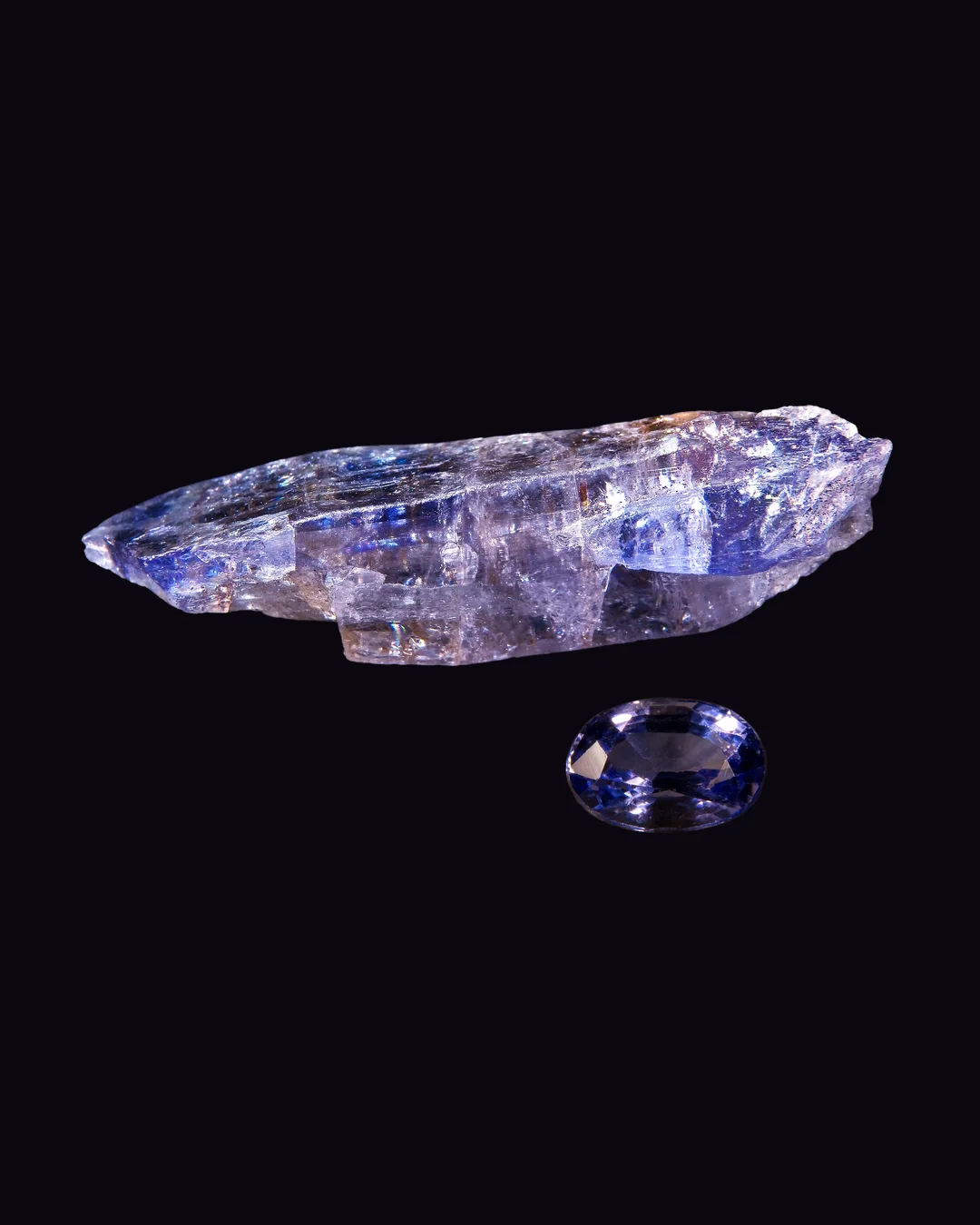
Tanzanite
Zoisite (blue-violet variety)
Tanzanite came out of one small patch of hills in northern Tanzania in 1967. There is nowhere else on earth. It does not come out blue. Most of it comes out brown. So the trade bakes it. About 380 degrees turns brown to violet. Nearly every stone sold went through it, and no test can find it after. You know the feeling. You came out of a house that wanted you a certain colour and you changed to match. Nobody forced it. That is the part that still sits badly at two in the morning. It cracks easily. One knock on a tap and it splits along a flat line. The colour is yours now.
People carry it for intuition, transformation and communication. Tradition attaches it to the element air, the third-eye, crown, throat chakra, Uranus. It is most often given to Sagittarius, Gemini, Libra. It measures 6-7 on the Mohs scale.
Seen · you don't have this one yet
Common·Uncommon·Rare·Arcane
Almost every tanzanite has been heated to turn it from brown to blue-violet. It is still tanzanite. The trade treats the heating as standard rather than as a fault.
What it is confused with
Iolite, sapphire, amethyst, blue glass, synthetic forsterite, coated quartz
Transparent violet-blue with strong trichroism. Turn it and it shows blue, violet and a reddish burgundy down three different axes, all visible without instruments. Crystals are striated prisms with a wedge-shaped or chisel-like tip. There is one direction of perfect cleavage, which gives flat mirror-bright breaks. The blue leans purple in a way sapphire does not. It is noticeably softer than quartz and scratches more easily.
Commonly faked · check before you buy
How to tell
Rotate the stone slowly in good light. Real tanzanite shows blue, then violet, then a reddish burgundy, depending on the angle. That triple colour is called trichroism. It also has one direction of perfect cleavage and a hardness around 6.5. Iolite goes grey to colourless instead of burgundy. Amethyst is 7 and shows angular colour banding. A cheap tanzanite is usually coated quartz or synthetic forsterite.
Effectively all tanzanite is heat-treated. It goes into an oven at 370 to 390 degrees Celsius, which turns the brownish natural material blue-violet. The treatment is universal, permanent and undetectable even in a lab. By convention nobody discloses it and it does not affect the price. Untreated blue tanzanite is vanishingly rare, so yours has almost certainly been heated.
The full mineral facts
Hardness, formula, and how the rock is put together.
Hardness
6-7 Mohs
Formula
Ca2Al3(SiO4)(Si2O7)O(OH) with V
Family
silicate
How it forms
Tanzanite formed deep inside hot folded rock hundreds of millions of years ago, and the whole world supply comes from a few square kilometres of hills in northern Tanzania.
Where it comes from
Tanzania (Merelani Hills, Simanjiro District), sole world source
What it means
The moon is in Gemini today, so this is the Gemini read.
Somebody in your family was the clever one and you got handed the funny slot instead.
Tanzanite grew deep inside hot folded rock hundreds of millions of years ago. It has only ever been found in a few square kilometres of hills in northern Tanzania.
Then it sat there brown until 1967, when somebody worked out what an oven would do to it.
Gemini, everybody agreed not to mention the treatment, and you agreed first.
The plain answer feels like admitting you are ordinary. Somebody in your family was the clever one and you got handed the funny slot instead.
So you perform the thought rather than have it, and afterwards you cannot remember which parts of it you meant.
You are allowed to be boring and correct.
That is today's sky, not your chart. Add your birth details and this stone gets read against your own.
Read it for my chart →You know what this one would do for you. You just don't have it.
Tanzanite for every sign
AriesYou were praised for being quick when you were small and almost never for finishing.
Take the name off and this is zoisite. Zoisite is an ordinary mineral that comes up grey and green all over the world.
One small patch of hills in Tanzania made it violet, and in 1968 somebody gave it a better name.
Aries, you only respect the version of yourself that came out of something hard.
Nobody is watching yet, so you get to be all instinct. Then people start expecting the thing you promised, and the room goes from cheering to waiting.
You were praised for being quick when you were small and almost never for finishing. So quick became the only thing you trust yourself to be.
Finish one boring thing this week. Tell nobody you did it.
TaurusThat is a bill somebody else ran up in your name.
Almost all tanzanite comes out of the ground brown. The trade puts it in an oven at about 380 degrees and it comes out violet.
Nearly every stone sold has been through that, and no test on earth can find it afterwards. Nobody is required to tell you.
Taurus, you have a nose for anything too shiny and too cheap, and you got it the hard way.
Somebody handed you a story once and you believed the whole thing, out loud, in front of people who remembered.
Now you check the price twice and you check the seller and you still feel foolish for asking.
That is not suspicion. That is a bill somebody else ran up in your name.
GeminiSomebody in your family was the clever one and you got handed the funny slot instead.
Tanzanite grew deep inside hot folded rock hundreds of millions of years ago. It has only ever been found in a few square kilometres of hills in northern Tanzania.
Then it sat there brown until 1967, when somebody worked out what an oven would do to it.
Gemini, everybody agreed not to mention the treatment, and you agreed first.
The plain answer feels like admitting you are ordinary. Somebody in your family was the clever one and you got handed the funny slot instead.
So you perform the thought rather than have it, and afterwards you cannot remember which parts of it you meant.
You are allowed to be boring and correct.
CancerYou were the barometer in that house and you were about nine.
This stone has one perfect cleavage plane running through it. Knock it on a tap and it splits along a flat line, cleanly, in one go.
Steam, ultrasonic cleaners and a sudden change of temperature do the same thing. It is not a stone for a ring you work in.
Cancer, there is one line in you that will not take a knock, and you keep it turned away from everybody.
You learned to keep a mood level for somebody who could not keep their own. You were the barometer in that house and you were about nine.
So you carry everything until a small thing lands wrong on an ordinary Tuesday, and you split along a line nobody else could see.
The line was always there.
It was never the small thing.
LeoYou worked out early that being the bright one kept people close.
Turn it slowly under a lamp and three colours come out of one stone. Violet from one direction, blue from another, a burgundy flush from the third.
That last one is part of how you know it is real. It is also the one nobody photographs.
Leo, you show a different colour to each person and not one of them is a lie.
You worked out early that being the bright one kept people close. It has never once failed, which is exactly why you have never stopped.
There is a face you put on at the door and something else that sits down when the door shuts, and only one of them gets asked about.
Who is asking about the other one?
VirgoYou were the reliable one before anybody checked whether you were all right.
Somebody bakes it. Around 380 degrees turns a brown stone violet, and the change is permanent and untraceable.
The trade does not count that as a treatment, because everybody does it. That is the entire argument.
Virgo, the version of you that everybody prefers only exists after the hard part.
The drawer gets reorganised at midnight because the real problem has no edges to grip. You were the reliable one before anybody checked whether you were all right.
Reliable got you thanked and it got you more to do, so you never learned how to stop without feeling like a fraud.
The list will still be there tomorrow.
Go to bed.
LibraYou learned to check their face before you knew what you wanted.
Every tanzanite on earth came out of a few square kilometres of the Merelani Hills. There is genuinely nowhere else.
It has been mined hard since 1967, which is why the price moves on rumour, and why cheap ones are usually coated quartz.
Libra, everything you are came out of one small house, and you have never gone back to look at it.
It started with one person at home whose mood set the temperature of the whole house. You learned to check their face before you knew what you wanted.
Thirty years on, somebody asks you where you want to eat and there is nobody in there to answer.
Your preference was never the thing that broke anything.
ScorpioYou hand people the trimmed version and wait to see if they ask.
It is hard enough to cut and soft enough to lose. One perfect cleavage runs through it, and a single knock finds it.
Warm soapy water and a soft cloth is the whole care routine. Anything more confident than that takes it apart.
Scorpio, the colour everybody wants from you only ever shows up after the heat.
They were not cruel about it. That is what made it stick, because there was nothing there to push back against.
You hand people the trimmed version and wait to see if they ask. Almost nobody asks, and you file that away as proof.
It was never too much for the room. It was only ever more than they were built to hold.
SagittariusSomebody spent your childhood listing the things you would not manage.
What this actually is, is a brittle mineral with a flat plane of weakness running through it, wearing a gemstone name. The name is younger than colour television.
It sells on the story of one place on earth running out. That story does work the stone cannot do on its own.
Sagittarius, everybody loves the version of you that came out of the oven and nobody asks about the brown.
Somebody spent your childhood listing the things you would not manage. You have been answering that list ever since, in places those people will never see.
The trouble is you can no longer tell the difference between wanting a thing and being told you cannot have it.
Some warnings are just physics.
CapricornYou worked out young that being useful got you left alone.
Hold it up in a window in the afternoon and the violet goes almost blue. Move one step and the burgundy comes through.
That colour arrived in a few hours in a kiln, after the rock spent hundreds of millions of years being brown.
Capricorn, you spent most of your life plain and you still do not trust the years that went well.
A day that produced nothing goes straight in the wasted pile. Rest goes in there too, and so does the year you spent keeping a family upright.
You worked out young that being useful got you left alone. You picked useful, and you have never once revisited the decision.
The people who stayed were never counting, and they are not counting now.
AquariusYou took the seat by the door young because watching was safer than joining.
Somebody put a brown stone in a kiln and took out a violet one. Then somebody else decided that did not count as a treatment, because everybody was doing it.
The stone is real. The convention around it is the invented part.
Aquarius, you noticed the thing everyone had agreed not to mention, and saying it out loud has cost you jobs.
You took the seat by the door young because watching was safer than joining. Up there you get to be right, and nothing gets near enough to hurt.
People call it aloof and you let them, because the real version takes longer to explain and you are tired.
Who has been waiting for you to come down?
PiscesNow a stranger's bad afternoon can flatten your evening and you call it being sensitive.
It formed hundreds of millions of years ago inside hot rock that was folding in on itself. Heat and pressure did all of it, slowly, with nobody there.
Then a person finished the job in an afternoon. That is the part the shop counter leaves out.
Pisces, the version of you people admire only exists because somebody put you through heat.
Other people's moods used to reach you before they reached words. In that house it was useful, so nobody ever suggested you stop.
Now a stranger's bad afternoon can flatten your evening and you call it being sensitive. It was a job you were given.
Doors can be fitted late.
Yours only has to shut sometimes.
Correspondences
What tradition attaches to this stone. Folklore, not chemistry.
Element
air
Planet
Uranus
Chakra
third-eye, crown, throat
Signs
sagittarius, gemini, libra, capricorn
What tradition says
In crystal lore, tanzanite is kept for fast spiritual growth and for linking the mind to the voice. The stone was discovered in 1967 and named in 1968, so its whole tradition is younger than colour television.
Care
- Water is fine. Dry it afterwards.
- This one is fragile. It has one perfect cleavage direction and only moderate hardness, so it cracks from knocks, from ultrasonic cleaners, from steam and from any sudden change in temperature. Warm soapy water and a soft cloth only. Do not wear it on a ring you work in.
Common questions
What does tanzanite mean?
Tanzanite is carried for intuition, transformation and communication. Tanzanite came out of one small patch of hills in northern Tanzania in 1967. Tradition links it to the third-eye, crown, throat chakra.
Is tanzanite real or fake?
Almost every tanzanite has been heated to turn it from brown to blue-violet. It is still tanzanite. Rotate the stone slowly in good light. Real tanzanite shows blue, then violet, then a reddish burgundy, depending on the angle. Effectively all tanzanite is heat-treated.
Can tanzanite go in water?
A short rinse is fine for tanzanite, then dry it.
Rare · violet-blue, indigo, blue-purple, burgundy from one axis
Where this leads
This stone belongs to
Related crystals
FOR ENTERTAINMENT AND REFLECTION. NOT MEDICAL, PSYCHOLOGICAL, FINANCIAL OR LEGAL ADVICE. How this works