Black Kyanite
Kyanite (dark iron-bearing)
After certain people leave, you go around opening windows. Black kyanite gets sold for exactly that feeling. It grows in splayed blades that look like a small broom, and the shape did all of its marketing. Underneath, it is plain kyanite darkened by iron. The sweeping idea is younger than the 1990s. That does not make the feeling fake. You have been letting people fill your whole house, then cleaning up after them once the door shuts. Nobody ever told you that you could say no on a Tuesday, for no reason at all. People have used the fanned pieces for clearing a room after a visit. Hold it by the base. The blades snap and shed splinters.
People carry it for protection, boundaries and grounding. Tradition attaches it to the element earth, the root, throat chakra, Saturn. It is most often given to Aries, Capricorn, Scorpio. It measures 4.5-7 on the Mohs scale.
Seen · you don't have this one yet
Common·Uncommon·Rare·Arcane
What it is confused with
Blue kyanite, black tourmaline, biotite, actinolite, hornblende
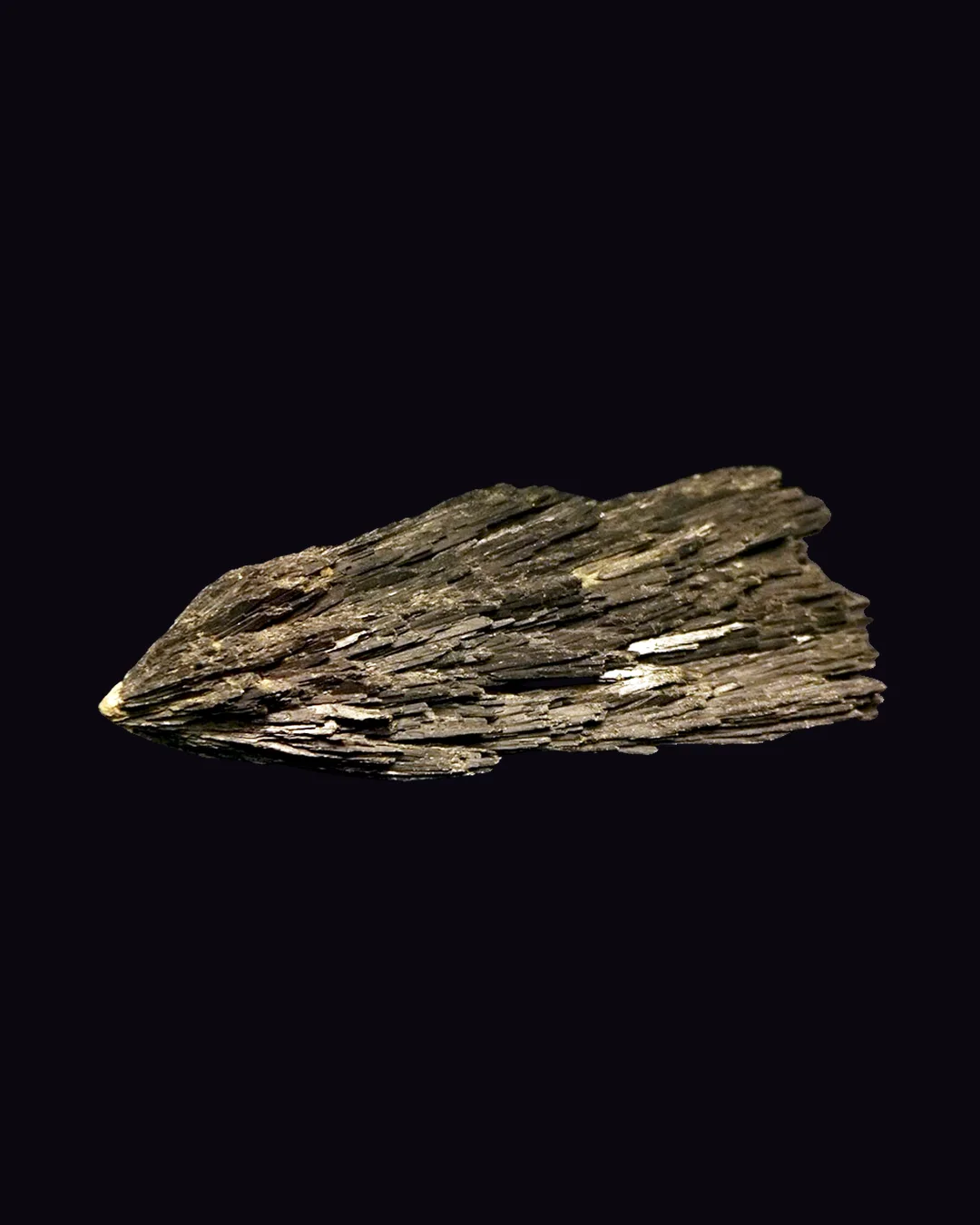
Black kyanite is a splayed fan of flat black to charcoal blades, all rising from one base like a hand-tied broom or a turkey tail. That fan shape is the whole look and it is why it gets sold as a witch's broom. Each blade is thin and flat with fine lines running along its length, and the split faces carry a pearly sheen. A blade flexes slightly before it snaps. The shine is matte to satin rather than glassy. It is nearly always sold raw and hardly ever polished.
How to tell
Kyanite has two hardnesses in one blade, the same test as blue kyanite. Run a knife along the length of a blade and it scratches easily. Run it across the blade and it resists. Nothing else behaves that way. Black tourmaline is a rounded rod with a triangular cross section, not a flat blade, and it is hard in every direction.
The full mineral facts
Hardness, formula, and how the rock is put together.
Hardness
4.5-7 Mohs
Formula
Al2SiO5 with Fe
Family
silicate
How it forms
Black kyanite began as aluminium rich mud that was buried and squeezed hard enough to grow blades, with iron making it dark.
Where it comes from
Brazil (Bahia, Minas Gerais), USA (North Carolina), Zimbabwe, India
What it means
The moon is in Sagittarius today, so this is the Sagittarius read.
Caution got filed with them, and you threw the whole file out.
Black kyanite is not a special species. It is the same mineral as the blue kind, with iron making it dark instead.
It is also not tourmaline, which is the rod shaped black stone it gets mistaken for. This one is a flat blade and it snaps. Drop it once and you are picking splinters out of the rug.
Sagittarius, you were pressed into a sharper shape than you would have chosen and you use it on the wrong people.
You have gone anyway. Late, alone, on almost no money, into rooms other people would not enter.
The people who told you to be careful were the same ones who did not show up. Caution got filed with them, and you threw the whole file out.
Handle it by the base. That is not them talking.
That is today's sky, not your chart. Add your birth details and this stone gets read against your own.
Read it for my chart →You know what this one would do for you. You just don't have it.
Black Kyanite for every sign
AriesYou have ended things fast because ending them slowly felt unbearable.
Black kyanite started as mud full of aluminium. It got buried and squeezed hard enough for blades to grow, and iron is what made it dark.
That took pressure over an amount of time you cannot picture. The broom shape is real. What the shape means was decided by sellers in the 1990s.
Aries, you would rather kick a door than wait for it.
You have ended things fast because ending them slowly felt unbearable. Every one of those endings was the right call and the wrong speed.
Somebody taught you young that waiting meant losing. Probably by taking something while you waited. Now stillness feels like danger and you move before you have to.
Nothing is being taken tonight.
TaurusYou have never forgotten the moment the story ran out.
The fanned shape did all the selling. Black kyanite looks like a small broom, so somebody decided it sweeps, and that idea is younger than the 1990s.
Underneath the story it is plain kyanite with iron in it. The feeling people get around it is real. The history behind the claim is short.
Taurus, you do not buy a story unless the thing under it holds up.
You paid for something once that was mostly the story. You have never forgotten the moment the story ran out.
Now you touch it, weigh it, ask where it came from. People think you are hard work. You are just somebody who got taught.
The stone is real. The broom is a sales pitch.
GeminiYou can hold four conversations and keep everyone comfortable in all of them.
Black kyanite is strange about hardness. Scratch along a blade and it marks easily, scratch across it and it holds.
It is not evenly strong and it does not pretend to be. The blades snap under almost no force and shed splinters into whatever they are stored with.
Gemini, you have a direction you are strong in and one you never show anybody.
You are fast in a room. You can hold four conversations and keep everyone comfortable in all of them.
What nobody sees is that you go home and cannot answer one simple question about your own week. Being quick got praised early, so the slow honest answer never got any practice.
Answer one slow question tonight.
CancerYou did not once say it was hard, so nobody asked.
This is not its own mineral. It is ordinary kyanite that iron turned dark, grown from squeezed mud like the blue kind.
The blue pieces get called beautiful and this one gets called protective, and the only difference between them is iron.
Cancer, people treat you as a darker copy of somebody in your family and you stopped correcting it.
You held a family through a bad stretch and made it look easy. You did not once say it was hard, so nobody asked.
The deal was struck when you were small. Be easy to have around, and you get to stay. You have never tested whether that was really the arrangement.
Store it alone in a box. Then go to bed early.
LeoYou learned to read faces before you learned to read books.
Fan it open on a table. The blades splay from one end like a small broom, which is exactly why it sells.
Hold it by that base. Take it by the tips and pieces come off in your hand and go into the carpet.
Leo, you open out for people because you learned young that closed does not get chosen.
You are the one who fixes the mood, and it happens before you decide to do it. You have walked into a tense kitchen and changed the temperature of it without saying anything clever.
That skill came from a house where somebody was unpredictable. You learned to read faces before you learned to read books. It kept you safe, and it never once got to stop.
Who reads you?
VirgoThe thing you need to say to your mother has been waiting since last year.
It began as mud with a lot of aluminium in it. Burial and pressure turned that mud into blades over an age.
Nothing about that process was tidy. The blades came out uneven and splayed, easy to break in one direction and stubborn in the other.
Virgo, the pressure that made you good at this is not something you would wish on anybody.
The cupboard got reorganised on Sunday. The thing you need to say to your mother has been waiting since last year.
When you were about seven you worked out that a neat house made the adults easier to live with. You were right. Nobody has ever told you that you could stop.
Say the thing. The cupboard is fine.
LibraYou learned to soften a sentence before you learned to ride a bike.
Somebody in the 1990s looked at these splayed blades and said broom. The sweeping idea comes entirely from that shape, and nothing older than that backs it up.
The mineral is old and the meaning is new. People do use the fanned pieces for clearing a room after a visit, and that is the honest version of the claim.
Libra, you have been sweeping up after other people since you were small, and someone called that a gift.
You check the whole room before you answer a simple question. Who goes quiet, who sulks, who reads a no as a rejection.
You learned to soften a sentence before you learned to ride a bike. Nobody handed you that job. You have never once handed it back.
Answer the question first. Check afterwards.
ScorpioYou are hard in the direction that matters and you always were.
Run a fingernail along one blade and then across it. Along the blade it marks, across it, it does not. Same stone, two answers.
The same piece of rock is soft one way and hard the other. Nothing about that is a defect. It is just how it grew.
Scorpio, you were bought for a shape and nobody asked what was underneath it.
You went smaller for about two years. Quieter at the table. Slower to say what you already knew. You even changed how you laughed.
It did not help, because the softness they wanted was not on offer. You are hard in the direction that matters and you always were.
You were never too much for the right person.
SagittariusCaution got filed with them, and you threw the whole file out.
Black kyanite is not a special species. It is the same mineral as the blue kind, with iron making it dark instead.
It is also not tourmaline, which is the rod shaped black stone it gets mistaken for. This one is a flat blade and it snaps. Drop it once and you are picking splinters out of the rug.
Sagittarius, you were pressed into a sharper shape than you would have chosen and you use it on the wrong people.
You have gone anyway. Late, alone, on almost no money, into rooms other people would not enter.
The people who told you to be careful were the same ones who did not show up. Caution got filed with them, and you threw the whole file out.
Handle it by the base. That is not them talking.
CapricornYou have been producing ever since and you have never asked whether you had to.
Black kyanite survives being buried and squeezed for an age. It does not survive being kept loose in a bag.
The blades snap with almost no force and shed splinters onto everything nearby. Enormous pressure, then a pocket finishes it.
Capricorn, you can carry the enormous thing, and it is the small daily one that snaps you.
Your list only holds finished things. The Saturday you spent sorting out somebody else's crisis is not written down anywhere.
At home, attention arrived when you produced and left when you did not. You were maybe ten. You have been producing ever since and you have never asked whether you had to.
Store it alone. Rest without earning it.
AquariusYou look like somebody who has it all worked out.
The broom idea was invented by sellers. Somebody saw a fanned blade, said it sweeps, and the whole meaning grew out of the shape in about thirty years.
The mineral does not know any of that. It is iron darkened kyanite that came out of squeezed mud, and it was doing fine before it had a job.
Aquarius, somebody handed you a job in your family at about eleven and you have never once asked to be relieved of it.
You have explained a whole family to a friend in one sentence and watched her go quiet. You are usually right.
Nobody has done it for you. You look like somebody who has it all worked out. You have never corrected that.
Who is working you out?
PiscesYou come out of a room carrying what was in it.
It started as mud. Burial and pressure worked on it for longer than anything you will ever wait through, and blades grew out of it.
Then a shop gave it a job. The sweeping idea is about thirty years old, and the mud is older than counting.
Pisces, you clean up after a mood the way you would clean up a spill, fast and without mentioning it.
You come out of a room carrying what was in it. Two hours later you cannot tell what was yours to begin with.
At home you always knew first, before anybody spoke. That got called a gift, and a gift is a thing people take, so nobody taught you how to close.
You are allowed to close.
Correspondences
What tradition attaches to this stone. Folklore, not chemistry.
Element
earth
Planet
Saturn
Chakra
root, throat
Signs
aries, capricorn, scorpio
What tradition says
In crystal lore, black kyanite is used for sweeping and clearing a space or a person. The meaning is built entirely on the fact that it looks like a broom. It dates to the 1990s or later.
Care
- Water is fine. Dry it afterwards.
- Salt scratches it. Do not bury it in salt.
- The blades snap and flake with almost no force, and the fans shed splinters. Hold it by the base, never by a blade. Store it alone in a box so nothing rubs against it. A gentle rinse is as far as you should go.
Common questions
What does black kyanite mean?
Black Kyanite is carried for protection, boundaries and grounding. After certain people leave, you go around opening windows. Tradition links it to the root, throat chakra.
Is black kyanite real or fake?
Black Kyanite is not faked often, but it is still worth checking. Kyanite has two hardnesses in one blade, the same test as blue kyanite. Run a knife along the length of a blade and it scratches easily.
Can black kyanite go in water?
A short rinse is fine for black kyanite, then dry it.
Uncommon · black, charcoal grey, blue-black, dark grey-green
Where this leads
This stone belongs to
Related crystals
FOR ENTERTAINMENT AND REFLECTION. NOT MEDICAL, PSYCHOLOGICAL, FINANCIAL OR LEGAL ADVICE. How this works