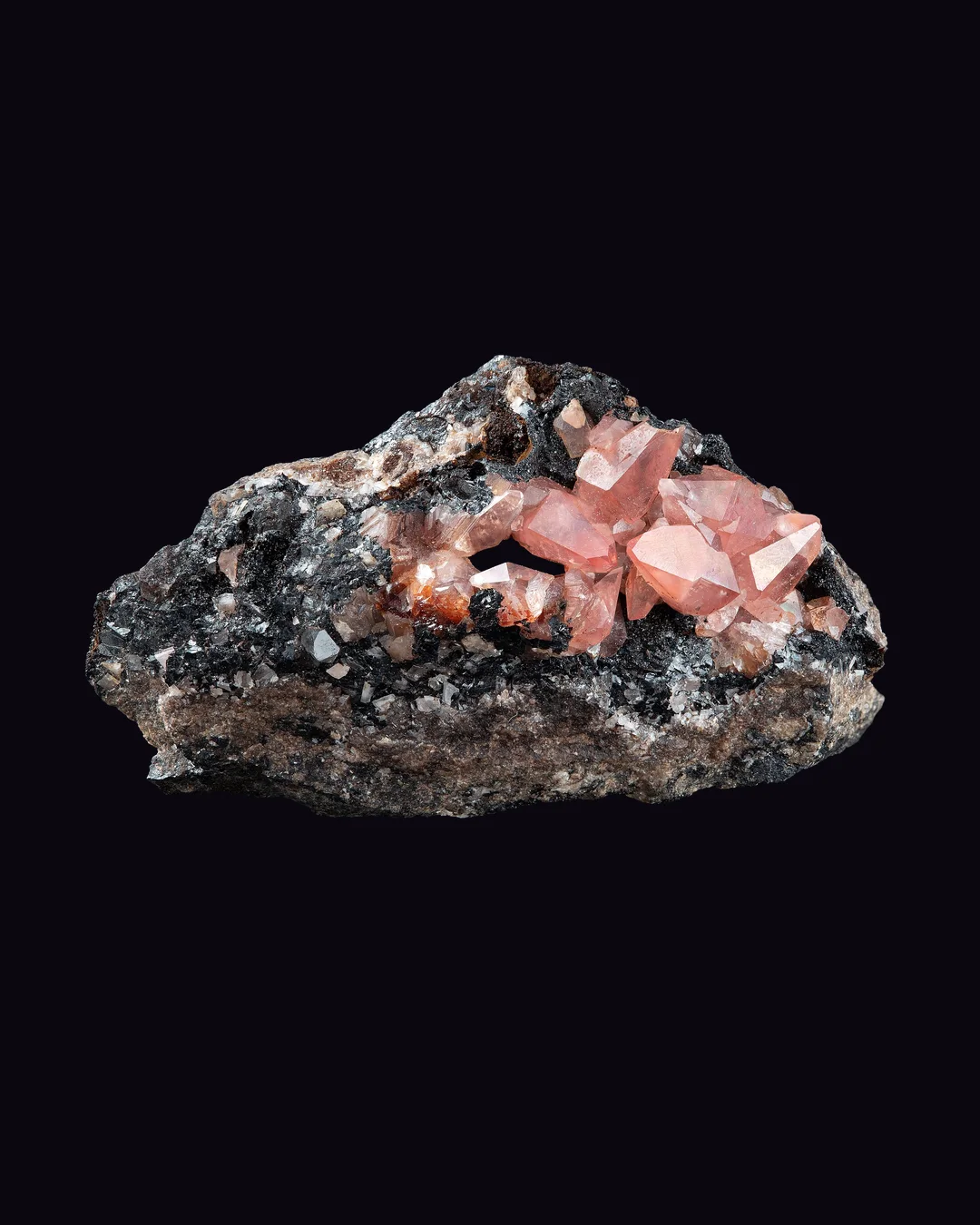
Rhodochrosite
Rhodochrosite
The pink and white bands are not a pattern anybody chose. Water carrying manganese ran through the same opening for a very long time, and each pass left one more ring. The stone is soft. Your fingernail will not mark it, but a key in the same pocket will. And it fades. Strong light pulls the raspberry down to a dusty pink, and it does not come back. The sunniest shelf in the house is the worst place for it. Water dulls the polish and lemon or vinegar eats into it. Salt etches it, so use a dry cloth and nothing else. You hand the warm version of yourself to everyone who asks, then wonder why there is so little of it left by Thursday. Put it somewhere dim. See if you can do the same.
People carry it for self-love, love and grief. Tradition attaches it to the element fire, the heart, solar-plexus chakra, Venus. It is most often given to Scorpio, Leo, Cancer. It measures 3.5-4 on the Mohs scale.
Seen · you don't have this one yet
Common·Uncommon·Rare·Arcane
This one does not go in water. It dissolves.
What it is confused with
Rhodonite, pink calcite, banded onyx, dyed howlite, mangano calcite
It gets confused with rhodonite, mangano calcite, dyed howlite and dyed marble. Rhodochrosite is banded pink and white in concentric or wavy stripes. The Argentine stalactitic material, sliced across, gives perfect pink-and-white bullseye rings. Crystalline specimens are transparent rose-red rhombohedra with a bright glassy shine. Its cleavage is perfect in three directions, so broken faces are flat parallelograms that flash like mirrors. It is soft enough for a copper coin to mark it, and it fizzes in acid.
How to tell
Put one drop of vinegar on a hidden spot. Rhodochrosite is a carbonate, so it fizzes. Rhodonite does not fizz, and rhodonite is not soft, where rhodochrosite is 3.5 to 4 on the Mohs scale. Pink-and-white banding in rings, plus flat cleavage faces that flash like mirrors, confirm it. Mangano calcite is softer still at 3, and it is usually paler and less strongly banded.
Rhodochrosite is not treated, though fractured slabs are sometimes filled with resin. Dyed pink howlite and dyed marble are sold as banded rhodochrosite.
The full mineral facts
Hardness, formula, and how the rock is put together.
Hardness
3.5-4 Mohs
Formula
MnCO3
Family
carbonate
How it forms
It forms where water carrying manganese moves through rock, growing as crystals in ore veins or building up in pink and white bands layer by layer in cave openings.
Where it comes from
Argentina (Capillitas, Catamarca), USA (Sweet Home Mine, Colorado), Peru, South Africa (N'Chwaning), China, Romania
What it means
The moon is in Gemini today, so this is the Gemini read.
You are very funny about the worst year of your life and the table laughs.
Cracked slabs of this get filled with resin so they hold together on a shelf. Dyed howlite and dyed marble go out under the same name.
The real thing is soft enough that a key in the same pocket will mark it. A hard, unmarked, perfectly even pink is usually the lie.
Gemini, you narrate the good bands and skip the white ones, and the white ones are most of it.
Being quick got you out of things. A joke closed an argument at twelve and it has been closing them ever since.
So the flat sentence never arrives. You are very funny about the worst year of your life and the table laughs. Then you go home and it is exactly as heavy as it was.
Somebody would sit through the boring version.
That is today's sky, not your chart. Add your birth details and this stone gets read against your own.
Read it for my chart →You know what this one would do for you. You just don't have it.
Rhodochrosite for every sign
AriesNobody ever taught you how to be unwatched.
It survives almost nothing. Water dulls the polish, salt etches it, and vinegar eats straight into it.
Strong light is the quiet one. It pulls the raspberry down to a dusty pink over months, and that colour never comes back.
Aries, you have something tender you built in private and you will fight anybody who mentions it.
Somebody clapped for how quick you were. Fast reader, fast talker, first out of the blocks. That became the whole story about you.
So the long middle feels like being nobody. You leave, and you call it boredom. Nobody ever taught you how to be unwatched.
The bands took thousands of passes. One at a time.
TaurusYou are just checking whether the bands go all the way through.
Water carrying manganese ran through the same crack in a cave for a very long time. Every pass left one more pink ring.
Nobody designed that pattern. What people do design is the dyed pink howlite sold beside it under the same name.
Taurus, you stopped believing anything cheap and shiny, and it was never a personality trait, it was a bill.
Somebody was warm and certain and quick with you once. You handed over more than money, and they were gone before you had finished paying.
Now you take a long time with everybody and people call it slow. It is not slow. You are just checking whether the bands go all the way through.
Nobody who was in a hurry ever deserved you.
GeminiYou are very funny about the worst year of your life and the table laughs.
Cracked slabs of this get filled with resin so they hold together on a shelf. Dyed howlite and dyed marble go out under the same name.
The real thing is soft enough that a key in the same pocket will mark it. A hard, unmarked, perfectly even pink is usually the lie.
Gemini, you narrate the good bands and skip the white ones, and the white ones are most of it.
Being quick got you out of things. A joke closed an argument at twelve and it has been closing them ever since.
So the flat sentence never arrives. You are very funny about the worst year of your life and the table laughs. Then you go home and it is exactly as heavy as it was.
Somebody would sit through the boring version.
CancerBy Thursday there is almost none of it left for you.
Look at the bands. Pink, then white, then pink, each one a separate time water came through the same opening in the rock.
It took an age to build and one summer on a bright sill takes the colour out. That fade does not reverse.
Cancer, you have a band for every time you let that person back in and you can date each one.
You learned to read a house from the hallway. Somebody set a cup down harder than usual and you were already working out what the evening needed.
That is not intuition, that is a job you were given young. Now you give people the warm version on demand. By Thursday there is almost none of it left for you.
Put it somewhere dim tonight. Try the same.
LeoYou leave a good night knowing exactly how everybody there is doing.
This is a carbonate, which means it is chemically close to chalk. That is why it is soft, and why anything acidic dissolves it.
The pink comes from manganese and nobody added it. What does get added is resin, poured into cracked slabs so they survive being handled.
Leo, one sour comment goes straight through you and you laugh in the same breath.
When you were bright, the house was easier. You clocked that early, and being the reason people felt better became the thing you were for.
Now it is what you get invited for. You leave a good night knowing exactly how everybody there is doing. You get in the car and there is no read on you at all.
The colour fades fastest in the brightest place.
VirgoA bad week arrives and you deep clean a cupboard.
Water dulls it. Salt etches it, and lemon juice eats holes in it.
It splits clean if you drop it, along flat planes that were always inside it. Nothing about this stone is low maintenance and the shop rarely says so.
Virgo, you have been building a soft thing in the dark and you will not show it to anybody yet.
There was a year when the actual problem was nothing you could touch. So you got the kitchen spotless and the paperwork straight, and it gave your hands somewhere to be.
It still does. A bad week arrives and you deep clean a cupboard. That is not silly, it is just not the same as being looked after.
Somebody would look after you if you let them.
LibraYou have just never made anybody sit through it.
Each band is one pass of manganese rich water through the same opening. Layer, pause, layer, over a length of time that had nothing to do with anybody's patience.
It is soft enough to mark with a key. The thing that took longest to build is the thing that damages easiest.
Libra, you have a layer for every time you went back, and you keep counting them as patience.
A disagreement in your house did not last ten minutes. It lasted three days of a particular quiet, and you were always the one who ended it first.
So you got fast at spotting the answer nobody would go cold about. Everyone reads that as not knowing your own mind.
You know it exactly. You have just never made anybody sit through it.
Say the one you actually want out loud.
ScorpioPeople call you guarded, but you are not guarded, you are just quoting from experience.
Cracked slabs get soaked with resin so they hold together for sale. Dyed marble goes out under this name as well.
The genuine one is fragile, fades in light and cannot be washed. Everything that makes it worth having is also what makes it hard to keep.
Scorpio, you are softer than you let on and the wrong thing kept in the same pocket has marked you.
It was probably said kindly. A partner, or your mother at a kitchen table, telling you that you feel things too hard.
You did not argue. You filed it, and now every true thing gets priced before you say it. People call you guarded, but you are not guarded, you are just quoting from experience.
You were not the problem in that kitchen.
SagittariusSome of what you kicked open has cost you people you have not counted.
Hold it near a window and you can see the bands stack up. Pink over white over pink, one pass of mineral water at a time.
Leave it in that window and you lose the raspberry inside a year. Strong light bleaches it to a dusty pink and it stays that way.
Sagittarius, you have layered good years over bad ones without ever going back to look at the bottom band.
Somebody told you no once and the no was really about them. Their fear, their small life, their idea of what a girl gets to do.
You saw straight through it. Then you stopped sorting the honest warnings from the frightened ones. Some of what you kicked open has cost you people you have not counted.
This is one of the warnings that is true.
CapricornYou were useful before you were old enough to decide to be.
What it actually is: manganese carbonate. Soft, close to chalk, and dissolving in anything acidic.
It was never built for work. Nobody made a tool out of this, and the trade knows it can barely survive a pocket.
Capricorn, nobody ever made a tool out of this stone, and you cannot picture being wanted for anything else.
You were useful before you were old enough to decide to be. So you carried more, it kept working, and nobody ever suggested you stop.
The years you spent holding people together are on no list you would call an achievement. Rest goes in the wasted pile. So does most of what actually made you.
Some things are allowed to just be soft.
AquariusNow you can set out your own year in order, causes and dates.
It cannot take water, salt, acid or a drop onto a hard floor. It splits along flat planes that were always inside it.
Light is the one that gets it quietly. The pink goes dusty over months in a bright room and nobody notices until the photographs disagree.
Aquarius, it is not the arguments taking the colour out of you, it is the months in between.
You worked out what the adults were really doing before you were ten. Who was performing, who was scared, who was being pleasant about something awful.
It kept you safe and it cost you the room. Now you can set out your own year in order, causes and dates. You feel almost nothing while you do it.
What are you like when nobody is being analysed?
PiscesYou call yourself too sensitive before anybody else can reach it.
Water carrying manganese came through the same opening again and again for longer than anybody counted. Each pass left one thin pink line.
Then somebody worked out you can dye pink howlite to look like that and sell it for less. The banding on a dyed one is too even.
Pisces, the same thing has run through you again and again and left a ring each time.
Other people hear a bad story and put it down at the end of the day. You take it home and at two in the morning it is still in the room with you.
Somebody named that a flaw, and they benefited from naming it. So you get in first now. You call yourself too sensitive before anybody else can reach it.
Would you say that about your friend?
Correspondences
What tradition attaches to this stone. Folklore, not chemistry.
Element
fire
Planet
Venus
Chakra
heart, solar-plexus
Signs
scorpio, leo, cancer
What tradition says
In crystal lore, rhodochrosite is the stone of self-love and of recovering warmth towards yourself. The name Inca Rose comes from the Argentine deposits, which were worked in pre-Columbian times.
Care
- Do not put this one in water. It dissolves or spalls. Dust it dry.
- Keep it out of direct sun. The colour goes and does not come back.
- Salt scratches it. Do not bury it in salt.
- This is a soft carbonate and it damages easily. Acid dissolves it. Water dulls the polish. Salt etches it. Its cleavage is perfect, so one drop splits it cleanly. Strong light fades the pink, so keep it out of the window. Dry cloth only.
Common questions
What does rhodochrosite mean?
Rhodochrosite is carried for self-love, love and grief. The pink and white bands are not a pattern anybody chose. Tradition links it to the heart, solar-plexus chakra.
Is rhodochrosite real or fake?
Rhodochrosite is not faked often, but it is still worth checking. Put one drop of vinegar on a hidden spot. Rhodochrosite is a carbonate, so it fizzes. Rhodochrosite is not treated, though fractured slabs are sometimes filled with resin.
Can rhodochrosite go in water?
No. Rhodochrosite dissolves or spalls in water. Dust it dry instead of soaking it, and keep it out of salt.
Uncommon · rose pink, raspberry red, pink with white banding, pale peach
Where this leads
This stone belongs to
Related crystals
FOR ENTERTAINMENT AND REFLECTION. NOT MEDICAL, PSYCHOLOGICAL, FINANCIAL OR LEGAL ADVICE. How this works